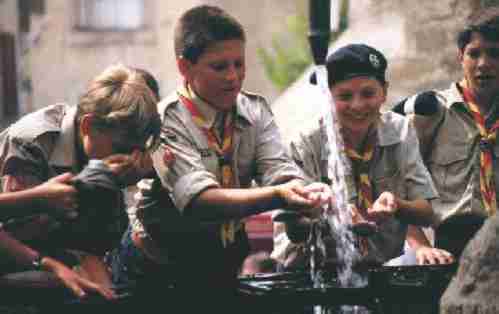
Figure 1.--Scouts around the world wear many different kinds of caps. Berets like those worn by these French Scouts are some of the most common. |

|
The traditional Boy Scout hat was the lemon-squeezer hat chosen by Lord Baden Powell. Scouts in many countries wore these hats for decades. Gradually different caps were introduced in various countries. One of the most popular proved to be the beret.
The beret was for many years seen as a uniquely French cap.
French Scouts wore berets from an early stage of the development
of the Boy Scout movement. It was not until after World
War II that Scouts in many other countries commonly began wearing them. The Beret has become the most common headgear worn by Scouts around the world. There are of course major differences from country to country. As the American Scout movement is so large and other countries have adopted baseball caps, more boys may actually wear baseball cap style hats.
French Boy Scots initially wore the beret much as school boys did, either pulled down or as a pancake. After World War II, however, as Scouts began wearing berets, they tended to wear it at an angle with "attitude," adopting a military style. Girl Scout, Guide, and Browie groups wearing berets,
never it wore them at an angle with this military look.
Only Scouts to my knowledge adopted the beret. I do not know of any Cub groups which wear berets. Brownies (Girl Cubs, the junior division of the Girl Scouts) in America, however, did wear berets--brown colored ones.
We note Scout berets done un a wide rabge of colors. There seems to have been two approaches. One approach was a bright color to add a slash of color into an otherwise drab uniform. The bright red American Scout beret is probably the best example of this. The other approach was a more muted color that was chosen to match the rest of the uniform. It could be the same color or a coordinated color. This was the option most commonly chosen. Good examples include Britain and Canada.
|
There are many different ways to wear the beret and the photographic record shows that boy have found just about every possivle way. Since the beret is a soft cap it can be fashioned into different shapes. This depends largely on how large it is made. Some berets are larger and floppier than others. Some boys are not used to wearing berets. This was the case in America. Some boys just put it ion top their heads and wore it flat as a pancake. The beret cam be pulled down and worn snuggly on the head. This is not one of tge more popular way that boys wore them. One of the most common approach was to pull the vrown forward. Other options was to pull the crown to the left or right. Or the crown could be pulled all the ways to the back of the head, often exposing the forehead. This is odten called the "coffee shop" look. The other major option was to pull the band, usually donne in leathert, all the way down so that no empty material is left at the crown. The beret thus essentially conforms to your head. It is easy to experiment with different looks. It is a simple matter of moving the picting up the center of the beret and moving the crown around and experimenting with different looks until the Scout finds the one thast appeals to him. Of course some Scout masters give some guidance on this so the unit has a uniform look.
We note Scouts all around the world wearing beret headwear. And the different associations sometimes chose destinctive colors for their berets. They have been most commonly worn in Europe, but we notice Scouts in many other countries wearing them. Berets were first worn in France and Belgium, countriesd where the beret were an established headwear style. After World War II we notice many other countries adopting them. Some German Scouts wore them. And they were adopted by the important British Scouting movement. This helped popularize them in British Empire countries such as Canada, Many other countries adopted berets including the Thai Scouting movement. We notice American Scouts wearing destinctive bright red berets during the 1970s and 80s. They were not the official Scout headwear, but an optional style that units could adopt. We do not have a complete list, but have acquired some information on the berets Scouts wore in several different countries. The variation is not just by countries. Scouts changed uniforms ovedr times. In addition, many countries had multiple associations. And the various levels of Scouts jad uniform variations. We note several Air Scout groups in various countries with light-blue berets.

Navigate the Historic Boys' Uniform Web Site:
[Main Scout headgear page]
[Activities]
[Biographies]
[Chronologies]
[Countries]
[Essays]
[Garments]
[Organizations]
[Religion]
[Other]
[Introduction]
[Bibliographies]
[Contributions]
[FAQs]
[Questions]
[Unknown images]
[Boys' Uniform Home]
Navigate the Historic Boys' Uniform Web chronological pages:
[1900s]
[1910s]
[1920s]
[1930s]
[1940s]
[1950s]
[1960s]
[1970s]
[1980s]
[1990s]
[2000s]
