
Boy Scout Movement: Internationalism
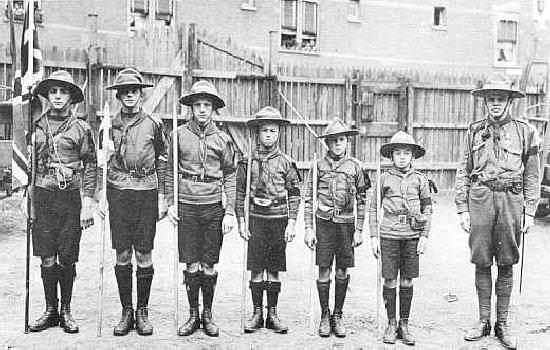
Figure 1.--There were very different visisions for Britosh Scouting in the early years. The path eventually chosen was to enbrace internationalism rather than a strict nationalist movement. Baden Powell's struggle with the British Boy Scouts and Order of World Scouts played a major role in developin this international outreach. These English boys in 1910 were the first Scout group to visit the Netherlands.
|
|
Scouting appealed to more than just British boys and boys in British domininios around the world. Soon Scouting appeared in America and continental European countries. Europe in the early 20th century was a hot bed of nationalism which was to lead to two disastrous world wars. Baden Powell thus had to decide whether the Scouts should be a British national group or part of a wider world-wide movement. Also because Britain ruled many countries with non-British populations, Scouting appeared in countries like India as well as other Asian and African countries. This presented a fundamental challenge. There were in Britain, America, and much of Europe fundamental assumptions about white racial superority. These attitudes were especially strong in America, but as Britain led the spread of Scouting in the early years it is the British attitude that is most important. Britain did not have segregation laws, but foreigners especially non-white foreigners were looked down on. There were numerous private-restrictions. Blacks could not, for example, compete at Wimbeldon. Overseas in the Empire there were many more restrictions on indigenous people. As a result, Baden Powell and his new Boy Scout movement had to make fundamental decissions about internationalism. There was also a competing internatioanl Scout group.
Nationalism
Europe in the early 20th century was a hot bed of nationalism which was to lead to two disastrous world wars. Youth groups had begun to form, but primarily within national or imperial borders. There were also exclusive religious orientations. The Boy's Brigade was the first youth groip, but was a British Protestant group. Some groups were organized in the British Dominions. The Wandervogel was German group. And while the orienttion varies, there was a strong German Volkist thread. American groups like the Dan Beard and Daniel Carter Beard had destinctly nationalist orientations. This nationalist pattern that had begun to develop when Gen. Baden Powell returned to Britain after the Boer Waer and began to get involved with the Boy's Brigade and the need to improve the physical and moral fitness of British boys. The Scouting movement that Baden-Powell began to conceive was a highly patriotic, nationlist group in keeping with the groups that had already begn to form.
Decession
Scouting appealed to more than just British boys. Boys in British Domininios and then America enthusiastically took to Scouting. And the movemrnt did not stop there. Very qyuckly Scours were organizing throughout Europe being Scouting beyond a narrow British or Anglo-Saxon or Protestaht fr=rame like the Boys'Brigade. And because of the World Wide reach of the Britih Empire, we soon have boys of every race and religion involved in the movement. This all happened in a world still dominated by Europeans with highly racist views. And such views were notlimited to either Europe or America. This all happened unexpectedly and without any planning or even intention on the part of Baden Powell and other British Scouters. Baden Powell thus had to decide whether the Scouts should be a British national group or part of a wider world-wide movement. HBU at this time does not know to what extent this issue was disscussed by Baden-Powell and his associates. Even the spread of Scouting to America was unplanned, rising from a chabce encounter of an Americn journalist and a British Scout on a foggy London street. Baden-Poell was thus preseted ith a fait accompli that he could wither fisavow or embrace.
Internationalism
All we know was that Baden Powell what ever his original intentions or nationlist/racist attitudes, became an appostle of internationalism. It appears that the short-lived Order of World Scouts played an important role in orienting Scouting toward internatiinalism. He thus became an strong proponent of internationism. The first international Jamboree had to be postponed, like the Olympics, because of World War I, but was held soon after the War. After world War I embraced the spread of Scoting around the world with a passion. Baden-Powell traveled widely to support the spread of the Scout movement around the world. This was at the time a very inovative decesion. The Boys' Brigade, for example, never expabded with a few exceptions beyond the British dominions. Some groups which followed the Scouts, like the Hitler Youth and Italian Balial, proclaimed the superiority of their country and had little interest in contacts with other countries.
Scouting guided by Baden Powell pursued its internationlist credo (a brotherhood of Scouting) in manyways. The World Organization of the Scout Movement (WOSM) was founded after World War in the aftermath oif the first International Jamboree. WOSM is the largest international Scouting organization. It's girl counterpart, the World Association of Girl Guides and Girl Scouts (WAGGGS) provide support to national associtions atound the world. They help build contacts arond the world for the national associations. The most obvious international activity is the World Jamboree. The first orld Jamboree was held in Britain (1920). Other asctivities include visits of Scout units to Scouts in other countries. For Americans this was difficult because of the cost, but for Europeans it was much easier as thevcojntries are relatively small with mby nearby by borders. Soon we see visits between countries with a long history of histilities. And Scouts engaged in a range of ctivitie including drives and collections to assist Scouts and others in fireign countries. Thi was especially pronounced during and after Wirkd War I and II.
Racism
Racism has priven a nore difficult issue for Scouting than nationality and religion. Because Britain ruled many countries with non-British populations, Scouting appeared in countries like India as well as other Asian and African countries. This presented a fundamental challenge. There were in Britain, America, and much of Europe fundamental assumptions about white racial superority. These attitudes were especially strong in America, but as Britain led the spread of Scouting in the early years it is the British attitude that is most important. Britain did not have segregation laws, but foreigners especially non-white foreigners were looked down on. There were numerous private-restrictions. Blacks could not, for example, compete at Wimbeldon. Overseas in the Empire there were many more restrictions on indigenous people. HBU has little infornmation on how Baden Powell and his Scouts confronted the issue of racism. We do know that the development of Scouting was promoted around the world regardless of the ethnicity of local populations. As best we can tell, this highly patritic British nationalist and military man was converted into a powerful spokeman for internationalism. It is a fascinating story rarely noted.
There was also a competing internatioanl Scout group. In fact, the short-lived Order of World Scouts (OWO) founded in 1911 was the earlist international Scouting organization. While the OWO organization was short lived, they made have well played an important role in incouraging Baden Powell's British Scouts to expand their international outreach.
Scouting proved to be such a populsr movement that Scout associations wre organized in most counties around the world. And many boys and girls no matter where they lived wanted to persue Scouting. This included children living in foreign countries. This included children living overseas premanently as well as those whose parents were living overseas on temporary or short-term assignments. Here there were different options. They might join the local Scouts. Others might form there on Scout troops. This would be the cade where large number of foreigners are living in overseas communities. This might be the case of European countries (British, Dutch, French, Italian, Portuguese, and others) with colonies. Some children lived in places with large, but diverse foreign communities. I am not entirely sure what they did. Tey may have formed a kind of international troup or joined with troops formed by the dominant foreign group. Perhaps readers will have more informatoon on this.
HBU

Navigate the Historic Boys' Uniform Chronology Pages:
[Return to the Main chronologies page]
[The 1900s]
[The 1910s]
[The 1920s]
[The 1930s]
[The 1940s]
[The 1950s]
[The 1960s]
[The 1970s]
[The 1980s]
[The 1990s]
[The 2000s]
Navigate the Historic Boys' Uniform Web Site:
[Introduction]
[Activities]
[Biography]
[Chronologies]
[Countries]
[Essays]
[Garments]
[Organizations]
[Other]
[Bibliographies]
[Contributions]
[FAQs]
[Questions]
[Unknown images]
[Boys' Uniform Home]
Navigate the Historic Boys' Uniform Web organizatiion pages:
[Return to the Main Scouting pages ]
[Boys' Brigade]
[Camp Fire]
[Hitler Youth]
[National]
[Pioneers]
[Royal Rangers]
Created: February 6, 2002
Last updated: 12:37 AM 6/10/2014