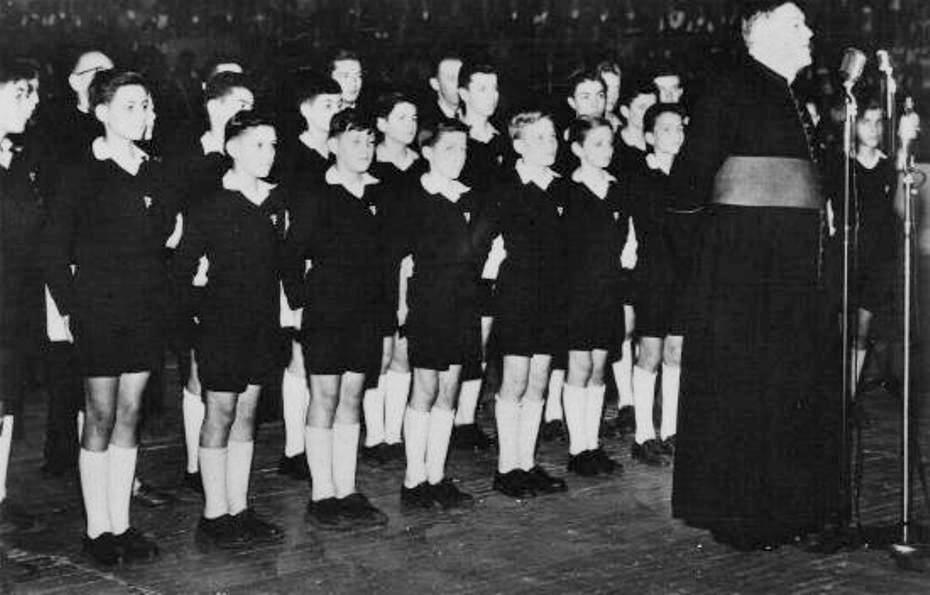
Figure 1.--Here I am with the PCCB Choir about 1950 with our trademark uniforms. Notice how we all have our hand behind our backs and our feet together and shoes touching. |

|
I was a member of the Manécanterie des Petits Chanteurs à la Croix de Bois. It is the more prestigious French Choir. Known abroad as The Little Singers of Paris. I was PCCB chorister during the late-1940s and earlt 50s. In my time this Institution was installed in Paris 17 Rue E. Flachat. (from 1943-63). Then there were a few years in Meudon (South Paris). There was a long stay in Château de Glaignes. There was a short stay back in Paris (2007-10), Finlly we settled in the Château Saint Loup 89210 Brienon sur Armançon. It was a wonderful experience, but very demanding. I loved the singing. I have continued to support the choir as an adult.
The tradition of boy choirs in France's great cathedrals had disapperared when a new choir was founded in 1906. That choir was the forerunner of the many wonderful boy choirs now operating in France. La Manécanterie des Petits Chanteurs à la Croix de Bois is today alonf with the Parios Cathedral Choir, the most famous boy choirs in France. Since the turn of the century, the approximately 100 Small Singers have followed a formal musical education at their chateau near Paris. Recruited from the general population, they are trained to a very high standard. The current director is Rodolphe Pierrepont. As well as sacred music, the choir performs popular French fare. La Manécanterie des Petits Chanteurs à la Croix de Bois are according to a HBC contributor one of the ten best boy choirs of Europe and compare with the Wiener Sängerknaben or Tölzerknaben in Germany and the Escalonia de Montserrat.
In my time this Institution was installed in Paris 17 Rue E. Flachat. (from 1943-63). Then there were a few years in Meudon (South Paris). There was a long stay in Château de Glaignes. There was a short stay back in Paris (2007-10), Finlly we settled in the Château Saint Loup 89210 Brienon sur Armançon.
In the 1950s we were recruited into all social circle. Many boys wanted to becom PCCB choristers. So, during our performs tours it was not uncommun for parents to ask Mrg. Maillet to allow their son to enter the Choir when they reached 10 years of age.
Most of us began ith the Choir when we turned 10 years old. Normlly after entering the Mané we stayed 4 yearsas Petit Chanteurs, some boys more and some less.
We lived a bit alike a boading school. But in fact, very often we left the Mané for our concert tours in France and abroad.
Those of us who lived in Paris could see our parents regularly. Our mates which lived far from Paris were not so fortunate. Some of them were not able to visi with their families very often. We lived a world apart from our families. It was a different experience growing up than that of most children. We were, however, very happy. We made friends and we all greatly enjoyed making misic,
The contacts we had with other boys our age outside the Choir werevery limited. Principally they those of the families which histed us during our concert tours. We wouold stay with local families for 1-2 days. They often saw us as exceptional children. This was sometime a bit embarrassing for us.
Our knowledge of music theory was limited and we were preparing the "Certificat d'Etude primaire", wich could be a real problem for boyy who wished to enter in secondary school. The teacher came and was paid by the " Ecole libre".
Personnaly I had a somewhat unusul childhood. When I was little boy I lived often with my Grandparents in the South. Then for a time abroad in Austria. When I came back in Paris I joind the PCCB. My parents insisted that I prepare to enter secondary school ('lycée' we said in my time) as they wanted me to get a university degree. This was a real problem to be PCCB. By chance I lived near the Mané and I took my classes at Saint François. At first, I had some difficulties with French grammar, later I was one of the students at the top of my class. For this raison I was not constantly at the Mané. I was frustraded not to
be able to join by friends on thier world concert tours which could last several mounths.
While at the Mané we dressed like we wanted within reason. This was identical with the popular fashions of the boys our age. hat was the comte,porary fashion. I remember praticly all of us wore short pants with a shirt and a sweater, never a necktie. But very often we prefered to wear our PCCB uniform. We we were proud of that! When we went on concert tours and when performing the rules were strict. We had to have a perfect look. Our standard uniform consisted of a sky-blue open collar shirt, a navy-blue sweater, flannel short pants, knee socks, and black shoes. we added a navy-blue coat when the weather
was chilly. And of course the sweaterschad our PCCB badge, we were very proud of that! Other boy choirs called 'filiales' were dressed similarly. We absolutly did not not pay much attention to our dress, because it was the fashion of our time. Most boys wore in short pants. The 2012 PCCB uniform has praticly not changed, it is the same uniform but with longer shorts, kind of a bermuda style.
Our concerts consisted of two parts. We started with some secular songs and we were dressed ln our best PCCB uniforms. During the intermission we sold 45 rpm records. Then for the second part, we put on our white albs over our uniform. We sung religious pieces. At the end the concert, the host families were waiting for us.

Navigate the Historic Boys' Clothing Web Site:
[Introduction]
[Activities]
[Biographies]
[Chronology]
[Clothing styles]
[Countries]
[Bibliographies]
[Contributions]
[FAQs]
[Glossaries]
[Images]
[Links]
[Registration]
[Tools]
[Boys' Clothing Home]
Navigate the Historic Boys' Clothing Web choir costume pages:
[Return to the Main individual French choir page]
[Return to the Main French choir page]
[Australia]
[Austria]
[Belgium]
[Bulgaria]
[Canada]
[Denmark]
[England]
[Finland]
[Germany]
[Japan]
[Netherlands]
[Poland]
[South Africa]
[United States]
Navigate the Historic Boys' Clothing Web style pages:
[Short pants suits]
[Blazers]
[Collars]
[Lace collars]
[Ruffled collars]
[Eton collar]
[Fauntleroy suits]
[Sailor suits]
[Ring bearer/page costumes]
[First Communion suits]