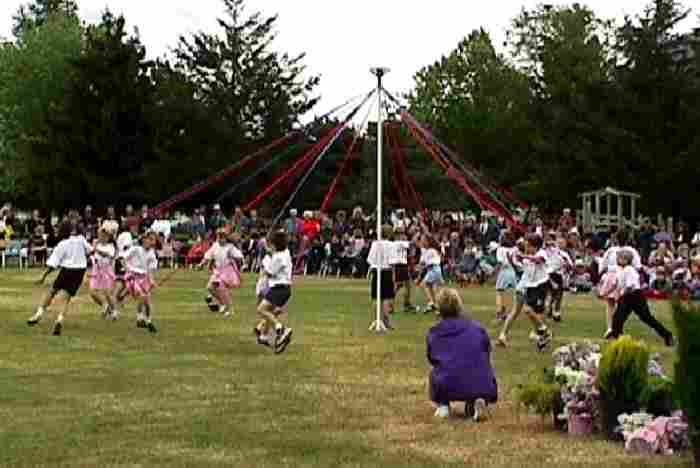
Figure 1.--These Canadian children are holding a traditional May Day celebration, complete with dancing around the Maypole. |

|
May Day is celebrated around the world. Traditional May Day celebrations were pre-Christian agricultural festivals. Eventually the significance was lost and the practices survived merely as popular festivities. It is a festival of happiness, joy and the coming of summer. Many schools around the world use the observance of May Day as a rich source of multicultural activities that can complement the May curriculum. Dancing around the Maypole is an often popular activity for the younger children, although the boys may need a little encouragement. In the late-19th century May Day also became known internationally as Labor Day. Socialists and Communists adopted it as a kind of left-wing celebration. After the Russian Revolution, May Day became an opportunity for an annual display of Soviet military strength. Thus May Day gradually became a highly politically charged holiday.
May day is the only major festival of pre-Christian Europe that was not adapted by the Christian church for its own purposes. Part of a yearly cycle that includes midwinter and harvest celebrations, it stands midway between the long, cold nights of
winter and the days of plenty at summers end, with symbolism and ceremony that reflects its pivotal position. Across Europe the key symbol of the day is fresh spring growth, and the general hope is for fecundity. Traditionally,
youths spent the eve of May Day in neighbouring woods and awoke the villagers the next morning by visiting each house,
singing a traditional carol and bearing garlands of fresh leaves and flowers. Or they might disguise one of their number as
Jack-in-the-Green by enshrouding him with a portable bower of fresh greenery. Jack and his followers danced around the
town collecting money from passersby for later feasting. In many villages these young people also cut down trees, which they then erected as maypoles in the village centres. Each pole served as a gathering place for community dances and activities. Traditional dramas enacted on May Day in many European countries commemorated the triumph of summer over winter, while in England the focus was on dancing and pageantry. Youths elected a king and queen of the May to preside over the
day's proceedings; sometimes they dressed as Robin Hood and Maid Marian, with members of their entourage representing Friar Tuck, Little John, and Robin's other merry men.
Although the origins of May Day are unknown, what is known of its history is suggestive. The festival is not based on a magical ritual to secure the fertility of the crops, as once thought, but instead is a community expression of hope and joy. The emphasis has always been social solidarity, and not the supernatural or the metaphysical.
Lanbor Day is celebrated around the world on May 1--except in the United States. It is a highly politicized event. May Day has been made a national holiday throughout Europe, but countries differeed widely as to when it was made n official holiday. This was something Socialists throughout Europe demanded beginning in the late-19th century. Governments often resisted the demand. It was made a holiday in the Soviet Union after the Revolution and it was in the Soviet Union that the largest May Day parades were held.
A variety of customs associated with May Day and the Maypole have developed in different countries.
May Day in Austria as in Germany ia dual holiday. There is the tradutional May Day celebrated in small towns and villages. This is a kind of spring festival where school children dress up. The girls wear flowers in their hair. Both boys and girls commonly wear folk outfits. Then there is the highly politicized May Day--the international Labor Day. I am not sure when May Day was made a national holiday. This was something Socialists throughout Europe demanded beginning in the late-19th century. Governments often resisted the demand. It did not become an official holiday in Germany until the advent of Hitler. We note that during World War I there was a massive demonsttration in Vienna demanding peace (May 1917). Demonstrators demanded a "settlement without Humiliation of any nation". The Communists and splinter leftist groups march separately. After the Soviets and Allies withdrew the Austrians were able to freely celebrate May Day. The modern May Day demonstrations are dominated by the Social Democrats. Peace is normally a major theme. Interestingly during the Cold War, the Communist Party concept of peace was not offened by the Soviet resort to force to maintain its Eastern European empire. And of course Communist supression of free trade uniojns was never raised. Another issue often raised on May Day in Austria is immigration.
At night, boys place maypoles before their sweethearts' windows.
The festivals reportedly began begun in ancient Rome with Flora and reached their height in England during the Middle Ages. On the first day of May, English villagers awakened at daybreak to roam the countryside gathering blossoming flowers and branches. A towering maypole was set up on the village green. This pole, usually made of the trunk of a tall birch tree, was decorated with bright field flowers. The villagers then danced and sang around the maypole, accompanied by a piper. Usually the Morris dance was performed by dancers wearing bells on their colorful costumes. Often the fairest maiden of the village was chosen queen of the May. Sometimes a May king was also chosen. These two led the village dancers and ruled over the festivities. In Elizabethan times, the king and queen were called Robin Hood and Maid Marian. Maypoles were usually set up for the day in small towns, but in London and the
larger towns they were erected permanently. They were considered heathen eyesores by the Puritans. May Day festivals became so gay and wild that the Puritans were able to force the government to forbid them. They soon sprang up again, however, and still continue in many English villages. Today in London children go from house to house bringing flowers in return for pennies. After the pennies are collected, they are thrown into a wishing well. Special wishes are made with hopes they will be granted. The pennies are later collected and given to different charitable organizations.
The French considered the month of May sacred to the Virgin Mary, so they enshrined young girls as May queens in their churches and
May queens led processions in honor or the Virgin Mary. Cows also play important roles in French May Day festivals. Bunches of flowers are tied
and draped around their tails as they are led in parades. Everyone tries to touch the cows because it is believed to be good luck. On May Day
morning, everyone drinks milk still warm from the milking to assure good luck during the year.
May Day is an internation celebratin honoring labor. In Germany it is commonly referred to as Tag der Arbeit. European countries began celebrating May Day as a labor celebration in the late 19th century. The International Workers' Congress in Paris designated May Day as a public holiday in 1889. Trade unions and Socialist political parties promoted May Day as a public holiday, but Kaiser Wilhelm II never approved. The Government did not designate May Day as a holiday until after World War I. Socialist partes dominated the new Weimar Republic that replaced the Kaiser following the War. The National Assembly declared May Day a public holiday (1919). I had thought that Hitler made May Day an official holiday, at the same time he suppresssed free trade unions. So I do not yet have full details on the history of May Day in Germany. Celebrations in Germany are observed by holding meetings, marches and public oratory. It is mostly organized by trade unions. After World War II the Communists celebrations of May Day was a major event. This was one of the Comminist festivals for which the Young Pioneers were used for parades. May Day comes in the Spring and there are also May Day celebrations associated with Spring that have nothing to do with Labor Day celebrations. Some of these celebrations have ancient origins. Hopefully our German reders can tell us more about May Day celebrations. German boys often secretly plant May trees in front of the windows of their sweethearts.
Greek children set out early in the morning to search for the first swallow of spring. When the bird is located, the children go from door to
door singing songs of spring. For their efforts, neighbors offer special treats to eat, such as fruits, nuts, and cakes.
The people of ancient Rome honored Flora, the goddess of flowers and springtime, with a festival called Florialia. The goddess was
represented by a small statue wreathed in garlands. A procession of singers and dancers carried the statue past a sacred blossom-decked tree.
Later, festivals of this kind spread to other lands conquered by the Romans. Today May Day is known as the happiest day of the year in Italy. All
varieties of flowers are placed in and around places of worship. Boys often serenade their sweethearts on this day.
The Tsarist Government supressed labor organization and Socialist political parties. The Bolshevicks after the Revolution made May Day a makor holiday in the Soviet Union. It was in the Soviet Union that the largest May Day parades were held. Soviet May Days differed from those in Western Europe. The Soviets made peace a major theme and ordered Communist parties in the West to pursue this theme. The Soviets also used May Day as a show case for new military weaponry.
In Switzerland, a May pine tree is often placed under a girl's window.
The Puritans frowned on May Day, so the day has never been celebrated with as much enthusiasm in the United States as in Great Britain. We do note that May Day was a popular holiday celebrated at schools in America during the early 20th cebtury. A good example is an unidentified Indianapolis school in 1929.
But May Day is celebrated by dancing and singing around a maypole tied with colorful streamers or ribbons. The dancers twist the streamers around the pole to make a pretty pattern to be enjoyed by all. On college campuses a May queen is often chosen and the old dances are performed around a maypole. Children often gather spring flowers, place them in handmade paper May baskets and hang them on the doorknobs of relatives and friends--they ring the doorbells and run away, leaving their flowers as a surprise. At May Day parties children select May queens, dance around the maypole, and sing May Day songs. These festivals often occur in parks or schools. May Day celebrations were not all My polls. We note a California school that had a Chinese or perhaps internatuinal theme.
Traditional May Day celebrations were pre-Christian agricultural festivals. Eventually the significance was lost and the practices survived merely as popular festivities. A widespread superstition held that washing the face in the May Day morning dew would beautify the skin. In Hawaii, May Day is Lei Day. Everyone gives the gift of a lei to another, putting it around the receiver's neck and accompanying it with the traditional kiss. Lei Day began in 1928. Some Hawaiian celebrations are complete with pageants, a Lei Queen and her court. In 1889, a congress of world Socialist parties held in Paris voted to support the U.S. labor movement's demand for an 8-hour day. It chose May 1, 1890, as a day of demonstrations in favor of the 8-hour day. Afterward, May 1 became a holiday called Labor Day in many nations. It resembles the September holiday in the U.S. The holiday is especially important in socialist and Communist countries--when political demonstrations are held.
Some popular May Day songs include:
May Flowers (Tune: "The Mulberry Bush")
Shout hurray for the flowers of May,
Flowers of May, flowers of May.
Shout hurray for the flowers of May,
Pretty springtime flowers!
Let's all play in the flowers of May,
Flowers of May, flowers of May.
Let's all play in the flowers of May,
Pretty springtime flowers!
--Jean Warren
May Day's Here (Tune: "Three Blind Mice")
May Day's here, May Day's here,
Sun shines bright, sun shines bright.
Birds and butterflies are in flight,
Blooming flowers--such a sight!
Everything feels just right.
May Day's here!
--Kristine Wagoner
Ring Around the Maypole (Tune: "Ring Around the Rosie")
Ring around the maypole,
(Join hands with others and move in a circle.)
Pocket full of roses.
Ribbons, ribbons,
We all fall down!
(Drop to floor.)
--Toni Lenhardt
May Basket (Tune: "Did You Every See a Lassie?")
Did you ever see a May basket,
A May basket, a May basket?
Did you ever see a May basket
That looked so good?
I worked for hours,
Then filled it with flowers.
Did you ever see a May basket
That looked so good?
--Jean Warren

Navigate the Historic Boys' Clothing Web Site:
[Return to the Main dance page]
[Return to the Main holiday page]
[Introduction]
[Activities]
[Biographies]
[Chronology]
[Cloth and textiles]
[Clothing styles]
[Countries]
[Topics]
[Bibliographies]
[Contributions]
[FAQs]
[Glossaries]
[Images]
[Links]
[Registration]
[Tools]
[Boys' Clothing Home]
Navigate the Historic Boys' Clothing Web chronological pages:
[The 1900s]
[The 1910s]
[The 1920s]
[The 1930s]
[Thw 1940s]
[The 1950s]
[The 1960s]
[The 1970s]
[The 1980s]
[The 1990s]
Navigate the Historic Boys' Clothing Web style pages:
[Kilts]
[Caps]
[Sailor hats]
[Lederhosen]
[Sailor hats]