|
Ruth Cobb was an English illustrator and writer especially appeciated for depicting children and dolls in chasrming, colorful costumes. Ruth was born in London (1878). Her father homas Cobb, a New Bond Street tailor who became a novelist. She grew up around the studio of Victorian society photographer Walery. The family moved to Tunbridge Wells where her sister and brother were born.
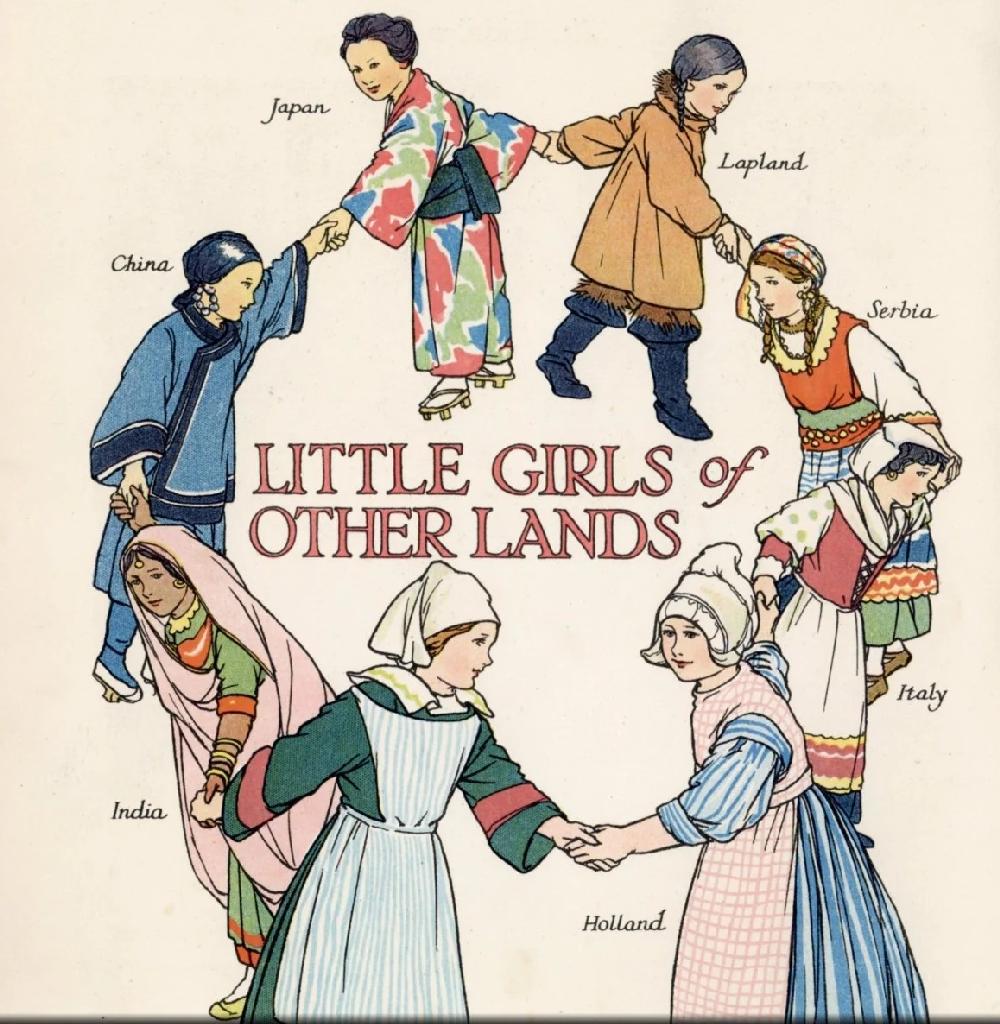
The family became writers, but Ruth at first was focused on being an illustrator. She began working in a studio and next a freelancer. As her reputation grew she was able to sell to popular magazines like Chatterbox, The Autocar, The Builder, and Punch. Her first real sucess was three books in the Dumpy Books series (1902). By this time the technology for printing full-color illiudtrations existed. She illstrated Richard Hunter’s verses with brightly colored drawings of Dollies, More Dollies, and Irene's Christmas Party. Other Dumpy books she illstrted included a book by her father and two by Mary Tourtel before her Rupert books.) Cobb then began producing larger-format books such as The Wonder-Voyage and A Trip to Fairyland. She was also a sought after illustrator by other authors. Thenthee were a set of berautifully illstrated books about children around the world. Inteestingly, for somevreason she leaves out American children. While Cobb continued to focus on children, she did some a variety of other commissions involving works for adults. She illistrated F.J. Harvey Darton's A Parcel of Kent. She also illustrated her brother’s first novel, Stand to Arms. She did an impressive cover for E.H. Young's 1930 best-selling book Miss Mole. Cobb was most active (1920s-30s). Cobb contributed to a large number of children's annuals that were popular at the time. She did a range of work for Blackie, Collins, Nelson, Tuck and others. She did both illutrations for others as well as text and pictures. The illustrations were done in boh blk and white. Children loved coloroing in the black-and-white drawings. Her work was shattered when Hitler and Stalin launched Wold War II (1939). Suddenly chlldfren's publihing was a very low priority. One source reports, "She went to live with relations in Sussex. There, she did a lot of voluntary war work, became President of a Women’s Institute, did map drawing, for the War Agricultural Committee in Lewes, and spoke for the Ministry of Information.” A typical lecture was 'Some of London’s Bombed Buildings.' She eventually began working for mahazines agin. At the end of the War she worked on a series of small illustrated topographical books. The War led to some serious thinking. The final book of the sereies was A Sussex Highway. The final chapter highlights Thomas Paine, author of 'The Rights of Man'.
Her adult books were well done, but her children’s illustrations iswhatshe is best remembered.
【Redd】
Redd, David. "Ruth Cobb," March of Times Books (October 12, 2015).

Navigate the HBC literary pages' Historical Clothing Web Site:
[Return to the Main English illustrator page]
[Return to the Main illustrator page]
[Return to the Main English literary page]
Navigate the Boys' Historical Clothing Web Site:
[Introduction]
[Activities]
[Biographies]
[Chronology]
[Clothing styles]
[Countries]
[Literary]
[Bibliographies]
[Contributions]
[FAQs]
[Glossaries]
[Images]
[Links]
[Registration]
[Tools]
[Boys' Clothing Home]