|
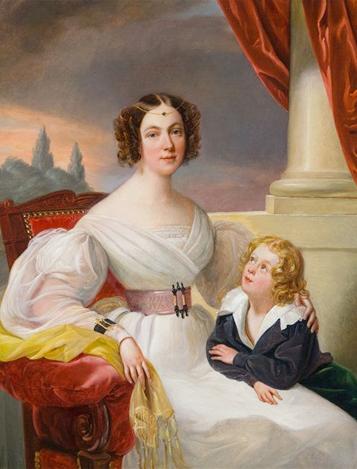
Johan Nepomuk Ender was born in Vienna during tumultuous times (1793). This was the year that King Louis XVI was executed and the regign of terror began. He grew up during the Napoleonic Wars. He he studied at the Vienna Academy. And soon was awarded four important prizes. He soon achieved a popular following as a portrait painter in fashionble Vienna. A formtive adveventure was a trip with Count Szecheni of Hungary on a tour of Turkey and Greece (1818-19). He then traveled to Italy to view the Renaissance masters (1820). He produced works from Biblical and historical subjects. Finally he stayed in Paris for a year. He returned to Vienna (1827). He then persued a career in Vienna specialing in portait miniatures and historical paintings. He was appointed as a professor at the Academy (1829-50). We find his work very valuable because he produced many portraits of families and children. This is very valuable because without photography there are far fewer images with which to work. The unidentified mother and child here are a good example (figure 1). We notice another unidentified boy in 1829. This provides us quite a number of images of children's clothing in the early-19th century before we have photographic evidence.
We notice another unidentified boy in 1829. The boy has a large Eton-like collar. We are not sure if the blue outer garment is a long jacket ot a tunic. It is worn with white pants. They look more like pants than pantaleyyes.
This Ender portrait was titled 'Mutter und sohn'--mother and son (figure 1) The family is not identifid, but it looks like a very affluent family.. It is not dated. We might guess it was painted about 1830--but at this time we are omly guessing. The mother dress with the elaborate slleces is the best way to date the image. Notice the boy's open ruffled collar. Notice the classical column and drapes. This popular convention also appared in early CDV portraits. (earlier formats tended to have plain backgrounds.) We notice a portrait of Alfred and Adam Potocki sitting in a carriage (1831). The Potockis were one ofthe wethiest and imprtant Polish arisocratic families. This continued after World War I with Polish independence (1918). Poland was partioned (19th centyury) and the family played an imprtant role in Austrian politics and society. The boys as was the custom of their mother were dressed alike. They wear square, opened necked maroon tunics with white pants and are pictured with a faithful pooch. Curiously for a mother who dressed them alike did their hair very differently. Amother earler portrat shows hem wearing matching blue tunics.

Navigate the Boys' Historical Clothing Web Site:
[Return to the Main individual A-F artist alphabetical page]
[Return to the Main Austrian artist page]
[Introduction]
[Activities]
[Biographies]
[Chronology]
[Clothing styles]
[Countries]
[Bibliographies]
[Contributions]
[FAQs]
[Glossaries]
[Images]
[Links]
[Registration]
[Tools]
[Boys' Clothing Home]