|
The Lambtons played an important role in English history. The Lambtons have been in the northern England (Hexham and New Castle) since the 13th Century. The family seat can be found at Lambton Castle, some 5 kilometres to the west of Penshaw Monument. The family's stately home became the base for a series of first agricultural and then industrial ventures. These saw the family grow in wealth and power. At their peak they held high position in the military and local politics (late-18th century. Successive heads of the family being awarded knighthoods. Here we look at tge Lambtons in the 19th century. We have little information on the clothing worn by the most important member of the family, John George Lambton. Infornmation on his grandson, however, illustrates clothing conventions in England during the 1860s.
The Lambtons have been in the northern England (Hexham and New Castle) since the 13th Century. The family seat can be found at Lambton Castle, some 5 kilometres to the west of Penshaw Monument.
The family's stately home became the base for a series of first agricultural and then industrial ventures.
These saw the family grow in wealth and power. At their peak they held high position in the military and local politics (late-18thbcentury. Successive heads of the family being awarded knighthoods. The first was William Lambton who was knighted by Charles I in 1614.
Joseph was born in the family home Harraton Hall (or possibly South Biddick Hall). He decided to enter the priesthood at a time of the English reformation. Which was not the safest career choice. As he was a Catholic, he was educated at the college of Rheims in France and the English College in Rome. He was ordained in Rome 1589 and sent back to England. Queen Elizabeth I was the rigning monarch at the time. Elizabeth was trying to defuse the religios controversies of the era. People were no longer executed for their faith. They were executed for treason. And many Catholics were still intent on removing the Protestant Elizabeth. He must have been involved in one of the many Catholic plots. The Spanish Armada was part of the Catholic effort to remove Elizabeth. Fortunatley Englands's first great spymaster protected her--Francis Walsingham. Joseph was executed (1593).
William Lambton who was knighted by Charles I (1614).
John George Lambton, First Eart of Durham, was a noted English statesman. I have no information on his clothing as a boy, but they presumably included tunics and skeleton suits He became a Liberal member of Parliament in 1813 and avocated reforms in the prevailing of electing members to parliament. As privy councillor and lord privy seal in the ministry (1830-33) of Charles Grey, Lambton was one of a group who drew up the Reform Bill of 1832. The Bill greatly expanded the sufferage in England. After serving as Ambassador to Russia, he was appointed Governor General of Canada and helped forge modern Canada out of fractous Upper and Lower Canada. While the unification of Canada was not achieved until 1867, it was Lambton who played a key role in initiating the process.
|
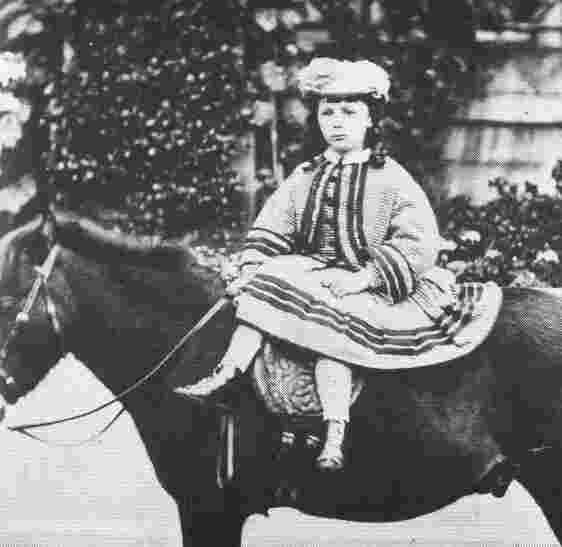
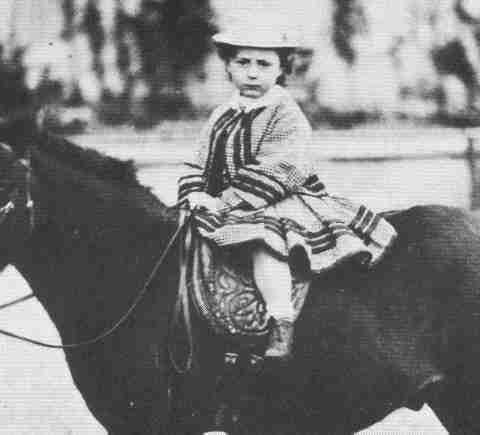
George Frederick D'Arcy Lambton, 2nd Earl of Durham at Copse Hill, Wimbledon (1828). He was a British pier. He was the second (and eldest surviving) son of John Lambton, 1st Earl of Durham, and his second wife Lady Louisa Elizabeth. His mother was a daughter of Charles Grey, 2nd Earl Grey -- an imprtant British prime-minister. The Earl had an impressive 13 children. This included John George who became the third Earl. The Earl had 13 children. Available family photographs show some of the children. George (1860-1928) as a small boy was dressed almost identically as a sister, Lady Beatrix (1859-1944). They were about the same age. e looks to be about 4 years old (figure 2). This was common at the time for boys until they were about 5 years of age. Images show George and Beatrix wearing identical riding dresses of check cloth trimmed with braid. The bodices fasten with buttons down the front, the sleeves are close-fitting to the wrist and the full skirts are pleated. They have matching jackets with small white collars. They wear short white socks and boots. George's boots are fastened with laces and Beatrix's with buttons. The only sgnifican differences are the hats (hers has plumes), the hair (she has ringlets), and the fact that she sits side saddle while her brother sits manly astride the horse, despite his dress.
John George Lambton, 3rd Earl of Durham was a British hereditary peer from one of the mst notble British aristocratic families. He was the eldest twin son of George Lambton, 2nd Earl of Durham. His mother was another aristocrat, Lady Beatrix Frances Hamilton, daughter of James Hamilton, 1st Duke of Abercorn. It was an illustruus family. His grandfather was an important statesman and colonial administrator, John Lambton, 1st Earl of Durham and his great-grandfather was the Whig Prime Minister Charles Grey, 2nd Earl Grey (1830-34). This was a short primership, but one of major reforms. We know little about his childhood. We notice Jiohn wearing a Highland kilt outfit (1868). This was the result of Queen Victoirai popularsing Scottish dress. John inherited the family earldom and its subsidiary titles when his father died (1879). He served as a lieutenant in the Coldstream Guards as a young man. Unlike his illustrious ancestors, after this Lord Durham primarily was involved in ceremonial roles. As an older man he was appointed Honorary Colonel of the Durham Heavy Brigade, Royal Artillery, the 6th Battalion Northumberland Fusiliers and the 8th Battalion Durham Light Infantry. He received the Volunteer Officers Decoration (1903). He partiipated in the Delhi Durbar (1903). This was the major event at the high point of Empire. It celebrated the succession of King Edward VII as Emperor of India aftrer the deathh of Queen Victoria. He was made a Knight Companion of the Garter (1909) and admitted to the Privy Council (1911). Both came from hia ingeited poition not life avhievements. He had the honor of bearing the Queen Consort's Ivory Rod with Dove at King George V coronation (1911). He was Lord High Steward to George V during his visit to India (1911-12). Lord Durham served as Lord-Lieutenant of County Durham (1884-1928) and Chancellor of the University of Durham (1919-28).

Navigate the Boys' Historical Clothing Web Site:
[Return to the Main biography page]
[Return to the Main biography G-L page]
[Return to the Main English page]
[Return to the Main Hm-Hz alphabetical movie page]
[Return to the Main alphabetical movie page]
[Return to the Main U.S. movie page]
[Return to the Main Christmas movie page]
[About Us]
[Introduction]
[Activities]
[Biographies]
[Chronology]
[Clothing styles]
[Countries]
[Girls]
[Theatricals]
[Topics]
[Bibliographies]
[Contributions]
[FAQs]
[Glossaries]
[Images]
[Index]
[Links]
[Registration]
[Tools]
[Boys' Historical Clothing Home]