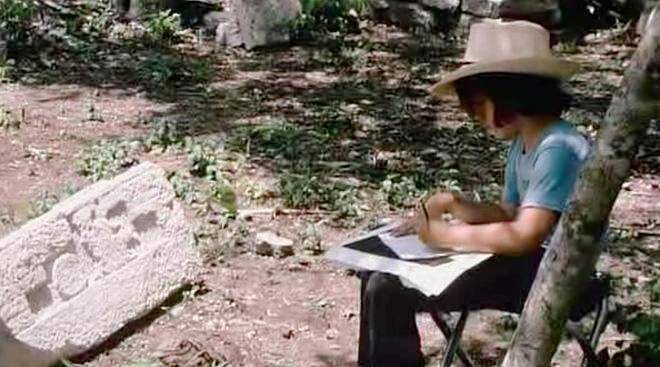
Figure 1.--Here David is deawing gylphs on a piece of masonry. With masonry, photographs often do not pick up details, especially if the masonry is weathered. Thus accurate drawings are the best way of preserving the work. |

|
Archaeologists and Mesoamerican scholars George and Gene Stuart was interested in the Mayan hieroglyphics. Their son David was born in 1965. They took David with them on field trips to Maya archaeology sites. David Stuart became fascinated by the Mayan writing and became a kind of junior archeogist. All the time learning more and more about the then unreadable language. Western scholars tended to think Masyan glyphs reprecented concepts. The Soviet scholars thought the images were phonetic. At 18 years of age, David became the youngest recipient of the MacArthur Fellowship prize (1984). This achievement came from his knowledge of the Maya civilization and his understanding of the Mayan hieroglyphic writing system This started from his childhood interest in Mesoamerica. David eventually made a great discovery that was a break through in reading the Mayan hierglyphs. He discovered that sets of images did indeed represent the same sound. Today scholars can read Mayan texts in their entirety.
Father was George Stuart. Mother Gene Stuart. Both were Mayanist scholars. They took David with them on some of their field expeditions to Mayan sites.
When David first went with his parents on their field trips to the Mesoamerican archaeological sites, the settings were little more than gigantic playgrounds for the youngster. Photographs show him wondering about the surrounding countryside as he played near by to where his parents were studying the Mayan hieroglyphic writing.
Fmily photographs show the different clothing styles Favid wore over time. Aged 3 David was dressed in t-shirts, shorts, white ankle socks, and sneakers. At the age of 8 he wears sleeveless white tee –shirts, long trousers. He is pictured at 8 wearing a Mexican straw hat. At 12 years of age he wore safari style shirts.
As a boy David would seem to have had a collection of toy cars. He is seen in one picture playing with a truck on an important historical site. It is his first childhood memory of being at Monte Alban in southern Mexico--Oaxaca. This wasa Zapotec site. Located in southern Mexico, the Zapotecs were a people that were influenced by the Maya. He played with his toy cars among the Danzante sculptures. It is always inteesting to see what young children take in from their surroundings. Apparently young David took in a lot more than his parents realized.
The family photographs show different hair styles and lengths. As a toddler he had short length hair. Between about 8 and 12 years old he had thick very long hair. Long hair at the time was popular. From the age of about 12 he seems to have preferred a shorter length hair style.
David started to develop an interest in the Maya. Of course, the interest was obviously started because his parents were working oin Mayan writing. The seeds were sown the year the 3year old visited Coba. He had experienced the wonder of flying in an aircraft. He looked through the window at the jungle beneath him and saw Mayan pyramids peeking out. The interest grew as his parents took him to more and more Mayan sites. Stuart expplains, "Other youngsters like me would have their interest kindled by enthusiastic amateurs who, in my case, stimulated my curiosity by taking me along with them to venues where they gave slide shows about the Mayan Kingdoms." The young David did not think it was always an exciting time. He felt bored because there did not seem much to occupy him or friends his age to play with. A turning point seems to have occurred around 1974. David was now 8 years old. This was the summer when David’s interest in Mayan writing burst out. His father was helping to run a an archaeological expedition at Coba. His parents took David with them to Coba in Quintana Roo. They were spending the summer there on an important field trip. In the beginning it had been an adventure they were on the road for 10 days. They travelled through the jungle and along dirt roads to the Mayan ruins. Once there they lived in a small Mayan hut. The weather was hot. There were irritating insects to contend with. Despite this the setting was rather attractive. The village was near beautiful lakes and rising above the jungle was the Mayan pyramids. The first three weeks and the small boy felt boredom. A transformation occurred. David often walked about the ruins. At first he had no feelings about his surrounding. Then he realised that for an 8 year old he was in an adventurous ruined city. He realised that where he was, possibly had not been explored by anyone. Around him he saw huge stepped buildings and he looked at them more closely. He started to draw the things he saw. Many of the monuments had been eroded by time. It was the hieroglyphics which interested him the most. He took much more interest in the things his father said they had found. When reports came of new finds by workmen David went with his father to see them. The interest made him want to read the books his father had brought with him. When excavations were over David was sorry to leave Coba. He went back in 1974 and was as eager as ever to wonder through the ruined city drawing and studying the carvings and copying the hieroglyphics. That year he knew he had been bitten by the ‘Mayan hieroglyphic bug. He never looked back.
David was 11 years old when he first met Linda Schele in 1976. She was an expert Mayan archaeologist. David met her one day in his father’s office. She was talking with fellow experts in the field when David suddenly spoke about the pictures they were examining. He had recognised the type of image it was. Linda was taken aback by one so young who knew about her discipline. She became David’s tutor and he studied with her for many years. When he was 12 years old he was taken with Linda and his mother on the first of many field expeditions to study Mayan hieroglyphics. He helped her check the drawings and together they went into the Mayan temples. In the summer of 1978 was an amazing time for David. He was with Linda and her husband. The work Linda asked him to do was to correct her drawings. He felt very proud that despite his young age he was given such an important piece of research to do. It was at this time that Linda gave him a drawings to study to help him come to a conclusion about a problem of interpretation he had. After a few days he took the drawings back and explained what he thought the drawings meant. Linda listened and then David was flabbergasted by what she said next. Linda said he should present a paper at the next Mayan archaeological gathering Linda organised. It was the scariest thing for a 13-year old to present his paper at a world renowned gathering of specialists of Mayan archaeology. When David was 15, this paper was published. It was the first of his many papers he would write about Mayan hieroglyphs.
It was New Years Eve 1980 and David was 14. Hew was with his father on a flight to Guatemala. They were going to a cave where Mayan hieroglyphs had been found. For David this was the first time he had been to a deserted part of jungle. David was filled with a mixture of emotions. He felt wonder and trepidation has he walked through the cave entrance. He had never seen the inside of a cave before and now he was wondering through the biggest in Guatemala. The Hieroglyphs he saw were astonishing. He studied them and came to a very important breakthrough in the study of the Mayan writing. He realised that the pictures represented phonic elements of the language which David had never seen before. Further research brought the realization that more than one picture represented the same phonic sound. This was the first deciphering David had done independently and it was a ground breaking discovery. He continued to work with Linda Schele and their further work confirmed David’s hypnosis. This overturned expert thinking at that time. Leading Mayan scholars had got it wrong but incredibly, a 14 year old boy had found the way to decipher Mayan hieroglyphics.
When David was 18 he was awarded the prestigious MacArthur Achievement prize. He was the youngest recipient to be awarded this in 1984 for discovering the principals of reading Mayan hieroglyphs.
David Stuart is now the Director of The Mesoamerica Centre at the University of Texas at Austin.
Stuart, David. Interviews for "Breaking the Maya Code". Transcript of filmed interview. (April 12 and 13, 2005).

Navigate the Boys' Historical Clothing Web Site:
[Return to the Main S ordinary bio page]
[Return to the Main ordinary bio page]
[Return to the Main Mayan hierglyphs page]
[Hair styles]
[Hats]
[Collar bows]
[Collars]
[Suits]
[Vests]
[Long pants]
[Confirmation]
Navigate the Boys' Historical Clothing Web Site:
[Introduction]
[Activities]
[Biographies]
[Chronology]
[Clothing styles]
[Countries]
[Bibliographies]
[Contributions]
[FAQs]
[Glossaries]
[Images]
[Links]
[Registration]
[Tools]
[Boys' Clothing Home]