|
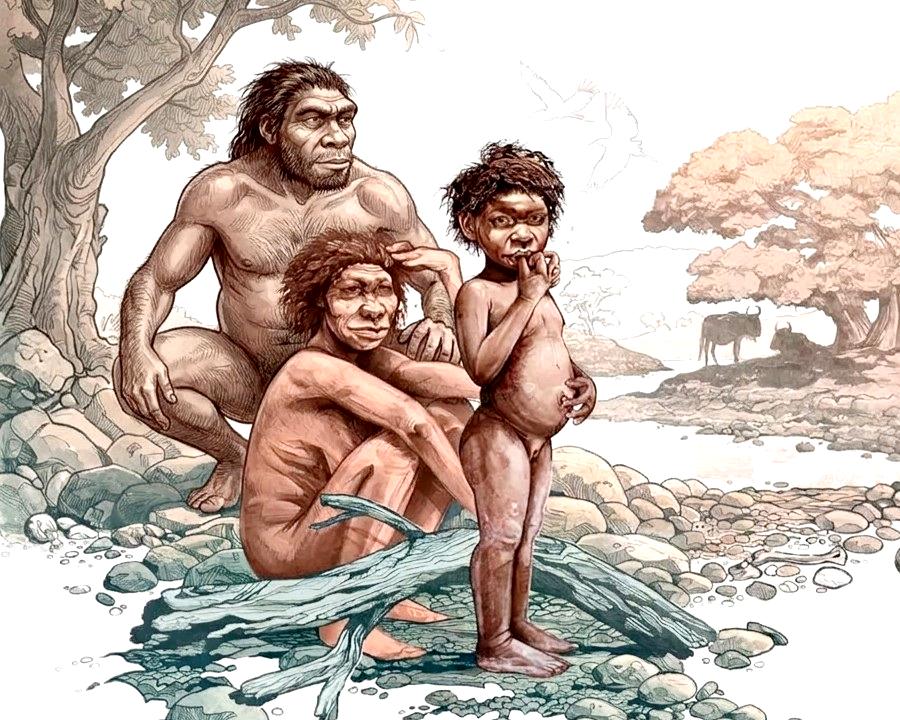
Homo erectus or upright man was probably the first hominid to develop a hunter-gatherer society--the life style practiced by humans for most of our history. And there is no doubt about Erectus status. It is unclear, however, to what extent he was a hunter as opposed to a scavenger. Hunting probably did not become primary until the neolithic era and the ability to make really sophisticated tools, especially weapons. Without weapons, hominid species would be very limited as to what they could hunt and kill. Here brain size was important. Erectus had a brain capacity averaging about 950 cc with some individuals as large as 1,200 cc, a substantial increase over Ergaster. The human-like appearance meant specifically long legs and short armsMost anthropologists identify H. erectus as the first hominid to look much like modern humans and to develop social relationships more like modern humans than the more ape-like Australopithecus species that preceded it. The human-like appearance meant specifically long legs and short arms. Those long legs meant that Erectus could travel long distances. Traces have been found in Africa dated to some about 1.9 million years BP. And this included sites in the Ethiopian Highlands. This means that Erectus was not resticted to the warm African lowlands where humans could thrive with basic technology, but could adapt to diverse climates. 【Handwerk 】 As a result, it was Erectus that spread all over the Eurasian land mass. Erectus had a larger brain reflected in more sophisticated tools. Erectus may also have alo discovered the use of fire. They likely used fire, but there is no evidence showing to what extent they controlled fire. Recent studies strongly support the idea that they may have utilized natural fires for warmth and cooking, but there is nothing confirming the jdea that they actually ignited fires themselves. They could have obtined fire from natural sources. Arhaeologists have found ash and charcoal accumulations looking somewhat resembling hearths, which substantite use of fire in caves. Of course, some of the finds could actually be sediment rather than evidence of controlled use of fire. The first human species known to wear clothing were the Neanderthals who are believed to have used animal hides for clothing to protect themselves from the cold. Erectus moved into Eurasia, including areas of southern Europe where clothing would be needed during the winter. The fossil record for Erectus is very limited and much of the archeological evidence is limited to stone tools. Erectus has been described as the most successful of all hominid species, surviving for an incredible time span, approching almost 2 million years.
Handwerk, Brian. "Two million years ago, This Homo erectus lived the high life," Smithonian Magazine (October 13, 2023).

Navigate the Children in History Website:
[Return to the Homo genus species]
[Return to the Homo genus]
[Return to the Main early Homonid species ]
[Return to the Main pre-history/Stone Age Paleolithic Era]
[Return to the Main stone age page]
[About Us]
[Introduction]
[Biographies]
[Chronology]
[Climatology]
[Clothing]
[Disease and Health]
[Economics]
[Freedom]
[Geography]
[History]
[Human Nature]
[Law]
[Nationalism]
[Presidents]
[Religion]
[Royalty]
[Science]
[Social Class]
[Bibliographies]
[Contributions]
[FAQs]
[Glossaries]
[Images]
[Links]
[Registration]
[Tools]
[Children in History Home]