|
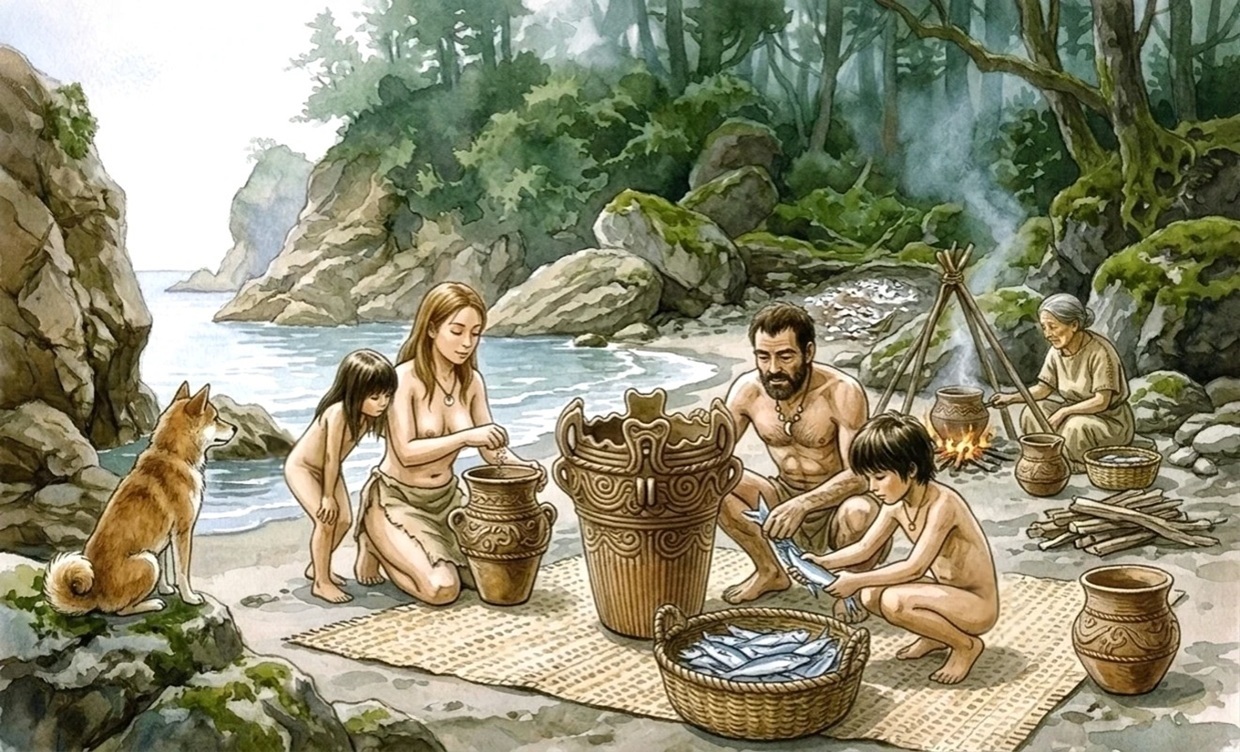
The world's last Ice Age began to ain (about 20,000 BP). Melting ice sheets led to rising sea levels. The land bridge that provided access for Paleolithic peoples to what was a narrow peninsula was submerged for the final time creating today's Japnaese archipelago. 【Mason, p. 13.】 Honshu and Hokkaido were separated from the Asian mainland and the different modern Home Islands began to form and were separated. Even so, the Jōmon people seem to have arrived over different routes at different times and clearly contributed to the genome of the modern ary Japanese people. 【Rasteiro and Lounès】 As Japan warmed the mega fauna disappeared and other plants and animals replaced them. In the process a new more sophisticated civilization emerged from the Paleolithic period. The Jōmon is commonly dated as beginning (14,000-11,000 BC). Precise dating of such as early period is impossible to date precisely. Historians divide the Jōmon into several destinctve periods. There is some disagreementbon this, but ome of the major periods are Incipient, Initial, Early, Middle, Late, and Final) 【Serizawa, pp. 1, 6–9.】 During this long period, two main changes appeared. First diverse hunter-gatherer society transitioned into semi-sedentary villages appearing. Second pottery appeared, an early sign of societal advance with the creation of ovens needed for firing. Pottery had a huge impact. Jōmon people were still hunter gatherers like the Paleolithic people, but now armed with bows and arrows. This enabled Jōmon hunters could safely bring down game from a distance. They also developed effective fishing gear such as hooks and harpoons. In addition, dogs were domesticated and some plant cultivation began. But the Jōmon were still primarily hunter gatherers. Even so the appearance of semi-sedentary settlements was notable. These settlements served as a base for living. Archeologists have found the first true dwellings and well as prepared graves. The manufacture of pottery by itself implies adegree of sedentary life because pottery is heavy, bulky, and fragile, unsuitable for a nomadic life style. 【Mason, p. 13.】 In the later Jōmon period we see the beginning of regional hub settlements. This included large buildings with thick pillars along with mounds used as a ritual spaces. Stone circles as large monuments have also been found. Pottery was a major advance in civilization. Pottery containers allowed people to boil and store food. This allowed people to more effectively utilize the available natural resources. Boiling allowed people to soften tough ingredients and remove the bitter taste of plants. the earliest Jōmon pottery was plain, but over time, the Jōmon developed distinctive 'cord-marked' patterns pressed into it. Other ceramics include distinct clay figurines known as dogū. We also see more advanced stone and bone tools. The climatic warming changed the environment and what could be hunted and gathered. Deciduous broad-leaved forests meant acorn, chestnut and walnut trees became widespread. 【Pearson, pp. 1, 245, 251.】 Sediment deposition due to a rise in the sea level and rainfall formed a terrain and environment that would increase fish and shellfish resources. The Jōmon did not establish permanent settlements, but the first semi-sedentary settlements did appear. Archeologists have found pit-houses grouped into small, relatively stable villages. This was the beginning of a fully nomadic lifestyle. There is also evidence of sophisticated rituals, growing trade networks, and the beginning of an artistic traditions, especially in ceramics. The twisted rope or plant fibers pressed into wet clay before firing, creating one of the world's first notable pottery styles. 【Craig and Saul】 We see increasingly elaborate pottery during the long Jōmon period. The Dogū human and animal figurine are especially interesting. Archeologists speculate that they were associated with fertility, healing, and/or ritual purposes. Weaving was developed during the Jōmon period. Inhabitants made primitive fabrics from plant fibers. The earliest rudimentary cloth involved y interlacing local plant fibers, such as bark and hemp. More advanced weaving and sericulture (silk production) occured significantly later, introduced via China and Korea during the Yayoi and Kofun periods. At the end of the Jōmon period the there was substantial overall drop in population. This is most commomly associated with declinng food production and environmental problems. 【Ohashi, et. al.】 There seems to be no evidence of abrupt increases in wardare and violence., The Jōmon Period ended with the appearance of Japomic-speaking Yayoi wet-rice farming and bronze-iron metalworking associated with people from mainland East Asia. Jōmon populations mixed with the new East Asian arrivals, although the dynamics and patterns are undetermined. The adoption of a new language is notable in termms of cultural domimnance. An admixture paradox (more paternl than maternal parentage) is anoither clue. 【Osada and Kawai】 The relationship of Jōmon people to the modern Japanese population is not entirely clear, but DNA studies suggest that the Jōmon people were rather diverse amd closely related to modern-day East Asians. 【Kanzawa-Kiriyama, Saso, and Suwa】 The genetic baseline is most strikingly preserved today among the indigenous Ainu people of northern Japan.
Craig, O. E.and H. Saul, H. "Earliest evidence for the use of pottery," Nature (2013) Vol. 496 Mo. 7445), pp. 351–54.
Kanzawa-Kiriyama, Hideaki, Aiko Saso, and Gen Suwa. "Ancient mitochondrial DNA sequences of Jōmon teeth samples from Sanganji, Tohoku district, Japan". Anthropological Science (2013) Vol. 121, No. 2, pp. 89–103.:
Mason, Penelope E. History of Japanese Art (2 ed.) (Upper Saddle River, New Jersey: Pearson Prentice Hall, 2005).
Ohashi, Jun, Katsushi Tokunaga, Yuki Hitomi, Hiromi Sawai, Seik-Soon Khor, Izumi Naka, and Yusuke Watanabe. "Analysis of whole Y-chromosome sequences reveals the Japanese population history in the Jomon period," Scientific Reports (June 19, 2019) Vol. 9, No. 1, p. 8556. .
Osada, Naoki and Yosuke Kawai. (2021). "Exploring models of human migration to the Japanese archipelago using genome-wide genetic data," Anthropological Science Vol. 129, No. 1, pp. 45–58.
Pearson, Richard."The Contribution of Archaeology to Japanese Studies". The Journal of Japanese Studies (1976) Vol. 2, No. 2, pp. 324-25.
Rasteiro, Rita and Chikhi Lounès. "Revisiting the peopling of Japan: An admixture perspective". Journal of Human Genetics (2009) Vol. 54, No. 6, pp. 349–54.
Serizawa, Chosuke (1976). "The Stone Age of Japan". Asian Perspectives. Japanese Prehistory (1976). Vol. 19, No. 1, .

Navigate the Children in History Website:
[About Us]
[Introduction]
[Biographies]
[Chronology]
[Climatology]
[Clothing]
[Disease and Health]
[Economics]
[Freedom]
[Geography]
[History]
[Human Nature]
[Ideology]
[Law]
[Nationalism]
[Presidents]
[Religion]
[Royalty]
[Science]
[Social Class]
[Bibliographies]
[Contributions]
[FAQs]
[Glossaries]
[Images]
[Links]
[Registration]
[Tools]
[Children in History Home]
Navigate the Boys' Historical Clothing Japanese pages:
[Return to the Main Japanese history page]
[Return to the Main Chinese history page]
[Return to the Main Korean history page]
[Return to the Main Taiwan history page/a>]
[Return to the Main Asian country history page]
[Choirs]
[Department store catalogs]
[Monarchy]
[Music recitals]
[Scouts]
[School uniforms]