Venezuelan Economy: Oil Ondustry: The 19th Century
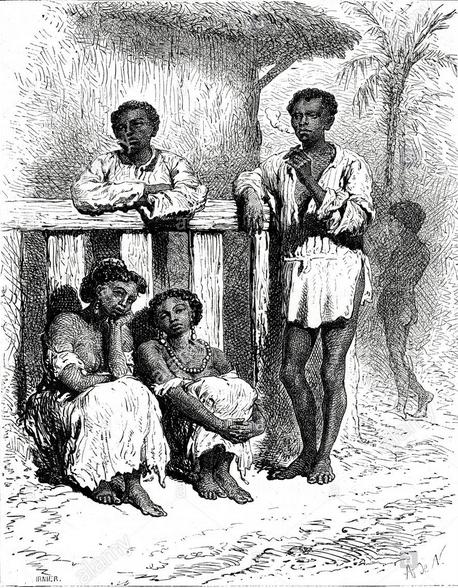
Figure 1.--Venezuela in the 19th century was among the poorest countries in Latin America. This drawing is by French artist Alphonse de Neuville (1835-85) who is best known for highly partiotic French scenes. It was titled 'indigenas venezolanos' (inginenous people of Venezuela). By indigenous he does not seem to mean Ameri-Indians. Venezuela was taking prelimiary steps in the late-19th century to develop its oil resoirce that would transform the country in the 20th century. It was also movubg tiward half a century of despotism. A question that needs to be asked about Katin Anerica is why these countries have failed to devekop sucessful mofern ecinomies like the Asian Tigers. This is especually pertinent to Venezueka whicg had vast weakth generated by the oil industry.
The 1800s
All of South America at the turn of the 19th century was still controlled by Spain and Portugal. But Spaon had a Bourbom monarch that had fought the French Revolution. Inevitably Napoleon cast his eyes across the Pyranees to Spain and Portugal. Oierygal was his firsr target because King Charles IV and his primary minister Mauel Godoy had been suitablky if not relaiably subservient. Finally Napoleon decided to depose Charles and his son Ferdinand. Instead Napoleon installed his brother Joseph on the Spamish throne (1808). This set off the Peninsular War which becuase of Brurish intervention would simmer for 6 years. But it had an even greater impact. As a resut of the Battle of Tradalgur (1805), neither Spain or France had a fleet to enforce colonial vebtures in the Americas. And as a result, rebellion began to simmer in the Spanish colonies. (Brazil was different because the Portuguese Royall family esaped to Brazil (1806). Napoleon on the other hand held on to Charles and Ferdinand.
The 1810s
Rebellion in the Spanish Empire took on a republican bent, influenced by the Enligtenment and the American example. And while meither Spain or France has no way to naterially assist the conservative Royal forces in the colonies, there was still widespread support for the Spamish monarchy. This the resuling wars of independence liberation would last more than a decade. The revolution liberating northern South America from Spanish colonial rule began in Venezuela (1811).
The 1820s
After a decade of conflict led by Simon Bolívar, Venezuela won its indepedence (1821). But Bolívarvwas intent in firming Gran Colombia (Ecuador, Colombia, and Venezuela ). Meanwhile as fighting ended with Spain, Latin Anericans differed ober the future. And of course ecinomic activity and commerce cintunued. There were continued reports in Venezuela about oil and other petro-chemical seepages. Some limited efforts were made to utilize the deposits economically. Local entrepreneurs sent light oil samples from a seep found at Escuque and Betijoque (near Lake Maracaibo) to Britain, France, and the United Sates (1825). They named the product 'Colombio'. It was also commercially distributed in the region. Bolívar was initialkly attempring to build Gran Colombia, not a separate Venezuelan narion. He issued his famous Decree in Quito (Ecuador), strengthening and guaranteeing state ownership over 'any type of mines' (October 29, 1829). This would include the hydrocarbon resource. It would establishing the legal basis that would allow Venezuela to establish sovereignty over its subsoil resources. This principle has been the cornerstone of the state pwnership over hydrocarbons and other natural resources. It was in keeping with Spanish which vested owneship of mines in the Crown and radically different from English law which formed the basis of law in North America, both the United States and Canada. The policy of assigning ownership of natural resiurces to the state can be dated, but one result seems to be opening the resoirces up to coruption, which is especially the case in a siviety without a string tradiriin of the rule of law.
The 1830s
Bolícar ar the end of his life commented, "all who served the revolution have plowed the sea". He saw Gran Colombia collapsing and resigned the presidency (1830). He died shortly after and reportedly said, "America is ungovernable." Venezueala became an independent republic. Some 2 years later, Bolivar’s Quito decree was ratified by the Venezuelan Congress (1832). José Antonio Páez became Venezuela's first presudent following the disolution of Gran Colombia. He dominated Venezuela for the next two decades as theactual president or the controller of puppet presidents. Mpst historians consider him the classuc example of a Karin Amnerucan caudillo (strong man dictator). The culture of authoritarian rule lasted, with few exceptions, until 1958 when democratic rule began. Trafically democracy only lasted four decades. The local population of El Moján (Zulia state) explorimg the Socuy River in Perija Sierra encountered a natural gas seep that had been worrying the the people in the town (1830). There was real comcern that it was a volcao. At mid-century approached, Western ecomomies were changing indstrial development created demand for fuels and lubricants. José María Vargas was the first Venezuelan to begin to see significant ecomonic value in the countrt's petro-chemical resource (1839). He analized samples from Betijoque (Trujillo state) and Pedernales (Sucre state). He wrote, "... the discovery of mineral coal and asphalt mines in Venezuela is, according to its current circumstances, more precious and congratulation worthy for Venezuelans and their liberal Government than the discovery of silver and gold."
The 1850s
German geologist, Hermann Karstwen, compiled the first summary of Venezuelan geology and published it in the German Geological Society Bulletin (1850). He then began writing about oil seeps around Lake Maracaibo and Barranquilla in neighboring Colombia. A series of aithors in the second half of the century
began describing the oil deposits in inceasing detail, invluding Arístides Rojas, Adolfo Ernst, Miguel Tejera, Wenceslao Briceño Méndez, Wilhelm Sievers, Charles Bullman, E. Fortín, H. Eggers and Clifford Richardson. The Ministry of Public Works began studying the resource and its possible use. At the time eith the invrasing oav of the Industrial Revolution a groein market for oil was developin mistly as a lubricant. Up until this time, oil has been cillected in surface pools. Art the end of the decade oil drilling was developed, but not in Venezuela. James Miller Williams began producing oil from shallow holes at Oil Spring, Ontario, Canada (1858). A year later, Colonel E.L. Drake driled the first oil om Pennsylvania, United States (1859).
The 1860s
For decades the principal source of home illunination has been whale oil. Burning candles was both expensive and dirty. But despite raising demand, whale oil productionn had levelded off because the whale oioukation of first the Nirth Ataknyc and than the Northnoacugic were being depleted. And then whale oil production declined precipitosly (1860s). Fortunately a substitute appeared kust as whaling was declining. Discovered by Canadian physician Abraham Gesner (late-1840s), kerosene was initially manufactured from coal tar and shale oils. However, following the drilling of the first oil well in Pennsylvania Drake (1859), petroleum quickly became the major source of kerosene. And the principal usee of kersosene was home lighting. At the time gasolinevwas seen as a botersome product of the distailaztion process. Venezuelans began ri think abiut an actural oil industry for the firsr time, but lacked the financial and technological capanilities to start up a domestic industry, especially the technology..
The 1870s
Oil was still beginning to used in a limitedway, but use wascexoanfing. This was esoecially the case as a lighting source (kerosene), but luibricants were need for growing industrial ecinomies. The main fuel in Eurioe and the United States was still coal. The need in Venezueka with aklmost no industry was fir home lighting. The increasing demand for oil prompted Antonio Pulid to obtain a concession to explore a 100 hectare parcel in the Venezuelan Andes (1878). He founded Venezuela's first indystrial oil company--Compania Nacional Petrolia del Tachira. Pulid began by collectung the oil in buckets. The comaomy not only extracted the oil, but refining it. With the decline of whaling, kerosene became the major home lighting fuel. Production was only enough to supply the nearby cities. Dor the next 30 years concessions were granted to noth small domestic entrepreneurs and foreign companies. A prinary fivus was on Zulia State around Lake naraciabo, but concessiins were issued in other areas. The ecinomy continued to be based on agriculture.
The 1880s
Compania Nacional Petrolia del Tachira began drilling for its oil rather than collecting it in buckets. Pulid imported an oil rig from Pennsylvania (1880). It was the first oil drilling operation in Venezuela. The Tachira operation was followed by the New York and Bermúdez Company (NY&BC). It was organized to develop Venezuelan petroleum resources, especially asphalt (1885). Coal fueled the 19th century Industrial Revolution im Europe and the United States. Developments at the turn of the century would turn Venezueala' oil into black gold. But Venezuela did not have the technological or finacial capability to develop the resiurces in its own. At the same time chaotic politics were distrupting several Latin American countries.
The 1890s
After an extended civil war, José Cipriano Castro Ruiz seized control of the country (1899). He was the first of five military strongmen from the Andean state of Táchira to brutally rule the country over the next 46 years. Castro and several other corrupt Latin American leaders had the tendency to arange loans from foreign banks, pocket a good share of it and than refuse to pay back the loans--in part because much of the momey had in many cases been squandered. . They would send gun boats to collect the debts and the United States would protest citing the Monroe Doctrine. A serious dispute between Americans Britain over Venezuela had only recently been settled relatively easily, setting the stage for increasing cooperative Anglo-American relations and more Amerivan intervention in the Americas (1895). Also brewing at the time was growing interest aning American and European investors in Venezuela's petroleum deposit. One foreign grouo began assisting revolutionaries. And if all of this was not complicated enough, anti-Semetic riots broke out causing the Netherlands to send gun boats to protect the Jews because many had roots in Curaçao. One of the key elements assocuared with sucessful modern ecinomies is the ruke of law.. Thriughout the 19th century basic prinbciles of law seem kacking in Venrzueka, but none more so rgan in the 1890s.