
Mexican Native American Boys (Michoacán, probably 1930s-40s)
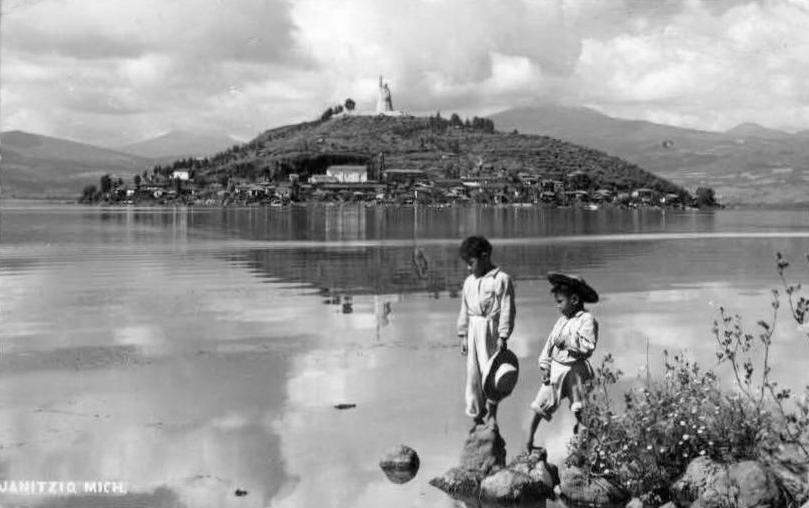
Figure 1.--This is Janitzio, an island in Michoacán State. This is a mountaneous Pacific-coast state which at the time was still not much influenced by the United States. The lake an island was 7,000 feet up in the mountains. The image is undated, but we would guess was taken in the 1930s or 40s in part because it is a black and white postcard.
|
|
This is Janitzio, an island in Michoacán State. This is a mountaneous Pacific-coast state which at the time was still not much influenced by the United States. The lake an island was 7,000 feet up in the mountains. The image is undated, but we would guess was taken in the 1930s or 40s in part because it is a black and white postcard. Lake Pátzcuaro is dotted with islands. It is one of the highest lakes in the country. Around the lakeshore, several Tarasco villages are located, some are only accessible by boat.
Fishing and tourism are the principal occupations. The local fishermen were famous for their traditional "butterfly" nets, but they are now mostly broughout for tourists.
A reader writes, "You said that the picture could have been taken in 30s or 40s. I can vouch that you can add the 50s, 60s or early-70s as well, that is when I visited the island on three occasions. The children were wearing the same white clothes, straw hat, no shoes, as in the postcard here. Some of them couldn't even speak Spanish but their ancient Indian language called Tarasco. The Tarascos were a nation (some say a Chichimec branch) that was never conquered by Cortez or other Conquistadores. Mainly because they allied themselves with the Spaniards. But they were conquered eventually, mainly by smallpox. The lake is called Patzcuaro, which is the name of the city on the banks of the lake were you take the boats to the island. The huge statue on the top is to honor Father Jose M. Morelos, one of the principal leaders of the Mexican War for Independence (1810s). Inside it has a stair and you can climb to a mirador located at the shoulder of the statue. Also inside, is full of the vivid Mexican murals depicting ther life of the revolutionary hero who was from Michoacan. The murals were painted by Ramon Alba de la Canal and others." The white compesino clothes were still fairly wide-spread in Mexico during the 1930s, but by the 70s were mostly found in isolated areas with Native Anerican populations not fully integrated into the national economy.
HBC

Navigate the Boys' Historical Clothing Web Site:
[Return to the Main Mexican 1930s chronology page]
[Return to the Main Mexican 20th century chronology page]
[Return to the Main Mexican chronology page]
[Introduction]
[Activities]
[Biographies]
[Chronology]
[Clothing styles]
[Countries]
[Bibliographies]
[Contributions]
[FAQs]
[Glosario en Español]
[Images]
[Links]
[Registration]
[Boys' Clothing Home]
Navigate the HBC Mexican pages
[Mexican choirs]
[Mexican Scouts]
[Mexican school uniforms]
[Mexican communions]
Navigate the Boys' Historical Clothing national pages:
[Return to the Main Mexican page]
[Return to the Main countries page]
[Australia]
[Belgium]
[England]
[France]
[Germany]
[Ireland]
[Italy]
[Japan]
[Korea]
[Scotland]
[United States]
Created: 9:46 PM 6/9/2011
Last updated: 9:46 PM 6/9/2011