|
"The steppe peoples of history and especially of prehistory are one of our species' great black holes .... ... a yawning void stretched nearly the full width of our super continent and exerting its outsized pull on our development for over five millennia .... These nameless people left no monuments or seminal text .... Instead, we live with their language, their gods and their genes."
-- Razib Khan
Most of us who have studied history beginning the Sumerians and then the Egyptians, Greeks and Romans--people who left behind physical nd written evidence that archeologists could actually find and study. Strangely, some like the Egyptian had little real impact on our modern lives. Pre-history might be mentioned, but was given little attention because it was largely seen as an era beyond the capability to study to any degree--basically lost to history. This has changed with the development of DNA as a historical tool. It has now unlocked aspects of pre-histoy and the findings are fascinating. We now know that a small Steppe people with no written language and leaving no monumental architecture had greater impact on history than most of the stunning ancient civilizations we all read about. This was the Yamnaya-- one of countless small Steppe tribes. As Razib Khan explains, we today five millennia later live with 'their language, their gods and their genes'. Few of us have Sumerian, Egyptian, or Greek genes, but many of us have Yamnaya (Steppe) genes.
Many authors have treated the Yamnaya as a kind of 'pure' people. We note one author who describes them as a mix of three groups of Eastern and Caucasian hunter-gatherers. The genome of the Caucasian hunter-gatherers indicated continuous mixing with neighborliness Middle Eastern groups. The same peoples who began inventing agriculture (about 8,000 BC). The mixing ceased before the peak of the Ice Age (about 25,000 BP). Populations dwindling under the harsh climaric conditions, Their genes homogenized during this period, indicating endogamous mating mating patterns within a more restricted group. Wiyh the end of the Ice Age, these Caucasian tribes gained greater mobility and again eventually contacts with other steppe groups and mixed with another people who had spent the Ice Age in isolation. his lsaid the genetic foundation for the Yamnaya people. 【NIMH】
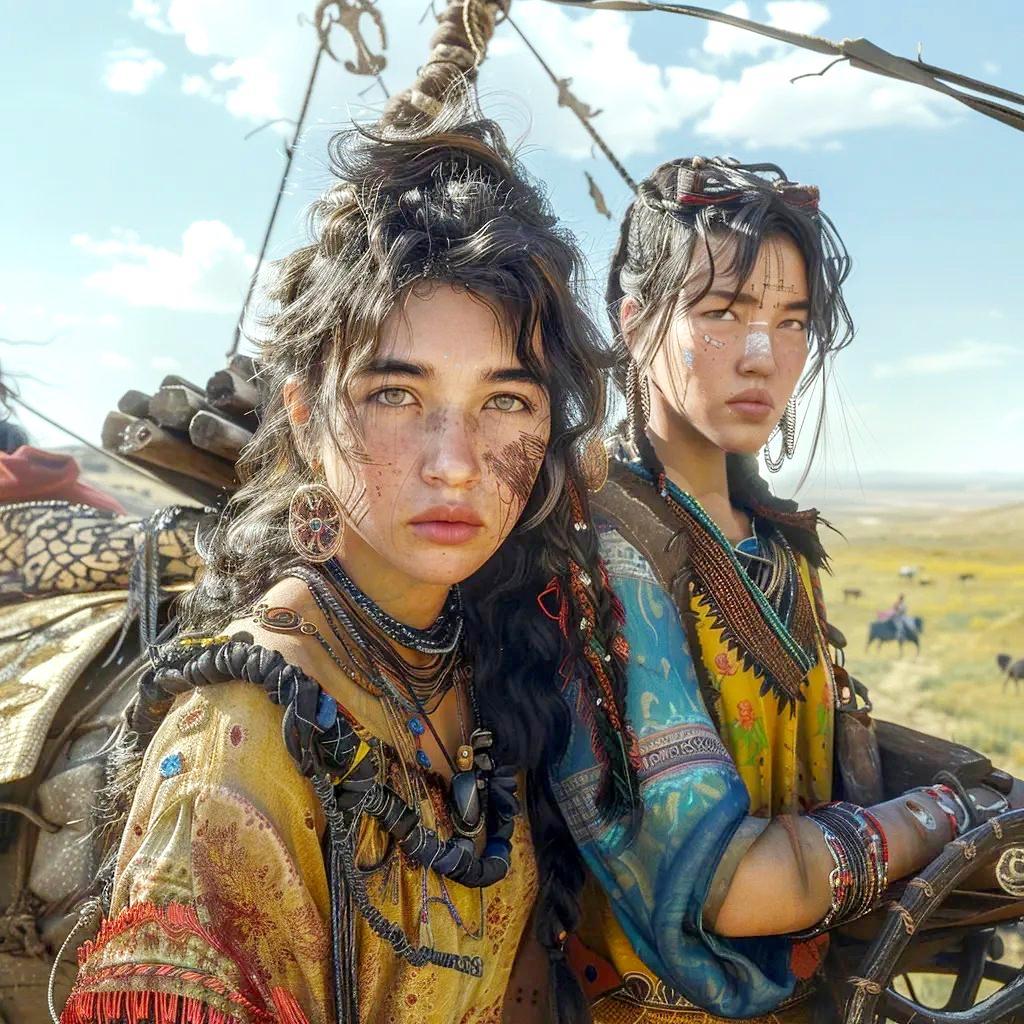
The Yamnaya people (c3300–2600 BC) were a relatively small,
nomadic Bronze Age pastoral society also known as the pit grave culture which appeared in the Pontic-Caspian steppe (modern Ukraine). 【Morgunova and Khokhlova 】 They were nomadic herders who lived on the grasslands of the Eurasian Steppe, raising cattle, sheep, and most notably horses. As a result, they left little physical trace, No cities, no monumental architecture. They were not the first to domesticate the horse. But it was done on the steppe. It may have been done by the Botai people to the east. Nor were they the group which invented the wheel. This apparently occurred by peoples to the west. But the Yamnaya seem to be the first to successfully put the two technologies together. The Yanmaya were renowned for horse riding and wheeled vehicles.
The Yamnaya is a name given to these by academic researchers. It comes from the Russian yama, meaning 'pit' because they buried high ranking individuals in 'kurgans' (earthen burial mounds) along with their tools, weapons, and wagons. Their diet as with other Steppe people was largely pastoral (dairy products (including horse milk) and meat. There was very limed agriculture. We know little about their religion, except their burial rituals in kurgans. We have found their grave goods and use of ochre. This suggests complex beliefs such as ancestor worship and social hierarchy,
This led to migrations into Europe and Asian. Now there are other theories about Indo-Europeans such as a Anatolian agricultural thesis. And the role of the Yamnaya is intensely debated by archeologists. But the Yamnaya thesis seems to be very likely because of rhe spread of patralineal social structures and the now traceable genetic imprint which DNA allows us to study.
Genetic studies shoe that the Cordered Ware culture which pre-dates the Celts and Germanic share a large percentage of DNA . 【Lobell and Powell】 Countries speaking Indo-European languages (both in Europe and Asia) have populations with discernible Steppe traces. shaping modern Eurasian genetics, languages, and social structures. And they were placed at the center of developments to the east and west.
As a result of the domesticated horse and the wheel. The Yamnaya became much more productive. A man could carry say 25-30 lbs during the say. With a wagon he could move 200 lbs. This made a huge difference in economic activity. This meant increased food production. And with he creased food supply, the population soared. The the Yamnaya began to spread, first west and later east. And with horses and wagons, this highly mobile population could spread very fast. Horses also gave them a military advantage. (The same thing occurred in Europe as a result id the Colombian Exchange-especially the introduction of potatoes (16th century).
Hunter gathering people entered Europe (about 37,000 BP). They dominated Europe until the arrival of neolithic Anatolian farmers (7,000 BC). The farmers didn’t at first intermingle much with the scattered hunter-gatherers because they seem to have brought their own families with them. These neolithic farmers were the people who built Stonehenge. There were two main populations know today only by their distinctive pottery styles. The Cordered wear people dominated eastern and Central Europe. The Bell Beaker people what is now France and Iberia. There were hunter-gatherers-fishers, but the bulk of he population were farmers. The expanding Yamnaya swept into Europe on horses and with ox-drawn carts (3,000-2,800 BC). 【Bower】 In only about a century, the Anatolian farming population was gone, replace by the Yamnaya Sreppe population. We do not know just how this happened, but the DNA evidence confirms that it did happen. Until recently all that was known was that languages were replaced in Europe and important in the East. But thanks to advances in genetics, we now know that people were replaced. The neolithic farmers were massively replaced. Just how violent his was is not entirely clear, but it took place within a few generations. Now there cold be various other factors like climate or disease, but violence is very likely. This is bcause it was the male lineages that were wiped out. Neolithic farmer males sopped reproducing. Many females survived, but not the males. As mall number of sexually active steppe males were fathering most of the children. The Yamnaya dominated and would replaced the existing people all the way west to Spain where. Somehow , they had a huge reproduction advantage, giving them essentially an virtually exclusive role in reproduction with indigenous neolithic farming women. 【NIMH】
This suggests a substantial degree of violence. It was slightly less complete in the western Bell Beaker group, but the same general pattern held true. This was an extraordinary event. The Yamnaya with a population of about 0.1 million people replace the European neolithic farmers with a population of some 7 million.
resulting in a massive genetic turnover that replaced approximately 50 percent or more of the existing Neolithic population. There was near-total replacement in some northern and central European areas. This is believed to have been a primarily a male-biased migration. Some experts believe that the steppe horsemen were mostly male who had left their women behind -- 5-14 males for every female intruder. 【Gibbons】 We don't understand why this was. Perhaps the Yamnaya were polygamous and there were many young males outwith wives. The Yamnaya initially mated with members of a eastern European people-- the Globular Amphora Culture. 【Bower】 These early groups are named after their distinctive globe-shaped vessels. The Yamnaya then expanding into northern Europe. The hybrid population adapted rapidly to its new surroundings and formed a dominant culture that archaeologists call the Corded Ware Culture. 【Linderholm, et.al.】 The same occurred to the Bell Beaker people further wet (France and Iberia). The result was, however to shift the European gene pool dramatically, introducing new technologies, and forming the basis for modern European ancestry. Yamnaya ancestry and taller adult heights and lighter skin tones in ancient and modern northern Europeans relative to their more southern counterparts.One of the few places in Europe where this did not occur is the island of Sardinia. Modern Sardinian's thus have the purest modern genetic signature of Europe's vanished neolithic farming population.
The Yamnaya population starburst was at first mostly to the West. There was a small spread due east leading to language isolates in Central Asia that have now disappeared. The important spread east (mostly south and east) came later, leading to the Iranian language families and the Indo-Aryan language families that dominate most of India (except the southern Tamil areas) and Sri Lanka. The arrival of the Yamnaya (herders from the central Eurasian steppe) is one of the three major components of the modern Indian population (1900-1500 BC). 【Price】 The process, howsoever, was different in Iran and India. In the spread east, the Yamnaya did not replace the existing population, but paced themselves at the top of the social structure. We are not sure just why the process was different. This is why today in India, steppe ancestry (DNA) is highest among the higher castes, especially the Bramins. 【TNN】 And Steppe ancestry is lowest among the lower castes, especially the Dalits (untouchables). 【Bamshad et. al.】 Why the Yamnaya did not replace the exiting population. It is in the East (Iran, Afghanistan, Pakistan, India, Bangladesh, and Sri Lanka that the largest numbers of Indio-European language speakers exist. Many of these people do not have high concentration of Steppe ancestry, but they speak Indo-European languages. Bengali for example is an Indo-European language, but Benaglis have low levels of Steppe ancestry. The Out of India hypothesis has been proposed by Indian nationalists, but there is little evidence supporting the idea.
Bamshad, Michael et. al, "Genetic evidence on the origins of Indian caste populations," Genome Research June 2001) Vol. 11, No. 6, pp. 994-1004).
Bower, Bruce. "How ancient herders rewrote northern Europeans’ genetic story, " SciebceNews (January 10, 2024). An international team of researchers describes these results, based on analyses of DNA from more than 1,600 ancient individuals.
Dutchen, Stephanie. "A steppe forward," Harvard Medicine News (March 2, 2015).
Gibbons, Ann. "Thousands of horsemen may have swept into Bronze Age Europe, transforming the local population," Science (February 21, 2017).
Linderholm Ann, et al. "Corded Ware cultural complexity uncovered using genomic and isotopic analysis from south-eastern Poland,"Scientific Rports (April 14, 2020).
Lobell, Jarrett A. and Eric A. Powell. "The story of the horse: How its unique role in human culture transformed history," Archaeology (July/August 2015), pp. 28-33.
Morgunova, Nina and Olga Khokhlova(2013). "Chronology and Periodization of the Pit-Grave Culture in the Area Between the Volga and Ural Rivers Based on 14C Dating and Paleopedological Research". Radiocarbon. (2013) Vol. 55, Nos. 2–3.
NIMH. "The Yamnayas, ancestors of most modern Europeans," RAGE (August 31, 2023
Price, Michsael. Where did India’s people come from? Massive genetic study reveals surprises," Science (March 4. 2024).
TNN. "Mangaluru varsity study shows shared paternal ancestry among Brahmins across India,: The Times of India (August 18, 2025).

Navigate the Children in History Website:
[Return to the main Main Indo-European page]
[Return to the main Main Steppe Crucible page]
[Return to the main Main Mongolian history page]
[Return to the main Main Asian history page]
[Return to the main Main horse page]
[Introduction]
[Biographies]
[Chronology]
[Climatology]
[Clothing]
[Disease and Health]
[Economics]
[Geography]
[History]
[Human Nature]
[Law]
[Nationalism]
[Presidents]
[Religion]
[Royalty]
[Science]
[Social Class]
[Bibliographies]
[Contributions]
[FAQs]
[Glossaries]
[Images]
[Links]
[Registration]
[Tools]
[Children in History Home]
Navigate the Boys' Historical Clothing national pages:
[Albania]
[Austria]
[Bosnia]
[Croatia]
[Hungary]
[Romania]
[Serbia]
[Slovenia]
[Australia]
[Belgium]
[England]
[France]
[Germany]
[Ireland]
[Italy]
[Japan]
[Korea]
[Mexico]
[New Zealand]
[Scotland]
[United States]