
Cold War: Health Care
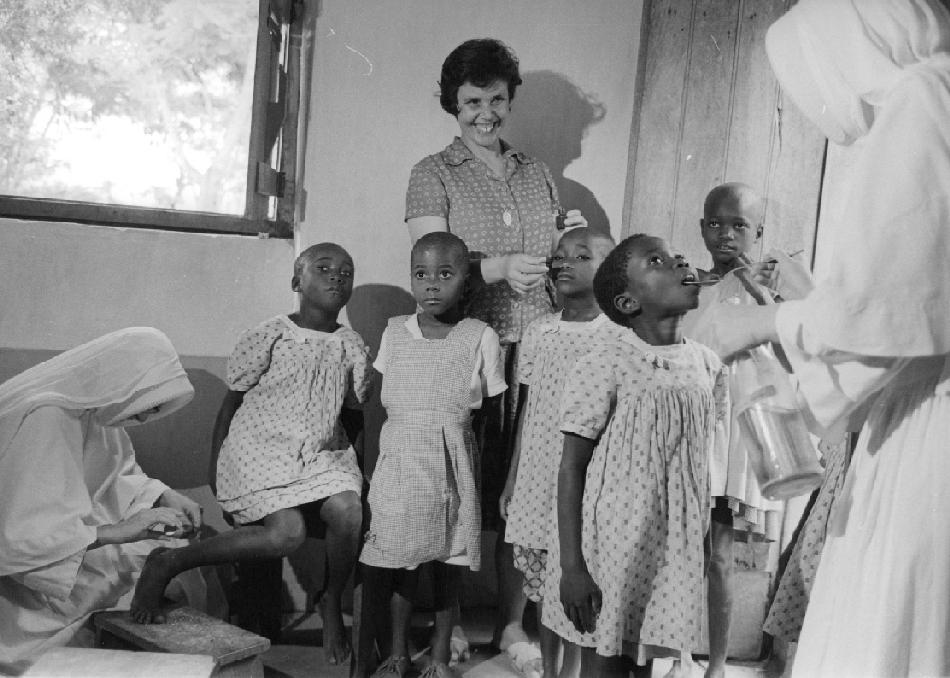
Figure 1.--Here we see Westerners, probably Europeans providing health care servives in Africa. We do not know what country is involved, but the image was dated 1964. The Soviets and Chinese positioned themselves as the champions of the newly independent countries abd decolonization. The Soviet AK-47 even appeared on the flag of Mozambique. What did not appwar at the time was the very poor results reported by Soviet client states and countries pursuing Soviet-styled socialism in areas like food production, ecomomomic growth and health care systems. While perhaps not as dramatic as military campaigns, these were the areas tat actully affected peoples living standars.
|
|
One rarely discussed issue as part of the Cold War is medicine and medical science. Soviet policy was even before World War II was decolonization before the process really began. At the time the soviets has no way to affect developments in the Third world. After World War II it did have that ability. Soviet aid to the new natioms had a strongg military compment, but there were also economic programs. The Soviet Union, for example, helped build an Indian steel industry. The effectivens of Soviet economic assistance is an important topic. Here we want to discuss medical issues. The Soviets did not make an important humanitarian effort in the Third World. This includes food aid as well. But the medical effort is especially interesting. The Soviet Union and than China has the world's largest state healh care systems. And give the massive effort to trian health care professuals, the Soviets and Chinese would seem to have a unique capability to aid Third World countries in this area. But this did not occur. Two factors seem to have been at play here. First, although both the soviets and Chinese had huge medical establishmnts, they created next to noting in the way of medical technology, either pharmecuticals or medical equipment and procedures. The Chinese did have one major achievement. Their victory in the Civil War brought stability to China and the ability to launch a basic, low tech sanitation campaign that paid substntial dividends in public health. Basically the Soviet Union and China rather than dveloping new technology, simply acquired western medical technology to the extent they could afford it. Major achievements , like defeating the childhood scourge of polio were all made in the West. It is interesting that all those who promote socialism andsocialist medicine, nevr mention that most of life saving advances in health sciences come from the private sector and virtually nothing from the state sector, including the massive Spoviet and Chinese Communist health care system. Second, their interest in humanitarian aid suxh as sponsoring clinics and hospitals seems limited. The major exceotion here from Communist countries seems to be Cuba's programsof providing doctors to left-wing African states. This is important because in assessing the impact of the Comminost west and Communism, an important metric is the lives saved by Western technology.
CIH

Navigate the Children in History Website:
[Return to Main Cold War page]
[Return to Main Communism page]
[About Us]
[Introduction]
[Biographies]
[Chronology]
[Climatology]
[Clothing]
[Disease and Health]
[Economics]
[Freedom]
[Geography]
[History]
[Human Nature]
[Law]
[Nationalism]
[Presidents]
[Religion]
[Royalty]
[Science]
[Social Class]
[Bibliographies]
[Contributions]
[FAQs]
[Glossaries]
[Images]
[Links]
[Registration]
[Tools]
[Children in History Home]
Created: 2:55 PM 1/28/2016
Last updated: 2:55 PM 1/28/2016