|
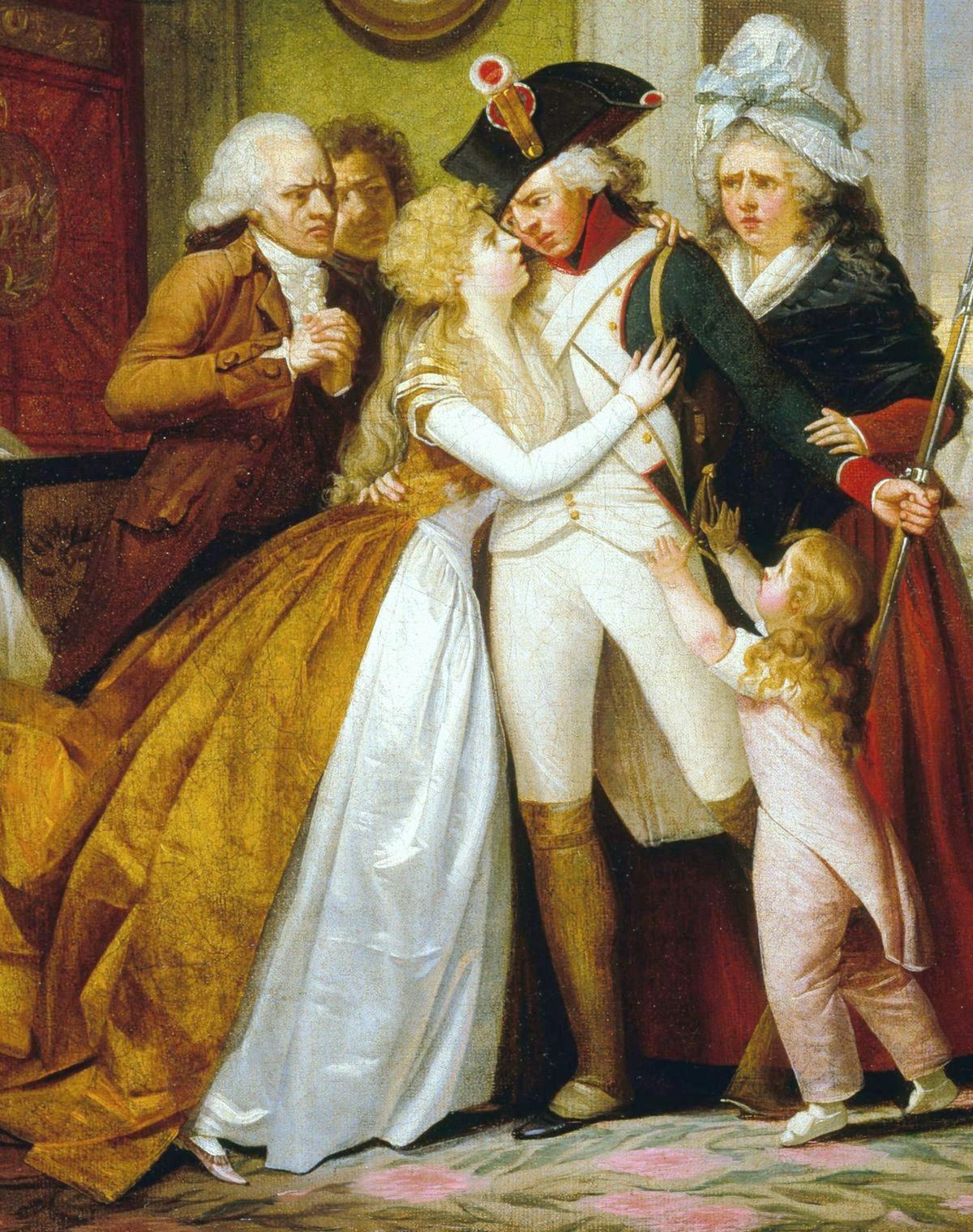
Any discussion of the French Revolution, needs to address two very different French armies. The first was the royal army. European armies at the time were not national armies. They were royal armies. Soldiers swore an oath of loyalty to the monarchy. With few exceptions, Europe was ruled by monarchies. The question thus arises, why did the Royal French Army not suppress the Paris mob that launched the Revolution? The Parisian mob which launched the Revolution did mot have access to arms. In the millennium and half following the fall of Rome, mobs did not overcome monarchic rule guarded by well-armed, professional soldiers. But the Royal Army did not form up to crush the Revolution. And a huge army was not needed. Napoleon would latter defeat a mob with as he put it, a whiff of grape shot'. The second army was the French Revolutionary Army, This was a citizen-based, mass army that shattered the ancien régime and played a decisive role in both defending and spreading revolutionary ideals throughout Europe. By the time that European monarchies intervened, the French Revolutionary Army was no undisciplined, unarmed mob. European military doctrine was fundamentally changed. And the ideas of the Enlightenment were firmly embedded in European thinking as well as a relatively new idea--nationalism. The French would eventually be defeated, but Europe would never be the same again. France was formidable because of its rich soil and mild climate--ideal for agriculture. And until the 19th century, agricultgure was these priomry bis for European econoimies. Louis XIV's French Armies proved a force to be reckoned with (17th century), squiring multi-national alliances to stop him. Most notably the Duke of Marlborough at Blenheim (1704). Even before Napoleon, France's news citizen armies proved formidable. Royal armies were composed of subjects. The French Revolutionry armies were composed of citizens. With Napoleon's military genius, French armies proved unstoppable. The only real barriers were the English Channel and the vast, frozen eastern tracts of Russia.
The first French army that needs to be addressed is the royal army. European armies at the time were not national armies. They were royal armies. Soldiers swore an oath of loyalty to the monarchy. With few exceptions, Europe was ruled by monarchies. The question thus arises, why did the Royal French Army not suppress the Paris mob that launched the Revolution? The Parisian mob which launched the Revolution did mot have access to arms. In the millennium and half following the fall of Rome, mobs did not overcome monarchic rule guarded by well-armed, professional soldiers. But the Royal Army did not form up to crush the Revolution. And a huge army was not needed. Napoleon would latter defeat a mob with as he put it, a whiff of grape shot'. The The French Army at the time of the Revolution was not the famed French Army. Support for the Amerivan Revolutio had incurred substantial debts. And French fimnaces were on shaky grounds to begin wih. The nobility was exempt from taxation--meaning a large part of the economy could not be taxed. Nothing like the sound finances and soid grounding of Brtish finances. ecause, by the time the monarchy faced serious challenges, it was disorganized, depleted, and increasingly aligned with revolutionary ideals. The Ancien Régime army, like other Euroopean armies, were relatively small, professional force. There was royalist sentiment, but there was alko support for the revolutionries. The officer corps was rawn from the airisicracy. There were also foreign regiments. It was not a mass conscript army. That wold be an innovation of the Revolution. Loyalty was devotion to yhe King or whoever paid the soldiers Reddit. But the impending bankruptsy of the momarchy meant many regiments were understrength. The need for new taxes is why King Louis convened the Estates General. Some regiments had been disbanded. The Royal Army lacked the manpower to deal with the combination of foreign invasion and armed uprising. A major complicastion was that the Royal Family was in the hands of the Revolutionaries. The Royal Family's Flight to Varennes (June 1791) was a turning point in the Revolution. When the King tried to flee and filed, royalist officers also began fleeing. This left the Royal Army wihout ,uch of its ledership and moale imploded. This meant that the remining force was gutted. Many officers had been exposed to Enlightenment ideas. Service in the Amerian Revolution also impacted the outlook of officers. As aresult, some officers sympathized with the Revolution And as events unfolded, he offiver corps became increasingly radicalized. Gradually The Revolutionary Army that from the Royal Army was increasingly caught up in revolutionary fervor. This was important becuse foreign intervention began wih the First Colion (1792). This meant that the Revolutionary Army was formed to defend the France from foreign invaion. Even the emining royalist generals like Dumouriez had to fight foreign enemies rather than march on Paris to free the King. The King’s attempts to rally the Army, especialkly the Flight to Varennes failed and elicited no support from the Army. The Royal Army failed to suppress the Revolution. It was too small and support for the King was compromised by defections and revolutionary supportt. By the time foreign armies inervened (1792), ikt was was committed to defending the Republic. There would be no counter-revolution.
The second French army that needs to be addressed is the French Revolutionary Army, This was a citizen-based, mass army that shattered the ancien régime and played a decisive role in both defending and spreading revolutionary ideals throughout Europe. By the time that European monarchies intervened, the French Revolutionary Army was no undisciplined, unarmed mob. European military doctrine was fundamentally changed. And the ideas of the Enlightenment were firmly embedded in European thinking as well as a relatively new idea--nationalism. The French would eventually be defeated, but Europe would never be the same again. France was formidable because of its rich soil and mild climate--ideal for agriculture. And until the 19th century, agricultgure was these priomry bis for European econoimies. Louis XIV's French Armies proved a force to be reckoned with (17th century), squiring multi-national alliances to stop him. Most notably the Duke of Marlborough at Blenheim (1704). Even before Napoleon, France's news citizen armies proved formidable. Royal armies were composed of subjects. The French Revolutionry armies were composed of citizens. With Napoleon's military genius, French armies proved unstoppable. The only real barriers were the English Channel and the vast, frozen eastern tracts of Russia. The French Revolutionary Army emerged out of old Royal Army as France transitioned from the monarchy to the new republic. Revolutionary leaders already questioned the King's loylty. The Flight to Varennes cinfirmed their suspions (June 1791). Austria and Prussua responded with the eclaration of Pillnitz announcing their intention to restore the monarchy in France (August 1791). hi lead to the First Coalition. A fighting began on the frontier, the siuation deterioated for the Royal Family. The War of the First Coalitioin began (April 1792). The King was accused of treason. Following the execution of tghe King (January 1793). Revolutionary leaders restructured the Army to align with revolutionary values. esoecially Liberty, Equality, and Fraternity. Much of aristocratic officer corps were repolaced with younger, often indexperienced officers, Even sympetheric royal officers were suspected. Royal officers emigrated or were executed during the Reign of Terror (1791–94). While much of the offier corps defected. The trained, ordinary soldirs remained in place and mostly boyal to the republic.
The Revolutionary Army was at first divided on a regional basis: the Army of the North, Army of the Center, Army of the Rhine, and Army of the South. There were additionl domestic formations , especially the Army of the Interior to protect Paris. These armies were eventully reorganized into units called demibrigades, combining citizen-soldiers with the professional from the Royal Army. Officers in the Royal Army were aristoicrats. Officers in the new Revolutionary Army were often elected or appointed based on merit, and as fighting unfolded on battlefield performance. The Revolutionary Army placed an emphasis on talent over social status. The Army
relied heavily on mass mobilization. The National Convention called for 300,000 soldiers, and the levée en masse required all able-bodied, unmarried men aged 18–25 to serve (1793). TYHis created a much larger army that the armies invading. Early defeatswere dollowed by glortious victopries as hge Army gained experince.
The Army served as a 'school for the republic', instilling revolutionary ideals among men and promoted egalitarian practices of the Revolution. The professional invading armies were shocked. They expected to faced disorganized bobs rather than a powerful fighting force. They had mo idea what a vast citizen army merged with whatwas left of the professional royal would mean on the battkefield. The aoldiers developed a sense of patriotic duty and revolutionary zeal that was unmatched at the time. The National Assembly supported the sokdiers at hime with subsidies for families and generous veterans’ benefits, furher reinforcing morale and loyalty. Napoleon proclamation of the French Empire (1804). The Revolutionary Army evolved into his Imperial Army. Its innovations in mass mobilization, merit-based promotion, and citizen-soldiers became the basis of modern military organization. One of history's great militry commanders was thus fifted the finest army in Europe.

Navigate the Children in History Website:
[Return to Main French Revolution page]
[Introduction]
[Animals]
[Biographies]
[Chronology]
[Climatology]
[Clothing]
[Disease and Health]
[Economics]
[Ethnicity]
[Geography]
[History]
[Human Nature]
[Law]
[Nationalism]
[Presidents]
[Religion]
[Royalty]
[Science]
[Social Class]
[Bibliographies]
[Contributions]
[FAQs]
[Glossaries]
[Images]
[Links]
[Registration]
[Tools]
[Children in History Home]