|
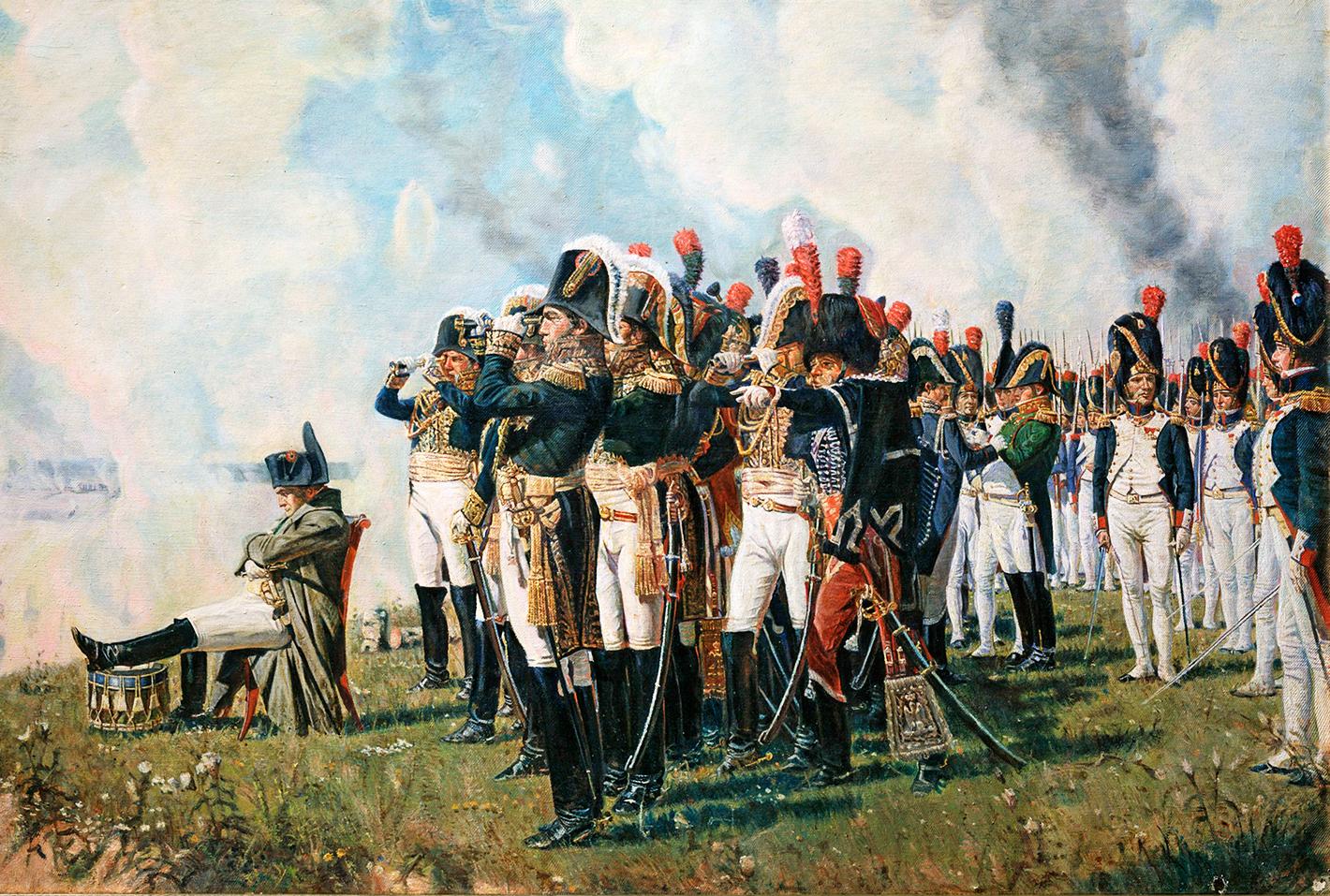
Throughout his meteoric career, Napoleon appointed 26 military Marshals in total, although no more than 20 held the title at any one time. These were basically his most experienced generals, often corps commanders. The corps system was part of his military structure that helped win so many of his battles. Napoleon established the French Empire and with it he brought back the title of Marshal of France (1804). The aristocratic rank dating back to feudal rimes had been abolished by the National Convention (1793). The title of Marshal of France was officially a civilian appointment but best remembered as a military status during the Napoleonic Wars. It was not a rank, but a reward given to his most experienced and successful generals -- not necessarily his closest associates. . It was a great honor to become a Marshal of France and the men who obtained this honor received great rewards and privileges. A Marshal was seen a grand officer of the Napoleon's Empire, giving them a high position at the court and to the presidency of an electoral college. Nappoleon wanted to reward and ensure the loyalty of the generals to his empire. Interestingly, while the rank and file French soldier adored the Emperor. he marshals not so much. Napoleon did not promote sycophants. A true so of the Enlightenment--Napoleon rewarded talent. He had a fundamental belief in meritocracy which is why he was so hated by the aristocratic rulers of Europe. Like Napoleon, the Marshals were a group of highly talented officers, but would have never risen very high under the Ancien Régime. They were a remarkably diverse group, having very little in common, They included scholars and virtual illiterates. The only major characteristic they had in common was virtually insane bravery. And they paid for it, most were wounded several times. The Napoleonic wars were fought very differently than he wars of the 20th century. World War I generals might lead their men from comfortable chateaus safely well behind the front line. Successful Napoleonic commanders because of the limits of battlefield communications led from the front. And this was where the Napoleonic Marshals could be found in the heat of battle. And their flamboyant uniforms left no doubt who they were. Napoleon commissioned a series of paintings his Marshals for the Hall of the Marshals ( salon des Maréchaux) in the Palais des Tuileries. Many of the these portraits survived Napoleon's fall and can be viewed in museums around the world. Others are held in private collections.
The Riksdag formulated a new constitution and elected Gustavus IV's uncle as King Charles XII. The Constitution of 1809, which was in force right up until 1975 and then was the second oldest Constitution in the world after the United States, was formulated in accordance with Montesquieu's theory of the separation of powers, taking into account constitutional developments in Sweden. The King was to be the sole ruler of the realm, but had at his side a Council of Ministers, who must countersign, i.e. approve, all decisions. Legislative power was divided equally between the King and the Riksdag, while the Riksdag alone could levy taxes.Territory was ceded to Russia and a pro-Napoleonic policy adopted. Charles was, however, aging and childless. A successor to the throne had to be found. First, the Danish prince, Karl August of Augustenborg, was chosen, but he died shortly after his arrival in Sweden. In an effort to appease Napoleon, the Riksdag chose one of Napoleon's trusted marshals as crown prince--Jean Baptiste Jules Bernadotte, Prince of Pontecorvo. The marshal accepted. One of the reasons for chosing Prince Bernadotte was a desire for an alliance with France and Napoleon in the hope of gaining the latter's support for winning Finland back from Russia. After his arrival in Sweden, Prince Bernadotte soon became the dominate force in Sweden, in reality Regent of the Realm. In 1812, he initiated quite a different policy, joined the coalition against Napoleon and in the Kiel peace treaty won Norway from Denmark and after a short campaign forced Norway to enter into a union with Sweden in 1814. This union was not dissolved until 1905.
Louis-Alexandre Berthier, Prince de Neuchâtel et Valangin/Prince de Wagram was a French military commander who served during the French Revolutionary Wars and the Napoleonic Wars. He was surely Napoleon's most valuavle associate. He was twice Minister of War of France and was made a Marshal of the Empire (1804). Berthier served as Napoleon's chief of staff from his first Italian campaign (1796) until his first abdication (1814). The operational efficiency of the Grande Armée was in no small part due to his considerable administrative and organizational skills. It was Berthier that nanaged the complex logistics od rapidly moving tghe Army from the Channel to Austerlitz--Napoleon's greatest victory. He died in unexplined circumstances just before Waterloo.
Henri-Jacques-Guillaume Clarke, 1st comte d'Hunebourg, 1st duc de Feltre (1765-1818), was a French military officer, diplomat, and politician. He served as Minister of War of the First French Empire (1807-14). Such an appointment over an extnded period must have meant that he was very close to Napoleon. He was interstingly made a Marshal of France during the Burbon restortaion (1816). Of course the very English/Irish name stands out. Clarke was born in Landrecies, northern France (1765). His parents were Irish from Lisdowney, County Kilkenny. We do not have family detils, but presumably thery fled Ireland because of oppresive British policies. Clarke strongly retained his Irish identity. He was one of the most influential and charismatic Franco-Irish generals in the French army during the Napoleonic Wars. The family is known to have hasd close links to the Irish Brigade in the French Army. His father served in Dillon's Regiment, and his mother's father and several uncles served in Clare's Regiment. Clarke married twice. His first wife was Elisabeth Christiane Alexander who was born in London (1768)). How the two met and when they marrie we doi not know. They seemed to hve married about 1788, just before the Revolution in France. Clarke at the time was a French Army officer ho made the transition from the royal Bourvon Army to the Revolutionary Army.
Joachim Murat was perhaps Napoleon's most dashing cavalry commanders. He was born (1767). Murat joined the French royal army just beforfe the Revolution as a mere cavalry trooper when he was only 20 years old. He first saw the rising General Napoleon Bonaparte when he was involved in the suppression of the Vendemaire coup. It was in Italy that Napoleon became a phenomenon. Winning promotion, Murat joined Bonaparte in Italy and was involved in the figting at Tagliamento (1796). Napoleon next conducted his Egyptian campaign. During the fighting, Napoleon awarded Murat a battlefield promotion to general of brigade. Murat commanded the French cavalry at Marengo to great affect in the defeat of the Austrians (1800). Marengo and successive events gave Napoleon control of Italy. Murat's skill and dash won him the admiration of the Emperor who by this time looked on him as one of his most trusted generals.
Michel Ney was one of Napoleon's great marshals. He cam from himble origins. His father was a coper. He was born in Sarrelouis, Moselle (1769). He joined a hussar (light cavalry) regiment as a teenager just before the Revolution (1787). His elan and personality combinind with skills as a horseman and fencing won him quick promotions.
Marshal Ney was known as the 'Bravest of the Brave' which is evidenced by his many wounds and injuries. There was never a question about his courage, but caution and reflection is a different matter. His temperment and inclination to attack commitment to the often overcame sound military thinking. He had a well-established military reputation before the rise of Napoleon--becoming a General of the Revolution. He than was an important commander for Napoleon at Neerwinden, Mainz, Mannheim, Winterthur, Hohenlinden, Elchingen, Jena, Eylau, Friedland, Bussaco, Smolensk, Borodino, Beresina, Weissenfels, Lutzen, Bautzen, Dennewitz, Leipzig. Napoleon made him a prince of the Empire--Prince de la Moscowa. At the end of Napolon's campahigns after the disaster in Russia (1812) and failed German campaign (1813), his relationship with the Emperor became strained. He was one of the French commanders who urged Napoleon to abdicate. He then joined the service of the restored Bourbons. He switched sides again to join Napoleon for the climatic Hundred Days' Campaign. Many militry historians believe that he made major mistakes at Quatre Bras which upset the Emperor's strategic plan, leading to final debacle at Waterloo. After Waterloo and the Emperor's exile to St. Helena, Ney was tried to treason bu the again restored Bourbons. He was found guilty and sentenced to death. He was executed December 7, 1815.

Navigate the Children in History Website:
[Return to Main Napoleonic war page]
[Return to Main Napoleonic War naval page]
[Return to Main decisive battle page]
[Return to Main Royal Navy page]
[About Us]
[Introduction]
[Biographies]
[Chronology]
[Climatology]
[Clothing]
[Disease and Health]
[Economics]
[Freedom]
[Geography]
[History]
[Human Nature]
[Ideology]
[Law]
[Nationalism]
[Presidents]
[Religion]
[Royalty]
[Science]
[Social Class]
[Bibliographies]
[Contributions]
[FAQs]
[Glossaries]
[Images]
[Links]
[Registration]
[Tools]
[Children in History Home]