|
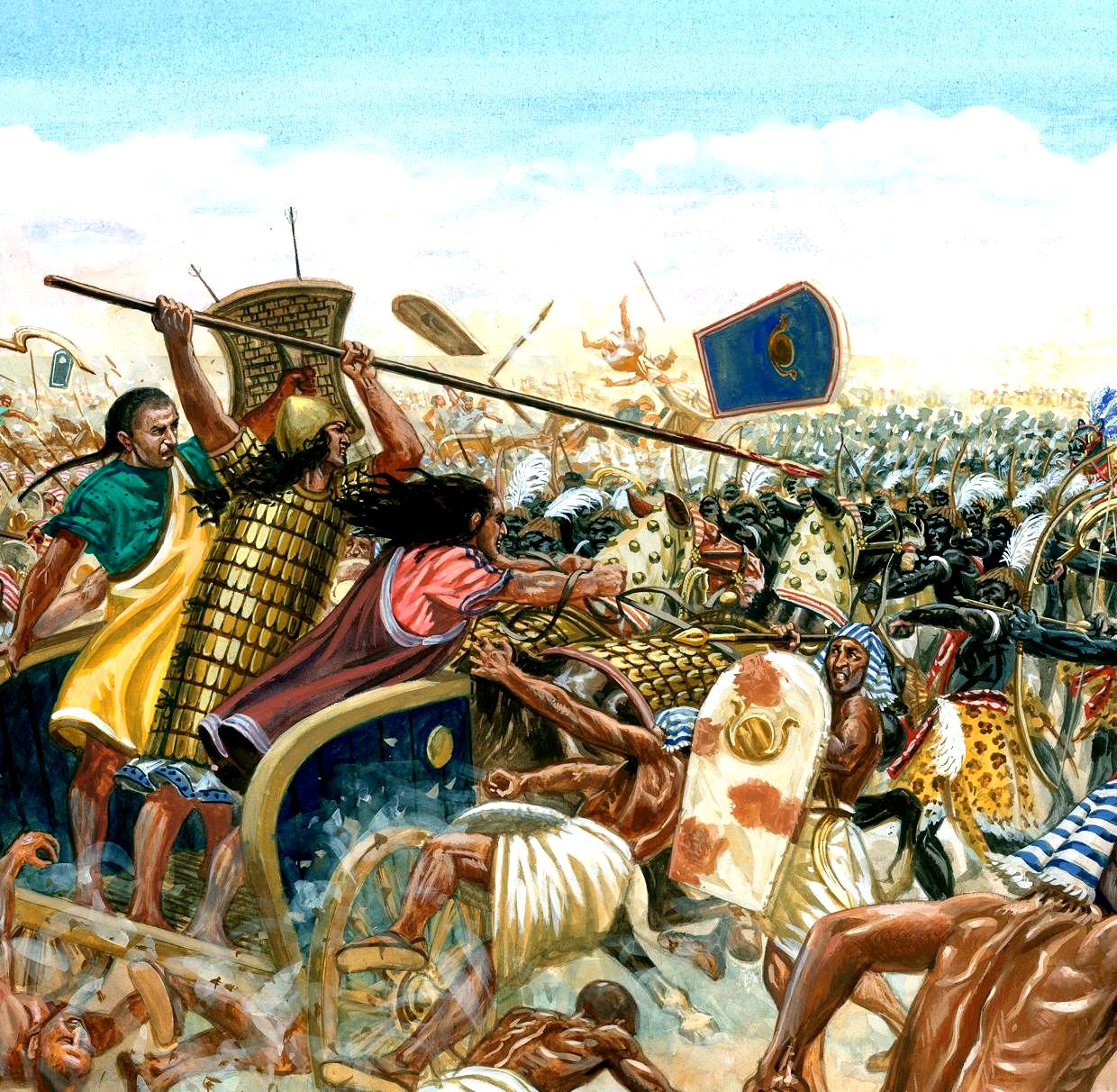
Qadesh is a battle of considerable importance because it is the first battle for which historians have a detailed account. It was also a very sizeable battle, as far as we know the greatest battle ever fought up to date and the ultimate chariot battle. The rising Hittite Empire was contesting the New Kingdom's Egyptian dominance and control of trade routes in what is now Syria. The two armies had the most modern weapons of thee day, swords, axes, and composite (wood, horn, sinew) bows. Metallurgists had developed highly effective bronze weapons. The Hittites favored straight swords, the Egyptians curved swords. Chariots were the mainstay of Middle Eastern armies at the time. Wall carvings show chariots being mass produced. Each side had distinctive chariots. The three-man Hittite chariots were stronger, but slower and less maneuverable. The two-men Egyptian chariots were faster and more maneuverable. Both side deployed fleets of chariots. And Qadesh was perhaps the greatest chariot battle of all time. Pharaoh Ramesses II rose to the throne upon the death of his father Seti I (1279 BC). Ramses was a valiant war commander. He had campaigned as crown prince with his father in Syria. He was determined to be a great pharaoh. Qadesh was a city strategically located along important trade routes on the border between the Hittite Empire and Egypt. Seti had conquered Qadesh, but it was later lost to the Hittites. Ramses was determined to retake the city and amassed an army of four corps, each with about 5,000 men. Ramses made no secret of his plans so the Hittite king, Muwatallish, gathered an even larger army to meet him. Muwatallish had 2,500 chariots and 40,000 infantry. Both armies fought with spears, swords, and bows. The Iron Age had begun, but both armies fought with mostly bronze weapons. Qadesh involved a 1,000 mile march of about a month for the Egyptians. Ramesses II moved north with the lead Amun corps. The other three corps were strung out on the desert behind him. As Ramses neared Qadesh, Bedouins in the service of the Hittites mislead him about the location of the Hittite army. He thus moves forward toward the city without waiting for the rest of his army. It was a terrible mistake. Ramses soon found himself northwest of Qadesh facing the entire Hittite army with only one of his corps. The Hittites were in battle order prepared to attack. Ramses sent messenger to the closest corps--the Re Corps. They rushed forward to join the Pharaoh, but Muwatallish had anticipated this move and attacked with his chariots and decimate the Re corps infantry. The Re corps chariots who were moving ahead of the infantry joined the Pharaoh and warned him that the Hittites were attacking. The Hittite chariots after destroying the Re Corps, turned north and attacked Ramesses' camp. Here accounts vary. Some maintain that the Amun corps infantry panicked and ran. Other sources say that Amun bowmen inflicted heavily casualties. The Hittite attack also appears to have been broken up by the tents and baggage in Ramses camp. They also appear to have been detracted by booty. Ramses although heavily outnumbered decided to use his numerically inferior chariot force to attack. Muwatallish seeing his first attack had failed, committed the rest of his chariot force. Just as the two forces are about to clash. the Ne'arin, the elite troops that had taken the coastal road arrive on the battlefield and caught the Hittites by surprise. Large numbers of Hittite soldiers were killed and their army had to withdraw north of the Orontes River. The huge Hittite infantry force which outnumbered the Egyptians more than two to one was never committed to the battle. With his chariot force largely destoyed, Muwatallish decided to break off combat. The two largely undefeated forced faced each other across the Orontes River, but did not resume combat. Ramses returned to Egypt and declared what seems to have been a stand off a great victory and depictions of that victory were emblazoned on the temples and palaces he had built. Later a peace treaty was negotiated with the Hittites to present a united front against the Assyrians. Surviving stone copies have been found in both Egypt and Turkey. Many historians consider this to be the oldest recorded peace treaty in history. Ramses married two Hittite princes. The reason we know about this battle is that it was described and depicted in great detail in monuments to Ramses, especially his great temple, the Ramsesium, in Luxor. The battle takes on even greater importance when it is considered that if Ramses had lost, the Hittites would have extended their empire south into Syria and Palestine and threatened Egypt itself. This means that the Jews would have come under Hittite influence. Important parts of the Bible concern the relationship between the Jews and Egypt. Given the influence of the Jews on Western civilization and Christianity, this development could have had very significant consequences.

Navigate the Children in History Website:
[Return to Main decisive battles of ancient histoty page]
[Return to Main decisive battles of history page]
[Return to Main military style page]
[Return to Main ancient civilization page]
[Introduction]
[Biographies]
[Chronology]
[Climatology]
[Clothing]
[Disease and Health]
[Economics]
[Geography]
[History]
[Human Nature]
[Law]
[Nationalism]
[Presidents]
[Religion]
[Royalty]
[Science]
[Social Class]
[Bibliographies]
[Contributions]
[FAQs]
[Glossaries]
[Images]
[Links]
[Registration]
[Tools]
[Children in History Home]