|
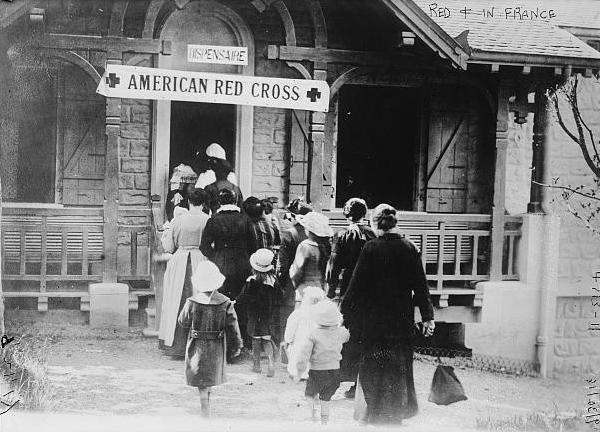
France's rich agricultural sector helped feed the country during World War I. France had industry, by it was more agricultural than either Britain or Germany. Like other countries, however, food production declined. France conscripted agricultural workers and had to feed a huge army, meaning unproductive workers. Thus France was not in a position to provide the massive food supplies needed by the 2 million refugees, both Belgians and the population of northern France. Homes and other facilities were opened throughout France for the refugees. America was in position to help. The American Commission for Relief in Belgium (CRB) also coordinated relief in northern France after 1915. This included both the Belgian and French refugees. The German invasion of northern France affected industrial production, but had less of an impact on agriculture. Private American ($3.6 billion) and British ($3 billion) war loans enabled France to maintain military production and import food. With American entry into the war, American food, money and raw materials flowed into France (1917). And the U.S. Government provided loans to support France. There was a very important program organized by the American Red Cross to aid Picarrdy, a badly damaged are of northern France. It grew out of the Committee for Devastated France. The most important relief organization of World War I would prove to be the American Red Cross (ARC). The Red Cross vegan in Europe as an organization to assist soldiers in war time (1863). In the generally more peaceful United States ,it developed as a relief organization to assist people caught up in national disasters (1881). When World War I broke out, there was an effort to send American Red Cross nurses to France (1914). This failed because of America's neutral status. Several non-governmental organizations got in involved in relief efforts, but not the American Red Cross. This changed when the United States declared war on Germany (1917). The primary effort during the War was to aid the soldiers of the AEF deployed to France, but once there the ARC because of the huge need, tha ARC got involved in relief efforts. One source describes the work, "The American Red Cross stepped back from their previous policy of neutrality, working alongside the United States Army Nurse Corps in ARC Military Hospitals, designed to only aid U.S. soldiers. ARC Convalescent Homes and ARC Hospitals were not limited to American soldiers but were dedicated only to Allied Forces. The ARC
also operated centers of relief for the French public. From 1917 to 1920, nurses and volunteers of the American Red Cross worked tirelessly to support the Allied cause, further aiding in the rebuilding of France and the Allied victory in World War I." 【Brown】 Activities included: Educational programs for women, supporting orphanages, War refugee programs, and health programs. During the War, American governmental relief efforts was limited to France and Italy. Geography meant that it was difficult if not impossible to get relief supplies to other countries impacted by te War that were occupied by the Central Powers or located east of the Central Powers. The work in France prepared the ARC to organize relief efforts in impacted countries after the War. No other U.S. Government or international agency was prepared to conduct the huge effort to prevent an horrific famine after the War. Non-governmental organizations aiding France included: American Committee for Devastated France, Smith College Relief Unit, American Society for the Relief of French War Orphans, and the Fatherless Children of France.
Brown, Lillian. "Carrying the flag in Europe: The American Red Cross in France during World War I," (https://digitalcommons.liberty.edu, undated). Lillian Brown

Navigate the CIH World War I Section:
[Return to the Main French World War I Home Front page]
[Return to the Main American World War I Relief Efforts: Country trends page]
[Return to Main AEF page]
[About Us]
[Aftermath]
[Alliances]
[Animals]
[Armistace]
[Biographies]
[Causes]
[Campaigns]
[Casualties]
[Children]
[Countries]
[Declaration of war]
[Deciding factors]
-------[Diplomacy]
[Economics]
-------[Geo-political crisis]
[Home front]
[Intelligence]
[Military forces]
[Neutrality]
[Pacifism]
[People]
[Peace treaties]
[Propaganda]
[POWs]
[Russian Revolution]
[Terrorism]
[Trench warfare]
[Weaponry]
[Bibliographies]
[Contributions]
[FAQs]
[Images]
[Links]
[Registration]
[Registration]
[Search]
[Tools]
[Return to Main World War I page]
[Return to Main war essay page]
[Return to CIH Home page]