|
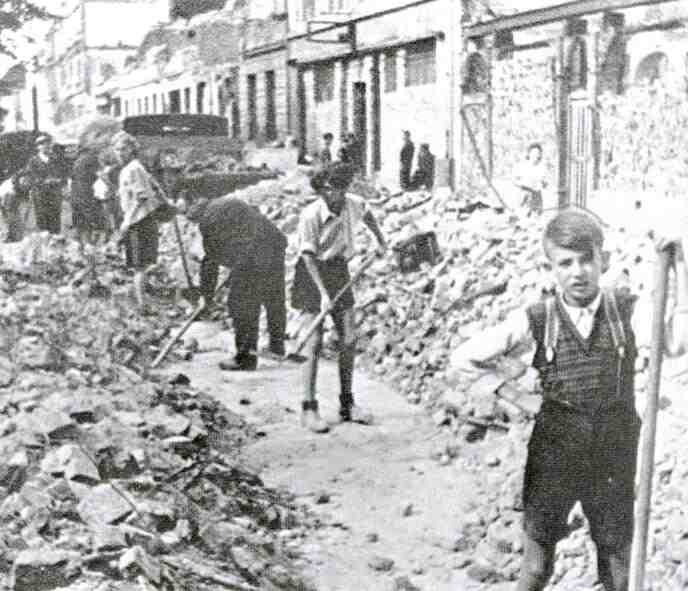
e historians and other commentators who try to lessen the impact of the strategic bombing campaign. Even insightfulg Geo-political commentators like Peter Zeihan make comments like, "Germany endured 6 years of bombing and production did not crack." 【Zeihan】 This simply was not the case. British Allied bombing during the first 2 years of the War was ineffectual. Af fist Bomber Command had difficulty finding cities. Only when Bomber Command acquired the long range Avro Lancasters did really effective bombing begin and in 1942 there were still too few heavies to really make a dent in German war production. The Americans joined the campaign (1943), but limited numbers of long-range heavy bombers and serious losses limited the campaign. This changed with Big Week (February 1944), when American P-51 escorts essentially destroyed the Luftwaffe, but Gen. Eisenhower immediately pulled the bombers back to prepare for D-Day. So Reich cities were for the most part spared for a time from the full impact of the Allied strategic bomber force. If the July Bomb Plot had succeeded, much of the destruction of German cities could have been avoided. 【von Beyme】 Operation Cobra using the heavy bombers blasted a hole in the German lines that launched the Allied breakout from Normandy (July 25-31, 1944). Bomber Command and the Eighth Air Force did not get control back until well after the Normandy break out (September 1944). This is when the strategic bombing of Germany bean in earnest. And the results were devastating. In only two months, German war production plummeted. Up until now. German cities were damaged, some such as Cologne and Hamburg. heavily damaged. Now Reich cities began to be destroyed. It was always the cities that would be the target of strategic bombing. The World War I German bombing of Britain hit the cities, including London. After Poland surrendered (October 1939), Hitler staged a victory parade through devastated Warsaw and made it clear to the assembled press corps that this is what he would do to the cities of any country that resisted his will. The British bombing at night had no option, but to bomb cities. The American daylight campaign had more refined targets, but they all meant hitting cities. 【Hansell】 And the targeting technology of World War II bombing meant that the Americans left much the same result. German cities were destroyed by the resumed campaign following D-Day. Much of the resulting destruction of German cities occurred during the resumed Strategic Bombing Campaign (September 1944-April 1945). Bomber losses had declined with 1) the destruction of the Luftwaffe and 2) shifting to targets in France. And American and British aircraft plants were at peak production capacity. There were no longer shortages of men and aircraft, The Allied bomber commanders unleashed a massive armada of heavy bombers on now lightly defended German cities. In only 8 months, the industrial cities of Germany were virtually leveled. RAF night bombing meant that specific targets could not be targeted, but only cities. The American bombers tried to target specific targets, but limitations in bombing technology meant that most bombs fell on areas of cities that were not targeted. German cities were virtually leveled, left massive piles of rubble. This was especially true of Berlin which was the capital of the NAZI Reich and was especially targeted by both the British and Americans. All important industrial cities were heavily attacked. Factories in the days before workers could afford cars were normally located in city centers. Thus the idustril city centers were obliterated. The available tatutucal data is staggering. The Allied strategic bombing campaign and ground combat caused catastrophic destruction to German cities, leaving an average of 40 percent of the total housing stock across larger cities completely ruined and over 70 percent of the core urban areas of the largest cities entirely destroyed. By the end of the war, 45 out of Germany's 60 largest cities were left in ruins. 【Jascobs】 Smaller cities were also devastated. Nuremberg was also destroyed, presumably because it was the symbolic symbol of NAZI Germany. It was here that the annual NAZI Party Congress was held, with parades by the Hitler Youth and other NAZI organizations. These were the ceremonies vividly recorded in 'Triumph of the Will'. A GI tells us, "What I really remember is the utter destruction of the German cities. I remember driving through Nuremberg with my Jeep and it was one lane only and it wasn't straight." 【Bill】
Bill. Unfortunatly we have lost the full citation.
Jacobs, Frank. "The horrors of World War II air war, in one stark map," bigthink.com (February 23, 2023).
Hansell. Haywood S. Jr. The Air Pplan that Defeated Hitker (Higgins-McArthue/Loggino& Porter: Atlanta, Georgia, 1972), 317p.
von Beyme, Klaus.
Zeihan, Peter. Peter has made so many beief YouTune spots that we have forgotton the specific ome, but he was fisussing the Ameican 226 air camapign against Iran.

Navigate the Children in History Website:
[Return to Renewed bpmbing campaign]
[Return to Main World War II air campaign war essay page]
[Return to Main World War II page]
[About Us]
[Introduction]
[Biographies]
[Chronology]
[Clothing]
[Disease and Health]
[Economics]
[Environmental issues]
[Feminism]
[Geography]
[History]
[Human Nature]
[Law]
[Nationalism]
[Presidents]
[Religion]
[Royalty]
[Science]
[Social Class]
[Bibliographies]
[Contributions]
[FAQs]
[Glossaries]
[Images]
[Index]
[Links]
[Registration]
[Search]
[Tools]
[Children in History Home]