
Ladybird Achievement Books: Clothing and Costume--The Late Victorian Era (1890s)
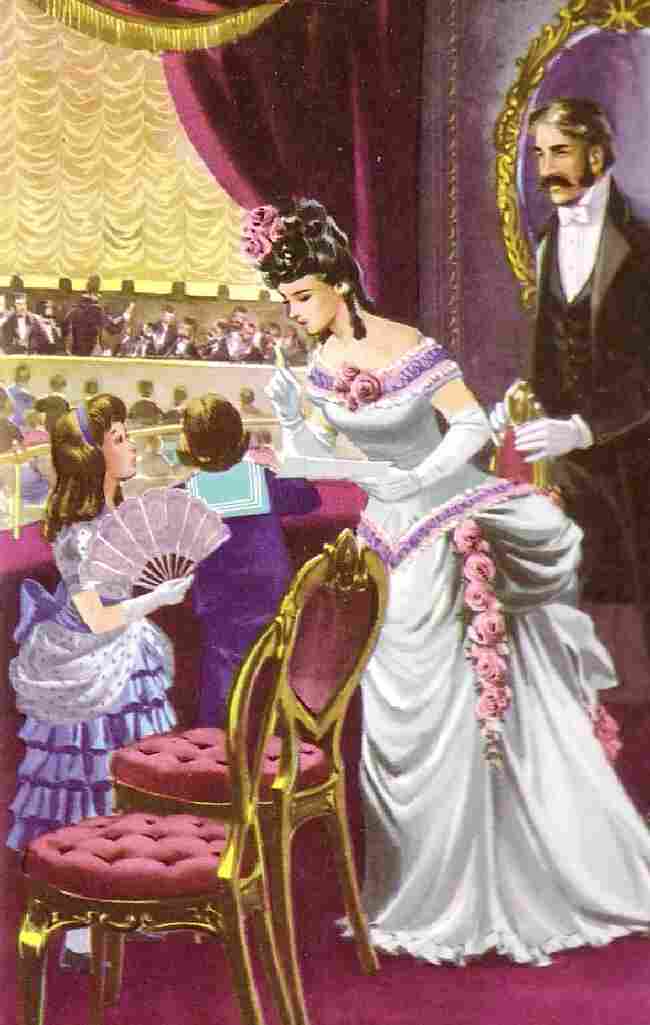
Figure 1.--Ladybird tells us "Our picture shows a family party at the theatre about the year 1890--a period called the 'Gay Nineties'. They are wearing their best clothes for the occasion." HBC has some questions about the illustration. Click on the image to see the modern illustration.
|
|
Queen Victoria was one of Britain's longest reigning monarchs. She reigned from the late 1830s through to the beginning of the 20th century. Many important boys' fashions originated during the Victorian era--several within Queen Victoria's own family. Fashions changed sunstantially during this period. The Ladybird books gives us a view of a well-to-do familythe 1890s during the Gay 90s. The text begins, "Our picture shows a family party at the theatre about the year 1890--a period called the 'Gay Nineties'. They are wearing their best clothes for the occasion." HBC has some differences as to the accuracy of the illustration.
Queen Victoria ruled for over 6 decades, an incredible reign. While much of it after Prince Albert's death was done from seclusion, she left an enormous impact on Victorian society. Not the least was the impact in fashion, including boys' fashions. Given that the Queen was so young when she ascended the throne and lived such a long life any analysis of the era has to seoarate her reign into that covering mid-19th century (1840-70) and late 19th century (1870-90) Britain. Many of the fashion inovations introduced or influenced by Queen
Victoria in the mid-19th century, such as sailor suits and kilts, had
becone accepted fashion conventions by the late 19th century. Through the development of photograph we have an incredible record of fashion, especially duting the late 19th century.
Queen Victoria was Britain's longest serving monarch. The generally uneventful reign of George IV 's brother, William IV (1830-37), was followed by that of Queen Victoria (1837-1901). Only 18 years when she came to the throne, innocent, self-centered and poorly educated--few expected very much. Victoria was, however, to oversee England at the height of its overseas power as well as an extraordinary explosion of technological advances which ushered Britain into the modern age. The British Empire was established in her reign, and it reached its greatest expanse under her. Perhaps even more importantly, major social and political reforms were initiated. The one major decision she made by herself was her choice of Albert of Saxe-Coburg for her husband. It was the love story of the 19th century. Victoria and Albert set the moral tone of the nation and helped shape Britain's emergence as a truly democratic nation. Victoria witnessed an extraordinary development of British power and influence. She and Albert changed how Britain's looked on their monarch. She became in many ways the grandmother of Europe, forging dynastic ties throughout the Continent. She also played a major role in influencing boys clothing around the world by the garments she selected for the young princes.
Ladybird Text
The Ladybird text reads as follows:
"Our picture shows a family party at the theatre about the year 1890--a period called the 'Gay Nineties'. They are wearing their best clothes for the occasion.
The lady wears a 'bustle', which came into fashion when the crinoline went out. The back of the skirt is padded and bunched up, and decorated with roses. The waist is small, and to achieve this, she wears very tight corsets underneath. Her hair is piled high with a flower decoration.
Father is in full evening dress, which is not very different from to-day. His son is wearing a sailor suit, and he will have a wooden whistle on a white lanyard in his pocket. Little boys sometimes wore velvet suits with lace collars, and long, curly hair for boys and girls was much admired.
His sister wears a frilly dress and gloves like her mother. The velvet band around her hair is pretty, and girls sometimes wear one to-day.
Children's cloths were still formal and fussy. For daily wear boys wore knickerbockers with long, black stockings over the knees. Girls wore long stockings too, and rather elaborate frocks."
HBC Assessment
HBC has some objection to this scene. We are not at all sure that hifgh-society families had parties at the theater or opera with children this age. More likely they would be left at hoe in the care of a nanny or governes. It does, however, give the illustrator a nice setting for showing off formal clothes. Also we are not sure about the sailor suit. We believe that it was quite common for a middle-class boy to have a sailor suit as his best outfit. This family, however, looks to be quite affluent. We are not at all sure that a boy from such a family would have a sailor sit as his best outfit. A reader writes, "I think HBC is right here about Victorian children and the theatre and sailor suits being more a middle class thing. The book seems to focus largely on upper class clothing." Here are reader makes an important point. Actually until after World War I it was wealthy people who made fashion and thus any assessment of fashion usually focuses on the affluent classes. After World War II, however, people of all classess more and more dressed alike. This is a realtively new development in the history of fashion.
HBC

Navigate the HBC literary pages' Historical Clothing Web Site:
[Return to the main Main Ladybird costume book]
[Return to the main Main children's literary page]
[Return to the main Main literary page]
Navigate the Boys' Historical Clothing Web Site:
[Introduction]
[Activities]
[Biographies]
[Chronology]
[Clothing styles]
[Countries]
[Bibliographies]
[Contributions]
[FAQs]
[Glossaries]
[Satellite sites]
[Tools]
[Boys' Clothing Home]
Created: February 29, 2004
Last updated: February 29, 2004