|
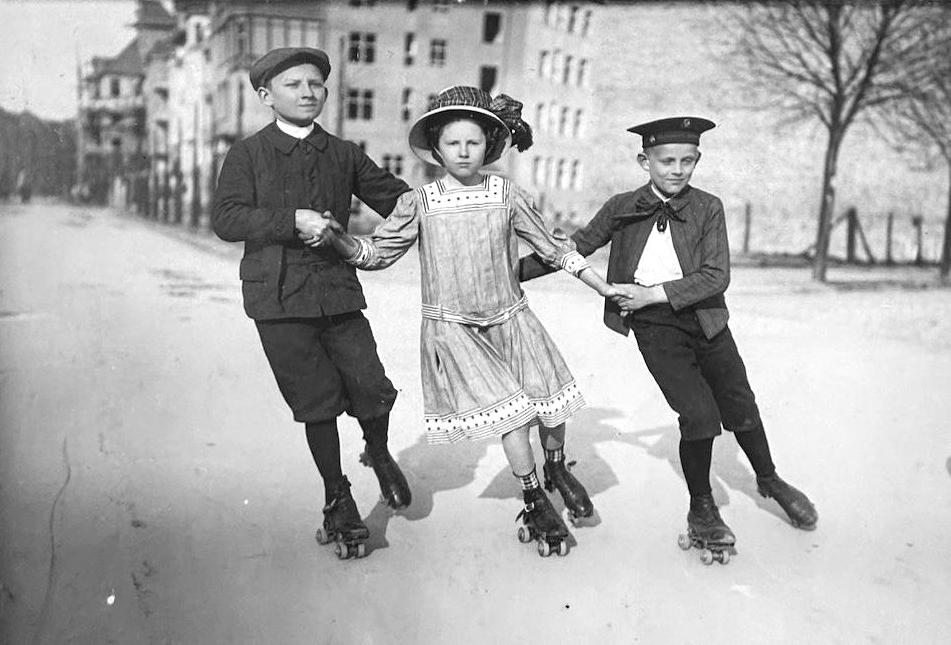
Philipp Kester was born Kirchenlaibach (1873). He grew up in Schwandorf and Regensburg. His father was an engineer with the German rail system. After completing cadet training he abandoning his studies in philology in Munich. He moved to New York (1895). Here he got involved in journalism and first experimented with photography (1904), selling his work to American photo agencies. This was possible because at the-turn-of-the 20th century, lithography had advanced to the point that photographs could be reproduced in newspapers and magazines at reasonable cost, creating a vibrant market for photography. He thus launched a career as photojournalist in Germany. He is best known for his every-day urban photography in Berlin and Munich during the early-20th century before World War I (1905-14). This involved a lot of stree work which captured evey aspect of Berlin life, incluing bech life at the Wannsee beaches. The rollar skating image here is a good example (figure 1). Kester worked in Berlin (1905-11), but moved to Munich (1911). He also had photo expeditions to other European cities. He worked as a press photographer, journalist, and owner of a newspaper illustration publishing house. In later years hefocused on this aspect of his career. He also did portraits, including internationally important personalities. During World War I, he suspended his photographic and journalist activities and enlisted in the Army. After the War, economic conditions made it difficult to immediately restart his photographic business. He did return to print journalism, most notably covering documenting the Hitler Beer Hall Putsch and trial (1923-24). He collaborated with the Hitler's photographer, Heinrich Hoffman, distributing Hitler photographs to the German and international press. His photography gadually declined as he increasingly focused on his photographic publishing company. We wonder because he lived through some of the mst phograpical periods in German history, why hewas not bery active--The NAZI era ans World War II. Was it because he wasbothered by what ws happening in Germany. During World War II he worked as an interpreter and translator. Kester died in Munich (1958).

Navigate the Boys' Historical Clothing Web Site:
[Return to:Main 20th century photographer page]
[Return to:Main photographer page]
[Return to:Main German photography page]
[Introduction]
[Activities]
[Biographies]
[Chronology]
[Clothing styles]
[Countries]
[Bibliographies]
[Contributions]
[FAQs]
[Glossaries]
[Images]
[Links]
[Registration]
[Tools]
[Boys' Clothing Home]