
Italian Fascist School System (1925-43/44)
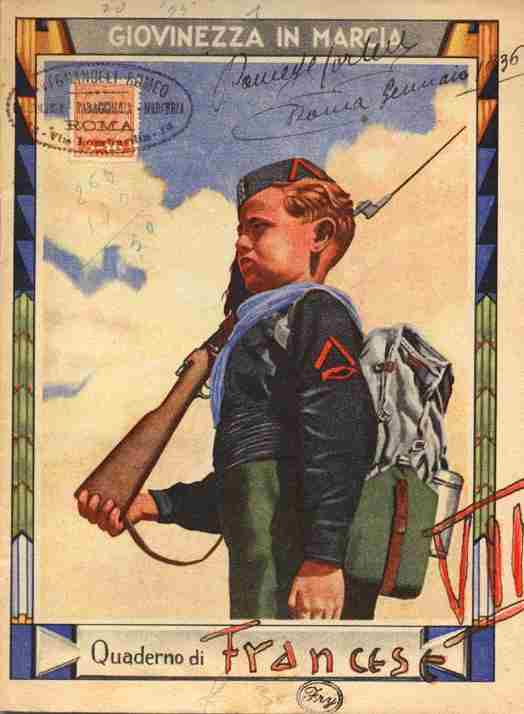
Figure 1.--This is a school note book used by an Italian prinary school boy. Note how a boy in 1936 has written in the subject, "Francese". Children were required to use these notebooks with colored Fascist covers and inspiring quotations from Mussolini on the front and back. The uniform pictured is the Fascist youth movement, the Bilial.
|
Italian Fascism was unique among the radical forces produced by the early Twentieth century. It developing out of economic problems which followed Italy's costly involvement in World War I. Strangely it had no clear predecessor in the 19th entury. The Italain Fascist movement emerged in 1919, catapulting its leader, the journalist Benito Mussolini, into the premiership 3 years later in 1922 and then to the creation of a new political dictatorship beginning in 1925. We believe that the Italian Fascists exercised control over all schools in Italy, although they did not close down Catholic and private schools. We have, however, little information at this time on Fascist school policies. The Fascists were very critical of earlier educational systems. The Fascists prescribed both content and general methods of teaching, as part of Mussolini's pedagogical "reforms." This pedagogical "charter" drawn up by Mussolini's minister of education, Giuseppe Bottai, is a radical reforming document that proposes to substitute for the existing bourgeois system one more responsive to the needs of students not heading for the university. The system would include nursery schools, trade and artisan schools, special training for girls, and the introduction of practical crafts, among other considerations. [Giuseppe Bottai. La Carta della Scuola. Milan: A. Mondadori, 1939.] In 1943 Bottai broke with Mussolini and, under the name of André Bataille, ended the war fighting the Germans as a corporal in the French Foreign Legion. An assignment book required of every school child in the Veneto. It begins with a full-page photograph of Mussolini, and includes quotations from his speeches and such highlights of Fascist history as the March on Rome and the Concordat between Church and State. They are followed by lists of the books to be used, the hours for each class, hours for teacher consultations, etc. Then begins the "diario" proper, with space for each day and each subject. At the top of each page there is a quotation from Mussolini. This diary not only offers a day-to-day description of the detailed activities of students, but also the method of presenting Fascist doctrine to them. [Diario della Scuola Fascista. Treviso: Longo & Zoppelli, 1939-1940.] One observer describes a series of large posters illustrating aspects of Fascist activities and distributed to public schools for placement in classrooms. Printed in color with a map of the Mediterranean coast stretching from Tunisia to Egypt, it depicts the achievements of Italian colonization. Curiously, the figures at the bottom advertise various creams, cleansers, and waxes intended for household use. Their manufacturer evidently had defrayed the expenses of the poster's publication.
A standard textbook for the subjects of religion, history, geography, and arithmetic opens
with the morning prayer to be repeated by all students -- not surprisingly, since the authors use the titles "monsignore" and "reverendo." Italian war victories and Fascist doctrine figure prominently in the text, and nearly every page includes a propaganda photograph or illustration. The book offers insight into the extent to which the regime permeated educational institutions. [3rd grade text book: Angelo Zammarchi and Cesare Angelini. Il Libro della III Elementare. Rome: La Libreria dello Stato, 1939.] Children's report cards or pagella from the province of Ferrara is richly adorned with Fascist symbolism. An anthology of readings for the fifth grade. It is interesting to note that nearly every story glorifies the Fascist regime and its activities. [P.N.F. Gioventů Italiana del Littorio. Il Libro della Quinta Classe. Letture. Rome: La Libreria dello Stato, 1939.]
Christopher Wagner

Related Chronolgy Pages in the Boys' Historical Web Site
[Main Chronology Page]
[The 1900s]
[The 1910s]
[The 1920s]
[The 1930s]
[The 1940s]
[The 1950s]
[The 1960s]
[The 1970s]
Navigate the Relate Boys Historical Clothing Style Pages
[Main country page]
[Long pants suits]
[Short pants suits]
[Lederhosen]
[Kneesocks]
[Eton suits]
[Jacket and trousers]
[Blazer
[School sandals]
Navigate the Boys' Historical Clothing School Uniform Pages
[Main Italian School System Page]
[Main School Uniform national page]
[Australia]
[England]
[France]
[Germany]
[Ireland]
[Italy]
[Japan]
[New Zealand]
[Scotland]
[United States]
Navigate the Boys' Historical Clothing Web Page
[Introduction]
[Biographies]
[Bibliographies]
[Chronology]
[Clothing styles]
[Contributions]
[Boys' Clothing Home]
Created: September 1, 2001
Last updated: September 1, 2001