
Japanese Elenentary School Uniforms: Military Styles
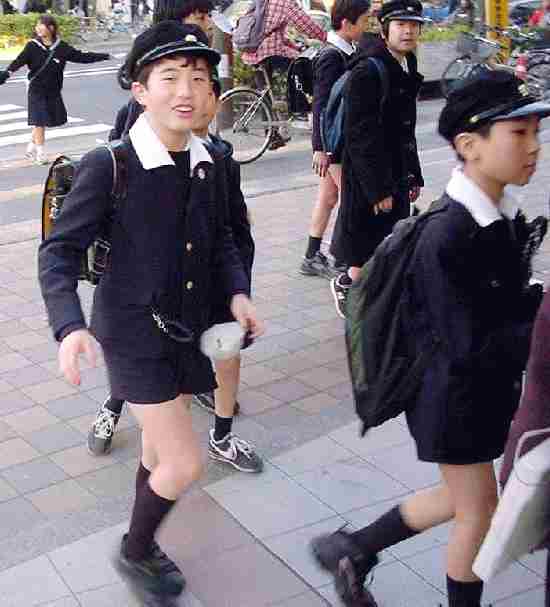
Figure 1.--This Tokyo elementary school has a military style uniform for both the boys and girls. These styles are usually worn by older students at junior and senior high schools. Notice one boy wearing the regulation uniform. The boy to the left appears to be wearing a blue sweater under his white shirt.
|
The Prussian style military uniform is primarily assocaited with junior and senior high schools. There are a few elementary school, however, that also require this uniform--usually with a military-style cap and short pants. The girls at these schools normally wear the sailor suit uniform that girls at junior and senior high schools normally wear. While these uniforms are quite similar there are small differences anong schools as well as the regulations concerning how the uniform is worn. These military uniforms are a very traditional style. Japanese pre-World War II uniforms were very much like this, but they are now very rare at elementary schools.
Chronology
The military-style uniforms were adopted by Japanese schools in the late 19th century. Initially even many university students wore then. They were still worn by many elementaru children as late as World War II (1939-45). After the War they were generally dropped at most elementary schools, although they are still very commonly worn at junior and senior high schools.
Garments
A few elementary schools still have the traditional Prussian military-styled uniform consisting of peaked cap and blue jacket with brass buttons. The elementary schools with this uniform require short pants. Some junior high schools once wore short pants with it, but now all ahave long pants. The girls at these schools normally wear the sailor suit uniform that girls at junior and senior high schools normally wear.
Caps
The boys wear a standard Prussian-style military cap. These caps are fairly standard with a polished leather bill.
Overcoats
The winter coats worn by the boys at the schools with the military uniform can vary. The boys at the school pictured here wear a standard long blue overcoat with a hood. Wearingbthe overcoat appears to be optional.
Jackets
The boys wear a blazer-like blue jacket. These jackets are always blue. The jacket does not appear to have military dstyling--except for brass buttons.
Sweaters
Boys often wear blue sweaters with their uniforms. Strangely the boy above appears to be wearing a blue sweater under his whire shirt.
Shirt
Boys always wear white shirts with these military uniforms. While they all wear whitecshirts there are differences among the coillars styles worn at different schools.
Pants
The elementary schools with this uniform require short pants. HBC does not know of any elementary schools where the boys wear long pants with this uniform. Some junior high schools once wore short pants with it, but now all have long pants.
Socks
Socks can vary. Most schools required matching blue scocks be worn, although the children could often choose to wear either ankle or kneesocks. White kneesocks were also worn, but not as commonly as the blue socks.
Tights
The uniform is a classic boys school uniform--the pre-War uniforms were very similar to this one, except that tights wearing was common before the war and almost completely disappeared afterwards except among the very young.
Shoes
Elementary children commonly wear sneakers to school. The children at the school pictured here all mappear to be wearing blue or black sneaketrs (figure 1).
Book bags
Virtually all Japanese children have book bags. Many have traditional leather book bags. Some schools allow the children to choose the style they want. One boy here, for example, wears a non-traditional style (figure 1).
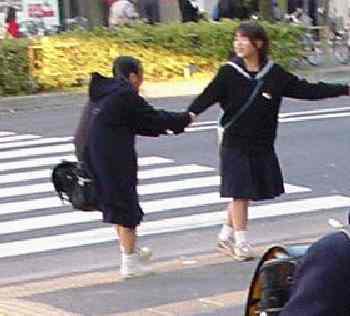
Figure 2.--Girls at the schools with military uniforms wear sailor suits like those worn by older girls at junior and senior high schools.
|
Sailor suits
Girls at the elementary schools with traditional military uniforms commonly wear sailor suits like the ones worn at junior and senior high schools.
Regulations
Japanese schools are know for often strictly enforcing uniform regulations. While these uniforms are quite similar there are small differences anong schools as well as the regulations concerning how the uniform is worn. Many schools let the children choose whether or not to wear winter coats. Some schools even did not have standard cpoats--although this was less likely at the schools woth the military uniforms. Often the children were allowed some choice as to the shoes and socks worn. At th school here the boys can wear either ankle or kneesocks.
Boys Opinions
HBC is unsure what the boys think of their traditional uniforms. Spme may kile the style as it is commonly worn by older boys.
Christopher Wagner

Related Chronolgy Pages in the Boys' Historical Web Site
[Main Chronology Page]
[The 1900s]
[The 1910s]
[The 1920s]
[The 1930s]
Navigate the Boys' Historical Clothing School Uniform Pages
[Main Japanese School Uniform Type Page]
[Main school uniform country page]
[Australia]
[England]
[France]
[Germany]
[Ireland]
[Italy]
[Japan]
[New Zealand]
[Scotland]
[United States]
Created: March 6, 2001
Last updated: March 6, 2001