New Zealand Strate Primary Schools Uniform: The 2000s
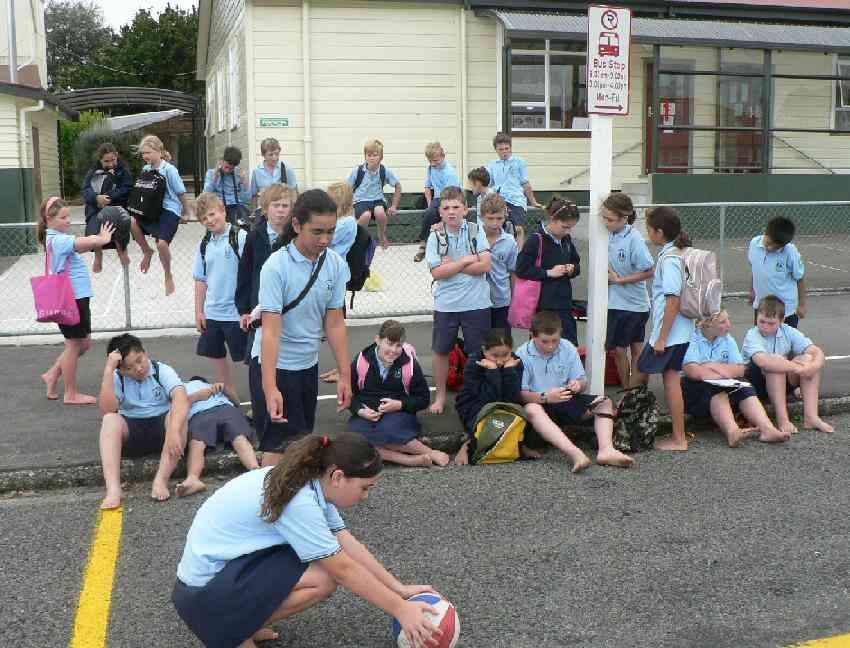
Figure 1.--Students at this state primary school are wearing a uniform typical of the unifirms adopted by state primaries in the 2000s. The children are waiting for the bus to arrive at the end of the day. The school introduced a compulsory uniform in 2007. The children wear typical polo shirts and shorts. All but one appear to be barefoot. Note none of them have on the hats they are required to wear while at school. The hats are not very populasr with the children.
|
|
A major change in schoolwear occurred at New Zealand state primary schools duriung the 2000s. A dramatic increase in the number of primary schools in New Zealand which have a compulsory uniform occurred during the late 1990s and 2000s. Until the mid-1990s school uniforms were unheard of for primary schools, only being introduced at intermediate or high schools. Government education policy appears to have been a facor in this sharp break with the 20th century, Each individual schools adopts its own uniform. Thus we see a number of variations, especially in color. There are, however, many common uniform garments. The basic color for school uniforms in New Zealand is grey and blue to a lesser extent. The primary schools have in many cases adopted more colorful uniform garments.
Education Policy
It is not entirely clear why this change took place. One possible reason for the sudden change was the elimination of school zones by the National Party-led government. The idea was that schools would now compete against each other in a free market like businesses. Smart uniforms were seen by some schools as a way of making a school look better to parents of prospective students. In New Zealand uniforms are strongly associated with good schools by many parents. The schools that introduced uniforms in this period were mostly urban schools where there were many nearby primary schools to compete with for students. We are not sure if this competition produced any positive effects. The School zones were, however, put back in place by the Labour Party-led Government in 2000, but they were not as strict as in other countries. School zones overlap and schools may choose to accept students from outside the zone. Some parents enroll their primary age children at schools nearby their workplaces rather than in the suburb where they live.
Estent of School Uniform Adoption
A second wave of school uniform introductions began in the 2000s and most primary schools in the major cities now have uniforms. This does not apply to rural school though, and most primaries outside the major cities do not have uniforms. Not all primary schools in the cities wear uniforms either, there are a handful of schools without compulsory uniforms still remaining. More often though, these schools have optional uniforms which are still worn by a large proportion of the students, sometimes mixing a uniform jumper or shorts etc. with non-uniform clothing.
Garments
Each individual schools adopts its own uniform. Thus we see a number of variations, especially in color. There are, however, many common uniform garments. The basic color for school uniforms in New Zealand is grey and blue to a lesser extent. The primary schools have in many cases adopted more colorful uniform garments.
Hats
Primary kids are required by law to wear hats as protection from the ozone hole. The UV index can hit 13 or even 14 in the summer in New Zealand and remains at 11 or above through much of spring and autumn. Primary and Intermediate schools have bucket hats for their kids to wear whenever they are outside. The hats usually have the school insignia on them as well. Noticeably though, kids never wear their hats outside of school, probably leaving them in the classroom so as not to forget them. A child without a hat cannot leave the shaded area or classroom to play. The hats are not very populasr with the children and you mostly see the children wearing them at school.
Shirts
Primary schools all use a very similar style of polo shirt in their uniforms. These come in a wide variety of colours but red, pine green, light blue or bright yellow are the most popular. Generally the shirt has the school name and insignia printed on the chest where a secondary school uniform might have a badge. Very few schools offer a long-sleeve shirt as another option.
Jumper/Vest
For the winter months schools often have a fleece pull-over jumper of the same colour as the polo shirt, though sometimes in the secondary colour of the uniform. A school with a bright yellow polo with black trim will then have a black jumper to go over it. Since schools do not offer a long-sleeve shirt the jumper is necessary as soon as it becomes too cold to wear a short-sleeve shirt. The jumper also had the school name embroidered on the chest. Another common option is a sleeveless zip-up vest.
Pants
All primary schools share a similar style of shorts. Unlike the secondary school shorts, which are designed for students sitting in a classroom most of the day, the primary school uniform is designed for kids who will be playing outside often. They are generally as baggy and long as most non-uniform boys’ shorts are. Often they are nearly calf-length and some schools choose options with cargo pockets. They are usually black, though navy blue, and dark green are also sometimes chosen. Many boys choose to wear these shorts all year. Some schools have another option of three-quarter length pants. These fall about calf-length without being as baggy as shorts of the same length. They often have draw-strings at the cuffs. These are ideal for playing on a wet field or puddle covered tarmac play area in the very wet New Zealand winter. They provide the added skin cover of pants without getting wet cuffs while the kids are playing. This is the rarest option provided by primary schools. Those that do offer this option usually choose pants the same colour as the shorts, sometimes with cargo pockets. Even where offered they are not often worn as they are poorly suited to the kind of sport and play expected on a daily basis in New Zealand primary schools. The cuffs are often prone to getting wet and frayed as kids play barefoot on wet surfaces.
Footwear
Footwear is often not even mentioned in many primary school uniform guides. The choice is often left up to parents. Schools that do mandate a type of shoe generally go along the same rules as intermediate and high schools have, requiring a plain black lace up shoe. Students are usually then asked to bring appropriate footwear for sports and play, though it is not specified what appropriate means. Primary schools differ from higher level schools in not having students wear the typical roman-style school sandal common to most intermediate high schools. Instead students are asked to wear any plain black sandal and most wear sport-type sandals. These are better built to the kind of play expected at primary school. Primary schools also allow students to wear sandals all year where most high schools only allow them in the summer terms.
The most common footwear at primary school is bare feet. School uniform codes specifically avoid advocating or outlawing the practice of coming to school barefoot. Students who do wear shoes or sandals to school very often leave them at the door to the classroom and remain barefoot all day. Students are expected to do many sports, especially athletics and rugby, in bare feet. Even in the winter students continue to attend in bare feet, though the schools encourage them to wear shoes.
This is partly due to the general acceptance of bare feet as a clothing option in New Zealand society as a whole. It is quite common to see adults walking barefoot into malls and supermarkets especially in warmer weather. In 2009 however there has been a major radio and billboard campaign culminating in a telethon to raise money for 10,000 children who walk to school barefoot everyday in the cold winter because they have no shoes. This highlights the odd situation where bare feet are associated with poverty at the same time that it is perfectly acceptable for children in the nation’s wealthiest suburbs to walk home from school barefoot. The vast majority of kids who attend school barefoot do so by choice for comfort. Many parents send their kids to school in shoes only to have them removed the moment they enter the school gate.
Sports uniforms
Some schools have a separate uniform for sport, much as most secondary schools do. The uniform usually consists of a short-sleeve polyester top and black shorts, both in school colours. There are no proscribed sport shoes and most students go barefoot out of preference, even those who wore sneakers to school. For a few sports, rugby being the main one, students are required to be barefoot.
HBC-SU

Related Chronolgy Pages in the Boys' Historical Web Site
[Main Chronology Page]
[The 1900s]
[The 1910s]
[The 1920s]
[The 1930s]
[The 1940s]
[The 1950s]
[The 1960s]
[The 1970s]
[The 1980s]
[The 1990s]
[The 2000s]
>p>Navigate the Relate Boys Historical Clothing Style Pages
[Main country page]
[Long pants suits]
[Short pants suits]
[Lederhosen]
[Kneesocks]
[Eton suits]
[Jacket and trousers]
[Blazer
[School sandals]
Navigate the Boys' Historical Clothing School Uniform Pages
[Return to the Main New Zealand School State Primary Page]
[Return to the Main New Zealand School Type Level Page]
[Return to the Main New Zealand School Type Page]
[Return to the Main New Zealans 21st Century Chronology Page]
[Main National School Uniform Page]
[Australia]
[England]
[France]
[Germany]
[Ireland]
[Italy]
[Japan]
[New Zealand]
[Scotland]
[United States]
Navigate the Boys' Historical Clothing Web Page
[Introduction]
[Activities]
[Biographies]
[Chronology]
[Clothing styles]
[Countries]
[Bibliographies]
[Contributions]
[FAQs]
[Glossary]
[Images]
[Links]
[Registration]
[Tools]
[Boys' Clothing Home]
Created: 10:27 PM 7/15/2009
Last updated: 10:27 PM 7/15/2009