|
We have found some images that we can not even identify the contient involved. Many of the imges we have archived have no accompanying information. Thus we often have to guess about dates, location, and other aspects of the photograph. Identifying the country can be a challenge, but the continent is usually obvious. It is unusual that we can not identify the continent. Usually the racial chracteristics of the children nd teachers usually allow us to at least identify continents. This is somewhat complicated by colonialism. Thus we see Europeans in Africa, Asia, and Oceania. We are sometimes able to suss out just where the photographs were taken. Smocks are European garments. Several of the colonial countries (Belgium, France, Italy, Portugal, and Spain) were countries where children wore smock. Colonial coyntries did not found public school system. (The Americans in their short-lived empirre were a rare exception.) While the Europeans fid not find public school systems, there were schools for the chilrem of the colonial administrators and businessmen. And even with the European children smocks were not all that common. Climate was a factor here. At any rate, we hope our readers may have some insights.
Here we see a school scene in some inidentified European country during or after World War I (1914-18). It is like France, but Italy is also possible. The children are wearing a mix of pinafores or smocks. This is probably because these children are probably still with their prents and mom id doing her best to meet chool requirements. We are not sure of this a class or a room where individual children were being examined. We do not think this is an orphange because the children are dressed so differently. We think this a school with refugee children or a regular school which is taking in refugee children. Notice the man doing the examination. He is wearing what looks like a military uniform. He may be an American Red Cross Volunteer. The American Red Cross played very different roles in the two wars. The American Red Cross played a major role in dealing with civiliasn issues like clothing, disease, food, health, sanitation, and water which developd in newly liberated areas. This developed largely because America was the major country providing relief assistance. In World War II the Red Cross priomarily dealt wih issues like annities for soldiers and POW issues. The also provided nuses to the services. Whole new international agenies were created to deal with cilvian relief. And the Army planned for the immeduate needs of liberated areas.
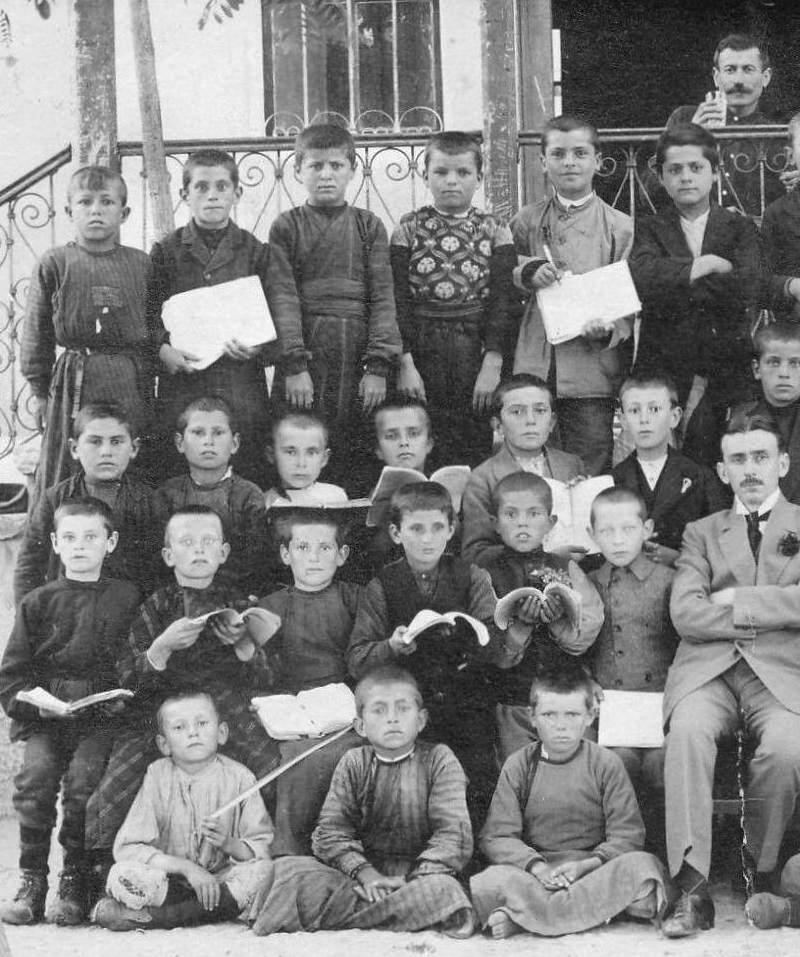
This school portait is a bit of mystery to us (figure 1). Most of the children are wearing smocks, although some look more like a robe than a tunic. The teachers look French to us, but we have never seen French boys dressed like this. We would guess that it might be French colonial Algeria, but we are not at all sure. We might guess Indo-China, but we do not see any Vietnamese boys. We are also unsure about the date. We would guess the 1910s, but the 'KLtd' stamp boxs on the back (1918-36) place in more in the 1920s. The boys seem dressed for a chilly day, but thehr officer at the top seems to be having a cool drink. A reader thinks it may be a Russian school. "I am wondering that if it is in the 1910s maybe this is a Russian school as the robes could be from some of the Russian ethnic areas that were mostly Muslim. There were many private schools in Imperial Russia so that may explain the differences and it would also explain the buzz haircuts of many of the boys." Thus is a possibolity, presumably in the provinces, Siberia, or Central Asia. Russian boys did have short hair cuts in the early-20th century, but so did many European boys (includung the French and Germans), although after the War buzz hair cuts like this went out of style. Some of the outfits the boys wear do look like the robes boys wore. We do not see, however, any Asian looking faces. Also the teacher looks exceptionlly well dressed, more French thn Russian. The date is also a problem. The KLtd. postcard stamp box appears to have first appeared in 1918. This Would be the Bolshevik Revolution-Civil War era and the ensuing early Soviet era. The fashionably dressed teacher does not fit in with Central Asia or the Soviets. He does look Fremch which would suggest Algeria.
Here are some photographs showing children of all ages, both boys and girls wearing plain smocks wth no collars. We at first thought this was a Catholic school, because there is a a lady who may be a nun in the images with the nursery school children. But there were not just nursery-level children wearing smocks. We have no idea how to date the photographs. The dealer suggested 1917-20. We think it may be a little later. Smocks of course were primarily a European school garmernt. Coed school enviroments were more of an American approach. The dealer suggested they were American. This may be the case, but we are not sure. e. Then we noted a photograph of older children perhapos 12-13 years old wearing the same pain smocks as thvnursery childrem. . This suggest to us that it may have been a Catholic orphange with all the children dressed alike. There are no clues as to what the children are wearing under their smocks. Unfortunarely two of the available images ave very small.
This snapshot shows two boys, preumably brothers, identically dressed for school. All we know for sure is that it was dated 12/10/50 which in Europe presumably means October 12, 1950. The boys wear identical berets and long dark smocks with Peter Pan collars and small bows. Our best guess is ht they are either French or Italian boys. The berets and smocks suggest France. The smock and white collars suggest Italy, although the bows are not what we usually see in Italy. We think Italy is the most likely country, but are not at all sure. Perhaps our European readers will have some insight here.

Navigate the Historic Boys' Clothing Web Site:
[Introduction]
[Activities]
[Bibliographies]
[Biographies]
[Chronologies]
[Countries]
[Style Index]
[Contributions]
[Expanded Site]
[Frequently Asked Questions]
[Glossary]
[Images]
[Links]
[Registration]
[Boys' Clothing Home]
Navigate the Historic Boys' Clothing Web chronological pages:
[The 1890s]
[The 1900s]
[The 1910s]
[The 1920s]
[The 1930s]
[The 1940s]
[The 1950s]
[The 1960s]
Navigate the Historic Boys' Clothing Web style pages:
[Return to the Main school smock country page]
[Return to the Main smocks page]
[Return to the Main Belgian school garment page]
[Dresses]
[Bodice dresses]
[Kilts]
[Smocks]
[Sailor suits]
[Sailor hats]
[Ring bearer/page costumes]
[Pinafores]
[Shortalls]