
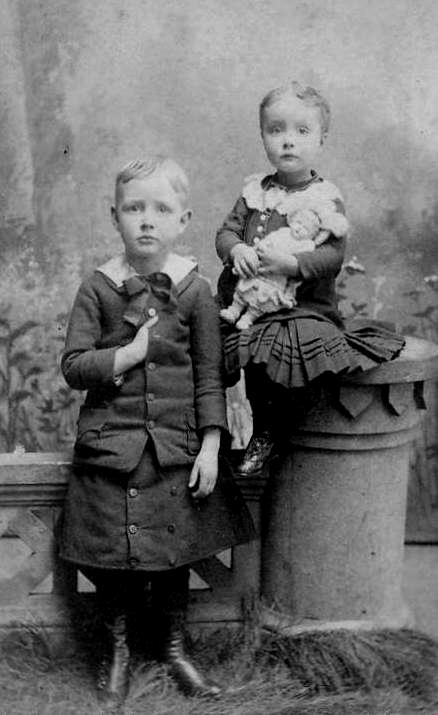
Figure 1.--This unidentified boy and his little sister (note porcelain doll) had their portrait taken in Washington Court House, Ohio. The children look to be 2-4 perhps 5 years old. The CDV portrait is undated, but we would guess was taken in the 1870s. The little girl wears a dress with a pleated skirt or a jacketed dress. The boy wears a kilt suit. Note the front of the kilt-skirt is plain without any pannel. There is no front pannel. Notice the two columns of buttons. Notice that the left column seems to be a closing device.
|
|
American Kilt Suits Garments: The Kilt--Styling
Kilt suits were worn with a wide variety of skirted garments. The three major kilt features we notice are 1) pleats, 2) buttons, and 3) front pannel. Without these features, at least one of them, the garment is a plain skirt not a kilt. Some of the kilt skirts had all three. Somes just one. Many were done as long, pleated skirts with a unpleated front pannel. Pleating was a very common way of indicatingg a kilt, but not definitive. Here we see a girl with a pleated skirt, but her brother with an unpleated kilt. You can see the front pannel here, set off with buttons (figure 1). The buttons were often done in two paralell vertical columns on these front pannels. This often seems to have matched the buttons on double-breasted jackets, but here we see the double buttons wuth aingle breasted kilt. Many of the jackets, however were single breasted or collar buttoning jackets with a single row of buttons. Some of the buttons seem to be used as a closing device while on other kilt-skirts they seem purely ornamental. We think this was done to emphasize that the garment was a kilt and not just a skirt that a girl might wear. We see quite a few of these double breasted styled front pannels. This seems to have been the most common kilt styling, at least for the kilt-skirts for which an attempt was made to create a kilt-like garment. This front pannel is sometimes wide enought that it is difficult to see if it is alsp pleated. What we do not see on these kilt suits is the sporran that Scotts wore with their kilts. This was an almost mandatory item with Scottish kilts, vurtually never work with kilt suit kilts.
Kilt Features
Kilt suits were worn with a wide variety of skirted garments. The three major kilt features we notice are 1) pleats, 2) buttons, 3) front pannel, and 4) the material. Without these features, at least one of them, the garment is more of a plain skirt than a kilt. Some of the kilt skirts had all four. Some just one of the features. Pleating was strongly associated with kilts. Virtually all Scottish and English kilts were pleated. It was nore of an option in America.
Pleating was a mandatory element of the kilts worn in Scotland and England. For American kilt/skirt worn with kilt suits it was a little different. Notice the boy here (figure 1). He wears a kilt suit with a skirt that is unpleated, but has a front pannel. Many were American kilt suits were done with kilt/skirts done as long, pleated skirts, but without a front pannel. We see both variants, pleating with and without front pannels. Despite the front pannel, mothers at the time would have called all these pleated skirts worn by boys kilts. Any mother chosing a kilt suit for her son would have known to call them kilts. and this included mothers far away from the dashionble big cities. Here the mail order catalogs were a major factor in spreading the fashion. We think though that some of these outfits were the result of home sewing. Doing pleats were much more complicated and used more material than a plain skirt which was rlatively easy to sew. Thus the unpleatd kilt suits were more likely to be sen at home. Girls wore pleated skirts, like the girl here, but they were not calld kilts. We see different kinds of pleats, both knife pleats and box pleats. Both were very common. Pleating was a very common way of indicatingg a kilt, but not definitive. Here we see a girl with a pleated skirt, but her brother with an unpleated kilt. You can see the front pannel here, set off with buttons (figure 1).
Buttons
The buttons were often done in two paralell vertical columns on these front pannels. This often seems to have matched the buttons on double-breasted jackets, but here we see the double buttons wuth aingle breasted kilt. Many of the jackets, however were single breasted or collar buttoning jackets with a single row of buttons. Some of the buttons seem to be used as a closing device while on other kilt-skirts they seem purely ornamental. We think this was done to emphasize that the garment was a kilt and not just a skirt that a girl might wear.
We see quite a few of these double-breasted styled front pannels. Scottish kilts had these front pannels, but not the buttons. This seems to be an American addition. These front pannels seem to have been the most common kilt styling, at least for the kilt-skirts for which an attempt was made to create a kilt-like garment. This front pannel is sometimes wide enought that it is difficult to see if it is alsp pleated, depending on how the boy was posed for the portrait. We have seen these pannels both with and without pleating. We would estimate that over half of kilt suit portraits we have archived had the front pannels and almost all had the double columns of buttons. The pannels without the buttons are very rare. As far as we can tell, the buttons were ornamental, but some seem to be a functioning part of the pannel.
Material
The material used for kilt suit coild be plaid, but often very dark, muted plaids. They were so muted that they are oftn hard to etect in portraits. We do often see, however, see the bright plaids often associated with kilts. The bright plaids we do see are nostly worn with the Funtleroy kilt suits. They have the same cut away jackets worn with the classic Fauntleroy suit, only won with a kilt rather than knee pants. We also see many kilt suits with plain material like the one the boy herre is wearing.
Sporrans
What we do not see on these kilt suits is the sporran that Scotts wore with their kilts. This was an almost mandatory item with Scottish kilts, virtually never work with kilt suit kilts. Sporans could be quite large and fncy for Highland kilt outfits. Csual ilts might have a more functional leather pouch. We see none of these worn with kilt suits.
HBC

Navigate the Boys' Historical Clothing kilt pages:
[Return to the Main American kilt/skirt suit kilt garment page]
-
[Return to the Main American kilt/skirt suit garment page]
-
[Return to the Main American kilt suit garment page]
[Return to the Main American kilt suit page]
[Return to the Main National kilt page]
[Kilt History]
[Kilt Usage]
[Kilt suits]
Navigate the Boys' Historical Clothing Web Site:
[Introduction]
[Activities]
[Biographies]
[Chronology]
[Clothing styles]
[Countries]
[Bibliographies]
[Contributions]
[FAQs]
[Glossaries]
[Images]
[Registration]
[Tools]
[Boys' Clothing Home]
Created: 1:20 AM 10/5/2011
Last updated: 11:47 PM 5/14/2017