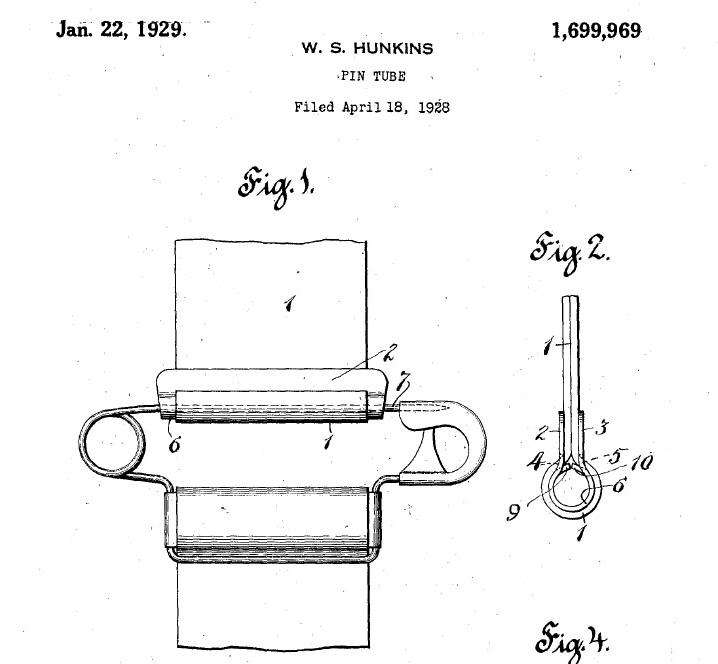
Figure 1.-- William S. Hunkins invented the pin-tube for attaching garters to support garments. We are not sure whem but sometime about 1900. He subsequently patentened refinment of his original desiign. He submitted this one in 1928. |

|
The technology that seems to have been the most popular for attaching garters to support devices was safety pin tubes. They became almost universal. The Hunkins pin tube was a hollow cylinder sewn or fastened to a strong cloth tab through which the safety pin could be secured. As one ad explains, "Slip the pin at the top of the hose supporter through the pin tube. No wearing or tearing of the garment by the hose supporter. The pin can't bend, sag or become unfastened. The supporter keeps its proper position and cannot pull at one end of the pin" Pin tubes were later made of nickle or some other non-rusting metal to prevent rust stains on underwear. William S. Hunkins invented the pin-tube adopted by the Minneapolis Knit Works and other manufscturewrs. He lived in Hollywood, California, during the early decades of the 20th century. We see his inventionalready in use as early as 1904--the waist. Refinements of the device were still being patented by Hunkins in 1921 and 1929. The most popular waist of all and the most extensively advertised became that of the Stein Company in Chicago (manufacturers of Hickory Waists and Garters). These ads refer to the "patent pin tube" but don't mention the name of the inventor, William S. Hunkins. The Hunkins pin tube became so familiar and so much used that eventually manufacturers no longer bother to specify that it had been invented by Hunkins. But Hunkins is important because his device was so widely adopted and used.
The technology that seems to have been the most popular for attaching garters to support devices was safety pin tubes. They became almost universal. The Hunkins pin tube was a hollow cylinder sewn or fastened to a strong cloth tab through which the safety pin could be secured. As one ad explains, "Slip the pin at the top of the hose supporter through the pin tube. No wearing or tearing of the garment by the hose supporter. The pin can't bend, sag or become unfastened. The supporter keeps its proper position and cannot pull at one end of the pin". Hunkins kept trying to
improve his product in minor ways, and we find U.S. Patents for partiular models of the pin tube issued on November 1, 1921 (No. 1395417) and on January 22, 1929 (No. 1699969). Here we see an illustration of the 1928-299 pin tube submitted with the patent application (figure 1). In his statement of 1921 (United States Patent Office), Hunkins explains his invention:
"My invention relates to a detachable connector particularly useful for
securing elastic hose supporter webbing to garments such as corsets and
corset waists [for boys and girls]. For manuy reasons known to the
trade, it is desirable to provide such means whereby whenever it become
necessary to wash, launder, or iron a waist or corset, the elastic
webbing [of the hose supporter strap] may be removed. To do this
easily and advantageously, I have provided a simple and effective means
of neat appearance which is always available for the above purpose, or
for permitting new or fresh elastic supporters to be attached. Various
other advantages will be apparent to anyone familiar with the needs in
this art from a reading of the following description."
The pin tubes of course were sewn onto garter tabs of the same sort as the eyeleted tabs. But of course the tube held the garter pin in place as securely (or perhaps even more securely) the the metal eyelets in the alternative style of tab. The pin tubes were originally made in steel. Later nickle or some other non-rusting metal was used to prevent rust stains on underwear. They were also made of strong enough metal to prevent them from being swashed shut in the wringer of a washing machine.
Inventors often kept improving
their products and re-patented the refinements. This happened, for
instance, with the Hunkins Pin Tube, the device that was invented to
hold the pin of hose supporters in place. There is more than one
patent for the Hunkins pin tube, an indication that Hunkins kept
updating the device with minor improvements. The improvements are not
always very obvious to the layman.
Hunkins's invention of the pin tube made it possible to pin the open pin of the safety pin through a metal tube only slightly shorter in length than the pin itself, leaving just enough room to close the safety pin on the far side of the tube and thus hold the hose supporter firmly in place, thereby preventing the hose supporter from being pulled crookedly or allowing the elastic of the garters to be strained unequally or twisted. Pin tubes were practical because they
kept hose supporters securely in place when children were romping and playing or engaging in strenuous activity. And boys and girls didn't have to be embarrassed by garters that came undone, were uncomfortable to wear, restricted bodily movement, or broke off from their moorings.
Pin tubes became the most standard method of attaching hose supporters.
William S. Hunkins invented the pin-tube adopted by the Minneapolis Knit Works and other manufscturewrs. He lived in Hollywood, California, during the early decades of the 20th century.
We are not sure when Hunkins first introduced his pin tube decice. We see his inventionalready in use as early as 1904--the M waist. Refinements of the device were still being patented by Hunkins in 1921 and 1929. The most popular waist of all and the most extensively advertised became that of the Stein Company in Chicago (manufacturers of Hickory Waists and Garters). These ads refer to the "patent pin tube" but don't mention the name of the inventor, William S. Hunkins. The Hunkins pin tube became so familiar and so much used that eventually manufacturers no longer bother to specify that it had been invented by Hunkins. But Hunkins is important because his device was so widely adopted and used. We still see metal pin tunes being used in the 1940s when long stockings and stocking suppoters began going out of style.
Metal pin tubes were used on several support garment types. We see them on underwaiss (often called under waists) and waist union suits. These were support garments without attached garters. The support garments with attached garters like garter waists obviously did not need the metal tubes. The gsarters were sewn on to the support garment znd were an integral part of it. The advantage of the underwaists was that the garters coiuld be chznbged and the garment cointinued to be worn for some time. Underwaisdts rately wore out while the garters did. Waist union suits like other underwear also wore out over time.

Navigate the Boys' Historical Clothing Web Site:
[Return to the Main garter attachment page]
[Return to the Main garter page]
[Introduction]
[Activities]
[Biographies]
[Chronology]
[Clothing styles]
[Countries]
[Bibliographies]
[Contributions]
[FAQs]
[Glossaries]
[Images]
[Links]
[Registration]
[Tools]
[Boys' Clothing Home]