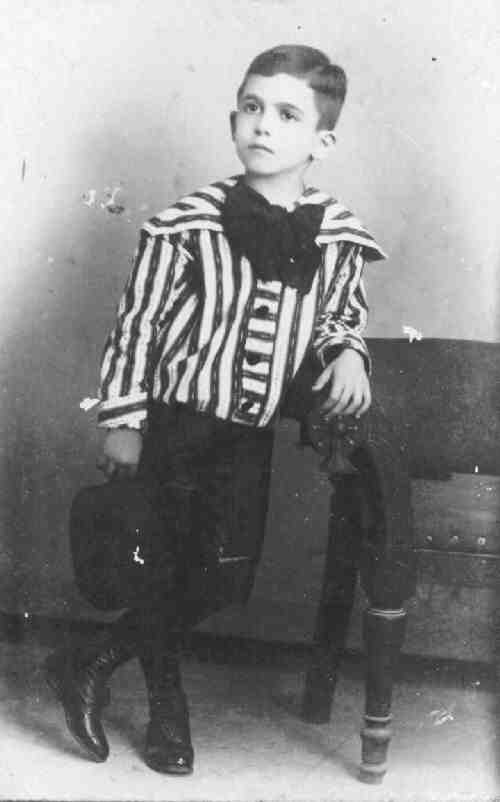
Figure 1.--This Spanish boy in the 1890s wears kneepants and long black stockings with a striped blouse and large floppy bow. Note the karge collar and back flap of the blouse. Also note the cap the boy is holding.

|
Figure 1.--This Spanish boy in the 1890s wears kneepants and long black stockings with a striped blouse and large floppy bow. Note the karge collar and back flap of the blouse. Also note the cap the boy is holding. |
Spanish boys commonly wore kneepants in the 19th century. Sailor suits were a popular style. By the 1930s boys commonly wore short pants and many boys wore smocks to school. After the 1960s short pants became much less common as most boys wanted to wear jeans. By the 1980s most Spanish children were wearing the pan-European styles of jeans, runnig pants, sweatshirts, and sneakers.
Spanish boys began to commonly wore kneepants in the 1870s. Sailor suits were a popular 19th century style that continued into the 20th century. Kneepants were the primary dress of Spanish boys in the late 19th century.
Spanish boys continued wearing kneepants in the 1900s. Knickers and short pants became increasingly common in the 1910s.
Spanish boys by the 1920s were wearing short panrs, knickers, and long pants. Short pants were very commn in the 1920s and 30s, but I am unsure as to the relative popularity of these styles. By the 1930s boys commonly wore short pants and many boys wore smocks to school. As a result of years of decline and the disatrous Civil War (1937-39), poverty was widespread. Clothing, especially children's clothing was the last thing on most people’s
minds, certainly the poor dressed in the most simple and useful clothes available.
Boys continued wearing short pants in the 1940s and 50s, although sailor suits passed from fashion--except for First Communion. Boys began to dress less formally in the 1960s, especially the second half of the decade when jeans began to be more commonly worn.
After the 1960s short pants became much less common as most boys wanted to wear jeans. The American influence became increasingly evident. By the 1980s most Spanish children were wearing the pan-European styles of jeans, running pants, sweatshirts, and sneakers.
HBC knows of no major boys fashion that developed in Spain. Boys fashions in SDpain appear to be mostly a reflection of styles developed in other countries.
Only limited information is available at this time on clothes worn by Spanish boys.
Smocks were worn by Spanish boys. Many elementary schools do seem to have required them, but I do not know if there was a national rule. There appears to
have been some regional differences, with destinctive styles in Catalonia. One Spanish contributor reports that boys in a small town near Barcelona wear a front
buttoning smock with a brown belt. Normally the whole of Cataluna wears the very same type at school, white with blue stipes and blue collar, pocket and cuffs. I
still, however, have little information on Spain. At this time we do not have information on Spanish smocks in general, but only school smocks.
I believe sailor suits were very popular in the late 19th as in most of Europe, ut have no specific image at this time. Sailor suits were being worn by boys for first communion even in the 1990s.
Boys commonly wore blouses in the late 18th century. I have limited information on blouse styles. I do not know how popular Fauntleroy blouses were. One image shows a boy wearing a destinctive stripped blouse with aclarge collar and back flap.
Boys in the late 19th century might wear large floppy bows with blouses.
Keepants were the primary dress of Spanish boys in the late 19th century. They continued to be worn until the 1920s. Knickers band short pants became increasingly common in the 1910s. Spanish boys by the 1920s were wearing short panrs, knickers, and long pants. Short pants were very commn in the 1920s and 30s, but I am unsure as to the relative popularity of these styles. By the 1930s boys commonly wore short pants and many boys wore smocks to school. After the 1960s short pants became much less common as most boys wanted to wear jeans.
Boys wore long dark stockings with kneepants. Socks began to be worn in the 1910s as boys began wearing knickers and short pasnts. White three-quarter or kneesocks might be worn with short pants for formal occasion. I am unsure wehat kind of socks were worn with knickers. Boysd were still wearing dark long stockings with knicketrs for formal occasions in the 1920s.
Spanish school children were commonly wearing smocks by the 1930s, although I am not sure when this paractice first began. Short pants were common until the 1970s. Young kindergarten age children still commonly wear smocks in Spain. It is no longer common, however, for older boys to wear them--but some still do. A Spanish contributor to HBC in 1999 reported school boys about about 7 or 8 years old still wearing the smocks over their street clothes.
First Communion in Spain has been a major event, as to be expected in a Catholic
country. Boys in the 1920s commonly wore formal dark suits, sometimes with wing collars and whire bowries. This is less so now, but ardently Catholic families still do attach great importance to the event. For the children it has become a bonanza, even exceeding Christmas, although only once. A Spanish contributor informs HBC that sailor suits are popular for boys' First Communion suits, even in the 1990s.
Some information is available on individual Spanish boys.
Salvador Dali: The 1910s

Navigate the Boys' Historical Clothing Web Site:
[Spanish choirs]
[Spanish ethnic groupa]
[Spanish movies]
[Spanish royalty]
[Spanish youth organizations]
Navigate the Boys' Historical Clothing Web Site:
[Introduction]
[Activities]
[Biographies]
[Chronology]
[Clothing styles]
[Countries]
[Bibliographies]
[Contributions]
[FAQs]
[Spanish glossaries]
[Satellite sites]
[Boys' Clothing Home]
Navigate the Boys' Historical Clothing national pages:
[Return to the Main countries page]
[Australia]
[Belgium]
[England]
[France]
[Germany]
[Ireland]
[Italy]
[Japan]
[Korea]
[Mexico]
[Scotland]
[]
[United States]