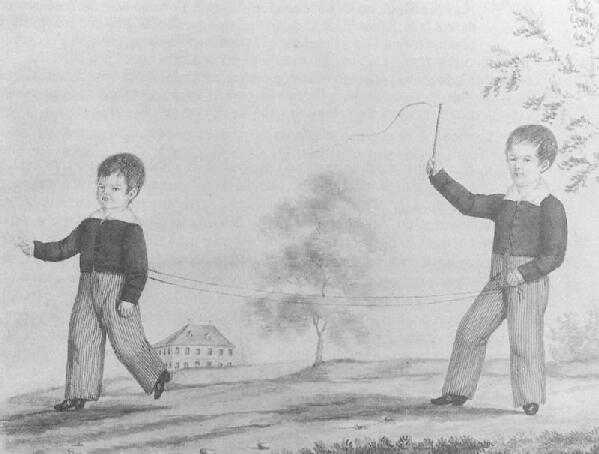
Figure 1.--This picce of naive art has been attributed to Wilhelm von Moll Berczy and is believed to have been painted about 1810. It shows two boys playing horse and harness. I'm not sure what country is involved here. |

|
Until the turn of the 20th century, horses were important in the lives of children and adults. Just as modern boys dream of driving cars, boys used to dream of driving and riding horses. It is natural that this desire was reflected in their play. Thus we note numerous images of children playing with what look like minature horse and reigns. We do not know what the game was called. They show surprising similarity to leading strings or child saftey harnesses. The context of these images with children involved on both ends, suggest that they are toys. We do not yet have, however, any actual contemporary written sources describing this type of play. We have noted thm depicted in the Sears catalog.
We are not sure when children began playing horsey. Our information dates from the early 19th century, but we suspect that children were playing this game well before the 19th century. The sources for this game come primarily from early 19th crentury drawings and paintings. The work here was painted about 1810 (figure 1) any shows a very simple rig. We notice an ad from a 1878 magazine offering clothing patterns that depicted a very elaborate rig. This means that the rig and gear were made especially as play items for children. We are not sure if the rig was for sale or an elaborate fantasy. There is also a 1900 illustration from Sears showing that this game persisted to the early 20th century when presumably the coming of the automobile changed children's interests. Apparently this game has not totally disappeared. A reader in Canada writes us, "I found a play harness last winter [2002] in a net store called Magic Cabin. It is a real soft harness made in Estonia or Germany. I remember in the 1970s When learning horse riding, my daughter played like this with her best friend to master technic of horsing." We have even noticed children playing in the 2000s, although generally with improvised gear.
As far as we can tell, playing horsey was a game popular throughout Europe and North America, if not the world. A reader tells us, "It was played in Tajikistan but you might have three or four boys being the horse. It was more like charioteer racing in a Ben Hur setting." We think, however, that playing horsey was a popular game in many different countries. The horse was a main form of transport throughout the 19th century. The train became important in the mid-19th century, but the horse was the most important form of family transport for most children throughout the century. This was true both in cities and rural areas. Thus children in all countries had experienes with horses. Our archive has large collections for the main countries, thus we do not have confirmation for the smaller countries. We have found several images from the larger countries. We can thus confirm that playing horsey was popular in the 19th century and ecen in the early-20th century. Most of our information is about America. We note children pklaying horsey in many different countries, including Germany.
Children like to play with items from their everyday life. Moder children like to play with cars and airplanes. Children in the 19th cenntury were no different. Until the turn of the 20th century, horses were important in the lives of children and adults. Just as modern boys dream of driving cars, boys used to dream of driving and riding horses. It is natural that this desire was reflected in their play.
The childrrn had fun both pretending to possess a horse or pretending to be the horse. It was primarily an outdoor game. We do not know what the game was called. We use the term horsey, but we are not entirely sure this term was commonly used in the 19th century.
Playing horsey seems to have been primarily a boys' game, but we do see girls playing as well. Here we suspect having older brothers was a factor. We have found a few images of girls playing horsey. Much more common, however, are images of boys playing horsey are groups of boys with only a girl or two. Here chronological trends complicate our assessment. The images from the 19th century are mostly staged studio image. We have actual snap shots from the 20th century which provide more relaistic play images. Theese are early-20th cenbtury images. After World War I in the 1920s, olaying horsey decilned in popularity.
We note numerous images of children playing horsey. Some have minature horse tackles, harness and reigns. They were made for children to play with. We suspect that these were items that the children or their parennts improvised rather than purchased. We have noted them depicted in the illustrations from the Sears catalog. We are not sure though if Sears actually old these for children or if they just appeared in the catalog illustrations, such as the 1900 catalog. A reader writes, "I don't think the Sears catalog illustraation depicts leading strings are harnesses. I think the two children are playing horsey like the children depicted on this page."
We do not yet have, however, any actual contemporary written sources describing this type of play.
The children here are dressed similarly, suggesting that they are brother. They do not appear to be wearing skeleton suits, but there are similarities, short jackets and long pants. The dark-colored jackets areworn with light-colored long pants. Both boys have jackes buttoned to the collar and white collars, although the collars are different. Neither wear hats although they are outdoors.
The play harnesses and reigns show surprising similarity to leading strings or child saftey harnesses. The context of these images with children involved on both ends, suggest that they are toys. There were also many 19th century images of leading strings and saftey harnesses.
Iona and Peter Opie, Children's Games in Street and Playground (Oxford University Press, 1969)

Navigate the Boys' Historical Clothing Web Site:
[Return to Main individual games page]
[Return to Main outdoor games page]
[Introduction]
[Activities]
[Biographies]
[Chronology]
[Clothing styles]
[Countries]
[Bibliographies]
[Contributions]
[Essay]
[FAQs]
[Glossaries]
[Images]
[Links]
[Registration]
[Tools]
[Boys' Clothing Home]
Navigate the Boys' Historical Clothing Web Site:
[Skeleton suits]
[Fauntleroy suits]
[Sailor suits]
[Sailor hats]
[Buster Brown suits]
[Eton suits]
[Rompers]
[Tunics]
[Smocks]
[Pinafores]