|
Parks existed before the 19th century, but it was in the 19th century that they came into their own. As industru=ial cities grew, it was incesinky seen that gree areas for the city eidents were neded. Many of the most famous parks, like New York's Central Park, were opened in the 19th century. Some parents used to dress their children up even for park outings. An important event in the daily life of nursery-bound children were daily outings to the parks which were created in important European and American cities. Many autobiographies of British, European, and American cities recall outings to Hyde and St. James Parks (London) and Central Park (New York) and a long list of smaller parks. Some of the first European zoos were attractions built in these parks. Many property owners maintained private parks in cul de sacs in their own neighborhoods. This and linked pages seeks to show the clothing worn by boys for these outings during various historical periods.
Urban parks did not first appear in the 19th century, but they are largely a 19th century phenomenon. There were some precents. European nobility had estates with beautifully manicured grounds. There were also village greens. Urban planners were concerned with the honrendous conditions in the expanding urban centers in Europe and America. We are not sure about the early development of urban parks in Europe. Quite a fe of the European parks are very famous, such as Hyde Park, Luxembourg Gardens, Tivoli, and many others. Parks began to ppear in Anerica during the second half of the 19th century. The 1863 draft riots in America had a significant impact on city officials. Central Park had a major impact on American thinking. Many decided that the urban poor needed to be provided green space for outings. The general approach for developing American parks was to create parks on the outskirts of the city. Growing up in Washington, D.C., I remember Glen Echo. New Yorkers had Coney Island. Gradually cities expanded and enveloped many of these parks. Some were used for specialised purposes like zoos and museums. Cities began building neigborhood parks to provide green spaces and recreational areas within walking distances of urban parks. With the move to the suburbs, municipalities created municipal parks. The rules associated with using the parks as well as the expense at getting there mean that the parks were more used by the middle-class and affluent. They were often show places for the latest fashion.
With the growrg of industrial cities, and the trerrible living conditons, it was seen as necessary to ceate green areas in the cities--the origin of mzny moden urban parks. These parks became very popular for peoople of all classes. some are well know, commonly beloved parts of city life. As The parks and clothing worn for park outings has varied greatly over time. There also were differences among countries. We have begun to collect some basic information about different chronological periods, both on the parks themselves and the fashions we note being worn. Even though park visits were esentially
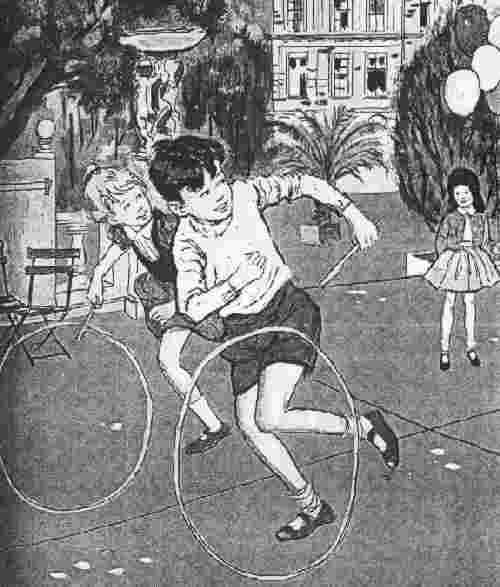
play outings, the Victorian child was often outfitted in rather formal clothes for these outings. Unfortunately, the photographic record offers few insights into clothing styles for park outings for most of the 19th century. Drawings and paintings offer some insights as do memoirs of the era. Hoopand sticks were popular in Victorian Europe and America.
After the turn of the century photography moved out of the studio and began supplying outdoor images.There is a much fuller understanding of clothing trnds during the Edwardian period as there are many available outdoor photographs, because cameras were now in the hands of amateur photographers. Outfitting boys for outings to the park in the years after World War I meant less formal wear than in the past. Fauntleroy suits were no longer seen and sailor suits became less common. More commfortable, less confining clothing appeared. Clothing after World War II continuing the informal styles that appeared after World War I. Increasingly comfort emerged as a key attribute and the child's preferences became increasingly important.
The idea of an urban park, green spaces within the city was a novel idea in the mid-19th century. And the idea at first was a far cry from the modern concept. The initial concept was a rather formal one. Some kind of fountail or other water feature suronded by emaculately kept gardens. There were also often heoic often equestrian monuments to great leaders, but water features proved the most popular. The idea was for sedate strolls by couples or families through establish paths. 'Keep off the grass' signs were common. They were not for children, especially unaccompanied groups of children to run loose. The only place where we tend to see groups of children were around the water features where they could bring their and test out their sail boats. Feeding the ducks and other water fowl was also popular. Atually getting in the water was not at first encouraged. Here there was an exception. Italy had nany piazzas. These were not precisely parks and not green spaces. But they had public water features including famous fountains where children could covort and play. Over times the idea of public parks changed, especially after World War II. The idea of playing sports in a park is a very modern phenomenon.
An interesting feature of public parks was photography. We see a lot of images taken in these parks. Most 19th century photography was studio photography. But at the turn of the century with the advent of the Kodak Browie we see an explodion of family snapshots, including park visits. The Browine and the various immitators brought down the cost of amateur fmily photography as sell as making it absurdly simple. Brinf placing your thumb over the lens, you could not mess up the image. Most middle-class families could afford cameras, but this was not the case for most working-class families. This photographers set up shop in parks and pther popular public places. Rgis could be done with virtully no money. All one needed was an inexpensive camera. Thus we not only see family snapshots, but pphotographs taken by these enterprising park photographrers.
One interesting question is how commonly smocks were worn. I can not substantiate this, but I believe smocks in England and America were primarly worn in the nursery and for play around the home. I think the smock was considered to be much to informal a garment to be worn for outings to the park which was considered to require more formal atire. Smocks seem to have been, as discussed above, considered more acceptable wear for outings in other countries such as France. Might preliminary thoughts on this issue, however, are based on a very small number of images and personal accounts. Thus I'd be interested in any comments visitors to this site might have. The Llewellyn-Davies boys of Peter Pan, for example, would wear their smocks to the park--of course Kensington Gardens.
|
The centrasl city parl developed as an important institution in several European countries. In Europe these parks in many cases evolved out of long accepted park areas. In the much newer American cities, purpose belt parks were created such a New York's Central Park. Some of the best known parks were in London and Paris, bit birtually every important city opened parks. The clothes worn to these parks are a fascinating indicator of national styles and fashion conventions.
Attitides toward what activities were allowed in parks evolved over time. Some cities wanted parks reserved for quiet reflective stroles. Gradually the parks became more receptive to children playing, but even today regulations vary widely from park to park. Perhaps the activity most associated with the park is the hoop and stick. One of the popular activities for the park was the hoop and stick. The park was popular because some open spaced was needed to have a good run. Perhaps the most democratic of all outdoor toys was the hoop and stick as the hoops were so readilly available. Marbles were ceratinly popular. A popular activity evolved around the ponds in many parks. I don't think the children were generally allowed to swim or paddle in the ponds. Here I am not positive, but the absence of images of children splashing in the ponds leads me to suspect that this was not common. I'm not sure why this was, perhaps to maintain amore tranquil environment. Children were often allowed, however to sail toy boats in the ponds and this seems to have been quite common. Many photographs do show children around park ponds sailing boats.
Some interesting information is available from accounts of the day as well as littery references.
Some of the more interesting accounts of the day and scholarly references include:
General--Bailey, Peter: Bailey has written a masterful survey of Victorian leisure. Ther may have been some more recent work on on parks since, but I am unaware of any.
England--Punch: A browse through some volumes of Punch you'd find a good many helpful cartoons set in parks and at the zoo; artists like Charles Keene and Linley Sambourne were very good at capturing how ordinary people in such places dressed.
England--Brooks, Shirley: The diaries of Shirley Brooks (an editor of Punch and miscellaneous writer) from the 1860s and early 1870s provide some interesting information about Victorian parks.
He and his family lived very near Regent's Park (then it was still called "the Regent's Park"), and he and his wife frequently took their two boys
there, usually on a Sunday to the Zoological Gardens. He often remarks that they frequently saw a great many people they knew on these outings, usually writers and painters of their acquaintance. His boys were there
by themselves on the day of the terrible accident in the park on January 15, 1867, when the ice broke on the main pond and dozens of people drowned. It was common for the Brooks family's to use the park. It was a routine
recreation for both parents and children. When the boys were off at school, Brooks and his wife would often take a stroll there by themselves.
England--Roberts Robert: Roberts makes a brief reference to visiting Peel Park, Salford in
the Edwaridan period in his working-class autobiography, A Ragged Schooling. He referes to taking a bucket with him in order to collect some good soil with which to grow geraniums back at his house. He also refers to visiting the free library and museum which were both located within the park.
Interesting insights from novels incude:
England--Barrie, James: Barrie's The Little White Bird
(1902) contains many references to Kensington Gardens, a good picture of
what park visits were like for Edardian children.
England--Thackeray, William M.: Thackeray in Chapter 37 of
Vanity Fair (1848) we learn that Rawdon Crawley takes his little
son to Hyde Park, walking by him while he rides on a pony. One day they
meet little Georgy Osborne there, who has been taken to the park by his
grandfather. In Chapter 38 we learn that Georgy's grandfather takes him to various parks
or to Kensington Gardens every Sunday to see the soldiers or feed the
ducks. In Chapter 41 Rawdon, while away from London with Becky, receives a letter
from his son, who says: "The pony is very well. Grey takes me to ride in
the Park." Grey presumably is a servant.
France,--Proust, Marcel: Proust's Remembrance of Things Past
has some descriptions of (Marcel) the narrator's park visits as a child
(and older) in Paris--but you have to wade through a torrent of rather
tiring text.
United States,--Norris, Frank: Norris provided a detailed
description in McTeague (1899) of accompanying Trina Sieppe and her
parents to the park for a picnic. Norris carries out the particulars
for several pages. The occurs in the first 1/3 of the novel.

Navigate the Boys' Historical Clothing Web Site:
[Return to:Main activities page]
[Introduction]
[Activities]
[Biographies]
[Chronology]
[Cloth and textiles]
[Clothing styles]
[Countries]
[Topics]
[Bibliographies]
[Contributions]
[FAQs]
[Glossaries]
[Images]
[Links]
[Registration]
[Tools]
[Boys' Clothing Home]
Navigate the Boys' Historical Clothing Web Site:
[Sailor suits]
[Sailor hats]
[Buster Brown suits]
[Eton suits]
[Rompers]
[Tunics]
[Smocks]
[Pinafores]