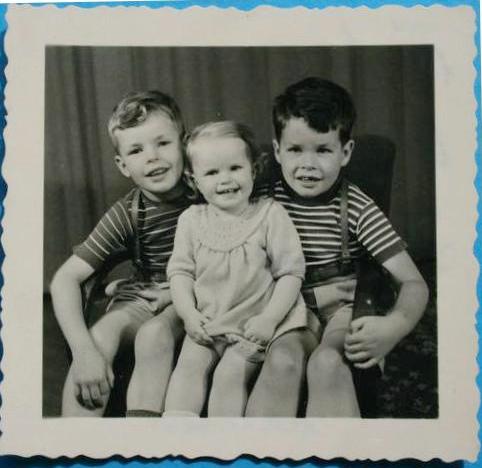
Figure 1.--This small black and white snapshot shows a trio of Belgian children taken in July 1950. Notice the wide white border and serrated edge. The dealer suggested it measured 6 x 6 cm, but it does not look square. |

|
We have been unable to find much information about photography in Belgium. We do note that some of the first forensic photographers were taken in Belgium (1843). That was only a few years after the invention of the Daguerreotype priocess. We notice relatively few Dags and Ambros, but the same was true for France and Germany as well. We first begin to see large numbers of photograohic images when the albumen process and the CDV becomes popular (1860s). We have not, however, archived many Belgian CDVs and cabinet cards so we do not yet know much about 19th centiry Belgian photography. The photographs we have archived suggest that Belgian photography followed the same basic trends prevalent in neigboring France and Germany. Belgium had a very strong chemical industry and Belgian companies manufactured photographic paper. Gevaert Ridax was an important manufacturer of photographic paper. Leo Hendrik Baekeland (1863–1944) was a Belgian chemist who invented Velox photographic paper (1893). Velox became the basis for Kodak photgraphic paper. We have not yet found much information on Belgian photographers. We do note the Baker-Johnsons, but their work is primrily associated withn the United States. We know much more about the 20th century and have a small, but growing number of Belgian images. The most important museum of photography in Europe is located in Charleroi, the largest city in Wallonia. It is situated in the former Carmelite monastery of Mont-sur-Marchienne.
We have been unable to find much information about photography in Belgium. We do note that some of the first forensic photographers were taken in Belgium (1843). This suggests that photography ws well-accepted in Belgium from a very early point. That was only a few years after the invention of the Daguerreotype priocess. We notice relatively few Dags and Ambros, but the same was true for France and Germany as well. We first begin to see large numbers of photographic images whgen the albumen process and the CDV becomes popular (1860s). We have not, however, archived many Belgian CDVs and cabinet cards so we do not yet know much about 19th centiry Belgian photography. The photographs we have archived suggest that Belgian photography followed the same basic trends prevalent in neigboring France and Germany. We know much more about the 20th century and have a small, but growing number of Belgian images.
We note the same types of photographic images in Belgium that we see elsewhere in Europe. As in other European countries we note very few Dags and Ambros, especially the cased images that were so common in America. We have not yet found many of the early formats from Belgium. Belgium is a small country, but it was a reasonably prosperous country in the 19th century. Economic prpsperirty is closely associated with the photographic industry and photographic record. So we hope to eventually find examples of the early formats. The first paper prints we notice are salt prints. We believe that there were large numbers of CDVs and cabinet cards although we have found very few so far to archive. We do have quite a number of 20th century images both portraits and snapshots. Most 19th century photographs were portraits. After the turn-of-the 20th century we begin to see a lot more Belgian photographs. We see snapshots which became and important part of the photographic record. Most come from the post-World War I era beginning in the 1920s. We note snap shot prints done in different shapes, including the square print here from the 1950s (figure 1). We also note a range of borders including smooth and ragged, serrated borders. Here we see the serrted edges in the 1950s. Some portraits were done on the same photogrphic paper used for snapshots. These various characteristics are useful in dating snapshots.
Belgium had a very strong chemical industry and Belgian companies manufactured photographic paper. Gevaert Ridax was an important manufacturer of photographic paper. Leo Hendrik Baekeland (1863–1944) was a Belgian chemist who invented Velox photographic paper (1893). Velox became the basis for Kodak photgraphic paper.
We have not yet found information on Belgian photographers. We do note the Baker-Johnsons, but their work is primarily associated with the United States. We note a more modern
photographer, Jeffrey Vanhoutte. He is concerned with creating images, not with recording actual images found in reality which HBC is proimarily concerned. He became interested in photography as a boy. His parents encouraged his interests and provided him a camera. He took photographs on school trips. He attended the Coloma School in Mechelen and earned a degree in professional photography. He began his professioinal career t age 21 years. He now hs his own studio. He works in the commercial and advertising spheres. He often adds an element of humor to his images, but characterictically in a subtle way.
The most important museum of photography in Europe is located in Charleroi, the largest city in Wallonia. It is situated in the former Carmelite monastery of Mont-sur-Marchienne.

Navigate the Boys' Historical Clothing Web Site:
[Return to the Main photography country page]
[Introduction]
[Activities]
[Biographies]
[Chronology]
[Clothing styles]
[Countries]
[Photography]
[Bibliographies]
[Contributions]
[FAQs]
[French glossary]
[Dutch glossary]
[Images]
[Links]
[Registration]
[Boys' Clothing Home]
Navigate the Boys' Historical Clothing Belgin pages:
[Return to the Main Belgian page]
[Belgian catalogs
[Belgian choirs]
[Belgian movies]
[Belgian royals]
[Belgian schools]
[Belgian youth groups]