
The NAZI Era: Racial Policies -- Blacks (1933-45)
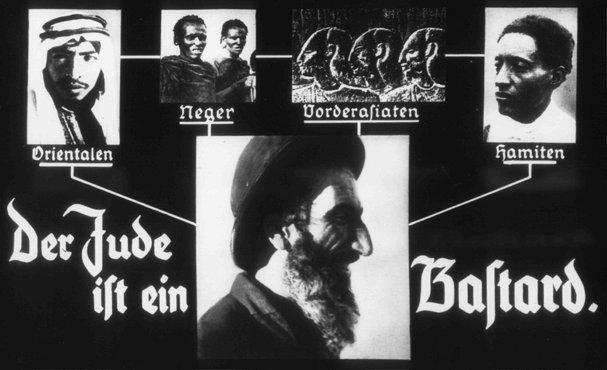
Figure 1.--NAZI racial hatred was not just directed at Jews. Other peoples were also deemed inferior. This frame from a NAZI film strip was made to be shown in schools. The caption reads "The Jew is a bastard." The image was meant to link Jews to others deemed inferior--eastern peoples, blacks, Mongols, and east Africans. Note an Arab was chosen to illustrate eastern peoples while at the same time the NAZIs were attempting with some success to gain support in the Arab world. Also note the reference to Mongols while at the samne time signing the Axis agreement with Japan.
|
|
Less know than the NAZI war against the Jews and gypsies is the NAZI actions against blacks. Less well publicized is the actions aginst blacks. Most readers are aware of Hitler's reaction toward American black athelete Jessie Ownens at the 1936 Olympic Games. Interestingly Jessie Owens was quite popular among the spectsators and other aththeletes. The NAZIs had a special dislike of blacks because the French had used African soldiers for occupation duty in the Saar which they occupied after World War. The result was thousands of German children with African fathers left behind when the French withdrew from the Saar. The children were despised by most Germans, not just the NAZIs, who considered them a blot on German honor. The children grew up thinking that they were Germans. Some were even moved by Hitler and his appeal. This is one of many examples of how even non-Aryan boys were moved by Hitler and NAZI pageantry. There were many examples of Jewish boys having the same feelings, testimony to the powerful affect that the NAZI movement had on German boys. Regardless of background, most German boys wanted to participate in the Hitler Youth movement, to wear the uniform and belong.
Historical Background
Germany before World War I had very few people of African descent. The Kaisser like other European leaders carved out African colonies, but much more recently than countries like England and France. Thus very few of their colonial subjects or other blacks had managed to emigrate to Germany. German racial policies in its colonies were stricter than in the other European colonies. German authorities, for example, prohibited inter-racial marriage. This situation changed in the aftermath of World War I. The French used African soldiers for occupation duty in the Saar which thy occupied after World War I. The French seem to have consicously selected the African troops as an insult to the Germans. Many if not most Germans, who even before Hitler were very race conscious, despised what they saw as a dark-skinned "invasion". There were further consequences. As in all occupations, there was fraternization between the French soldiers and German women. The difficult economic conditions after the War encouraged this. Many Germans actually starved to death in 1919-20. French troops occupied the Rhibeland and the Saar for an even longer period. The result was thousands of German children with African fathers left behind when the French withdrew from the Saar.
German Outrage
Most Germans, not only the NAZIs, considered these children a national disgrace. They were to as "Rhineland Bastards" or the "Black Disgrace". Hitler in Mein Kampf wrote that he would eliminate all the children born of African-German descent because he considered them an "insult" to the German nation. "The mulatto children came about through rape or the white mother was a whore," Hitler wrote. "In both cases, there is not the slightest moral duty regarding these offspring of a foreign race."
NAZI Forced Sterilizations
The NAZIs when they seized power did not set about killing the mixed race mulatto children. This was probably beause they addressed this issue before World War II and the adoption of the Final Sollution. Also an Aryan parent was involved. The NAZIs set up racial courts to deal with many aspects of the Nuremberg Laws. These courts issued mandatory sterilization orders for thousand of Germans, mostly youths. These orders were issued for large numbers of handicapped youths. Scientifuic understanding of genetics was still very limited in the 1930s and many of the handicapped indiduals sterilized were afflicted with handicaps tht were not hereditary in nature. The issue of the mullato children was of such importance to the NAZIs that it was not handled in the ordinary racial courts. The NAZIs established a secret group, Commission Number 3, to organize the sterilization of mulatto children so as to protect the purity of the Aryan race. NAZI officials in 1937 directed local authorities to submit a list of mulatto children. The children were taken from their homes or schools without parental permission and examined by commission members. The children would have been about 12-16 years old. Once a child based upon his physical appearance was decided to be of African descent, he or she was taken immediately to a hospital and sterilized. About 400 children were medically sterilized in this manner--often without their parents even knowing.
T4 Euthenasia Program
We believe that race may have been a factor in the T4 Euthenasia Program. Thusindividuals with disabilities (physical and mental) weremore likely to be selected if the were Jewish, black, or gyseys. We need to investigate this in more detail.
Schools
We have little information at this time as to how mulatto children were treated in German schools, both by the authorities and the other children. We do have the account of one individual, Hans Massaquoi, (See "Personsal Accounts" below.) A factor here is the relatively small number of these children.
Jesse Ownes
Most readers are aware of Hitler's reaction toward American black athelete Jessie Ownens at the 1936 Berlin Olympic Games. It is often mentioned that Hitler refused to shake Jesse Owen's hand after Owens defeated well known German runners and won the gold medal in running. A reader writes, "It is not certain whether this really happened, because not all gold medalists were expected to meet with the Führer. If it happened I won't be surprised considering the racial attitude in Germany at that time. On the other hand Jesse Owens was so popular with the public that he received many invitations. He also could board a Berlin city bus without being forced to sit in the rear." Despite NAZI attitudes toward Blacks, Jesse Owens was very popular in Germany, ironically perhaps more popular than in America at the time. Leni Riefenstahl highlighted Owens in her "Olympic Games" documentary and Owens had no trouble in boarding public transportation or entering restaurants or bars in Berlin. These were things he could not do in the American South and even in many northern hotels and restasurants. When Jesse Owens and the other black athletes returned to the United States they had in the South sit in the back of the bus and were forced to use water fountains and toilets with the sign: "Coloreds Only".
Personal Account
Hans Massaquoi was a German boy of mixed African-German parentage. He grew up in the NAZI era. His moving account, Destined to Witness : Growing Up Black in Nazi Germany depicts the trauma of his childhood and his survival. He recounts that as a small boy how he was fascinated and even moved by Hitler. This is one of many examples of how even non-Aryan boys were moved by Hitler and NAZI pageantry. There were many examples of Jewish boys having the same feelings. This is testimony to the powerful affect that the NAZI movement had on German boys. Regardless of background, most German boys wanted to participate in the Hitler Youth movement, to wear the uniform and belong. Massaquoi admits that he was seduced by NAZI busywork and organized pageantry. Then as he grew older and began to realize that there was no place for a non-Aryan in the Third Reich, he felt betrayed.
NAZI Anti-Black Propaganda
Goebbel's propaganda machine created quite a bit of anti-black propaganda. NAZI propaganda depicted friendship between whites and blacks in a negative light. The subject was addressed in film strips made to be shown in schools. Some of it was aimed at making a connection between blacks and Jews. Some of it was aimed at creating a negative image of America. Common thesems were to label American as degenerate because of Jews, blacks, jazz music (linked to blacks), and gangsters.
World War II
NAZI racial policies had a major impact on World War II. Groups targeted by the NAZIs were promarily Jews, Slavs, and Gypseys. Blacks were also affected, Blacks were less affected, primsarily because they were affected in smaller numbers. When the French surrendered (June 1940), the Whermact shot quite a few of the men in black colonial units instead of taking them as POWs. There are many eye witness accounts from white French soldiers. This was not the case of American POWS. Of course, the United Sates was not a defeated nation. Unlike Polish and Soviet POWs, American POWs were held in POW camps run by the Wehrmacy. Many were Luftwaffe camps because most American POWs were airmen until 1945. Although treatment varied from camp to camp, there was no centrally organized action to treat Jewish and black American POWs differently. At some camps, guards tried to promote racial discord. This was generally not sucessful. The Germans took few black American soldiers prisoner. Most American Pows until the Normandy D-Day invasion were airmen and there were few blacks in the Air Corps. German policies changed in the last few nonths of the War, primarily because of the increasing influence of the SS. After the Germans launched the Bulge offensive, they did attempt to identify Jewish POWs and some were sent to concentation camps rather than POW camps. [Kane, pp. 238-39.] I do not know of actions directed at black American POWs.
Post-World War II Occupation
Black American soldiers werwe involved in the occupation of Germany after World War II. Two historians point out that Germany was very special place for black soldiers, because in Germany they experienced a society without legal restrictions based on race for the first time. When they came to the land of Hitler and Nazism. They thought they would have a rough time as black soldiers. But in reality, they experienced the exact opposite. The black soldiers were treated very well and they could go into any bar or restaurant - and even date white women. The Americans abolished Nazi- race laws in 1945. [Höhn and Klimke] The American black press questioned why their government could not do in Washington what it did in Germany. [HBC: The reason of course is the United States had a Constitution which convey considerable power to the states.] America's South did not get rid of the post-Civil War Jim Crow laws until the 1960s. Black GIs in World War I had the samne experience in France. And during World War II had the same experience in England. A factor of course is blacks like other GIs had relatvely high salaries and access to scarce consumer goods. German women were attractted to GIs, both black and white, in part because of the abject poverty of post-War Germany. Conditions were very difficult in Germany after World War II and did not begin to improve until the German Economic Mirricle of the 1950s. It is surely inaccurate to portray the Germans as race blind. A prticularly toughy issue for the Germans was that about 5,000 of the 67,700 children father by GIs were mixced-race children fathered by black GIs. These children were almost impossible to adopt in Germany. Many were eventually sent to the United States for adoption. It is correct, however, that many Americans had deep-seeded racial prejudices.
Reader Comments
A reader writes, "You are right when you point out that Germany was not a very tolerant country before 1933, especially towards black citizens (offspring of French colonial troops after 1918). What came after 1933 was even worse and lead to the Holocaust. We all know that. So it is somewhat amazing that black American soldiers in many ways were treated better than one would expect after years of insane racism. Could it be that the Germans finally understood that THEY themselves were the underdog? Of course the laws had much to do with it. There also was a time under Mao that the Chinese were not allowed to smile at foreigners or even talk to them and ... they obeyed! I have heard that from an American friend who had been in China during the little red book period." Yes, racicm is a very complicated and important topic as well as one that is often difficult to discuss because of stroingly head beliefs. Sometimes it exists without government intervention, but often as with the American South, Tsarist Russia, or NAZI Germany, it was inshrined in law and extra-legal violence. Once the constraints of law are removed, such as Germany after the War, attitiudes at least with some individuals can change very rapidly, especially if status and financial roles are reversed. What other factors were involved in Germany are not entirely clear to us. Changing laws of course is vital. Many of us who grew up in the South were surprised as to how rapidy the region changed after the passage of the Civil Rights Laws (1964 and 65). It is also interesting to note how racism can persist. In Europe today, espcially in Eastern Europe, you have the experience of anti-semitism without Jews. Another phenomenon is reverse racism such as denying promotions to Mewark, New Jersey firemen because they are white or President Obama's willingness to condemn a white policemen on natioinal television when he admited he did not know the facts of the case. Here a largely unexplored topic is the impact on a people who are constantly told that their problems are the result of racism rather than taking responsibility for personal choices.
Sources
Höhn, Maria and Martin Klimke. GI's and Fräuleins. These two German historians discuss the relationship between black American soldiers and the civil rights struggle in the United States.
Kane, Robert B. Disobedience and Conspiracy in the German Army, 1918-1945
Massaquoi, Hans. Destined to Witness : Growing Up Black in Nazi Germany.
HBC

Navigate the Boys' Historical Clothing German pages:
[Return to the Main NAZI racial policy page]
[Return to the Holocaust targets page]
[German choirs]
[German scouts]
[Hitler Youth]
[German school uniforms]
[German royalty]
[German sailor suits]
[Lederhosen]
[Ethnic]
[Tights]
[Long stockings]
Navigate the Boys' Historical Clothing Web Site:
[Introduction]
[Activities]
[Biographies]
[Chronology]
[Clothing styles]
[Countries]
[Bibliographies]
[Contributions]
[FAQs]
[Biographies]
[Images]
[Links]
[Registration]
[Boys' Clothing Home]
Created: February 16, 2002
Last updated: 8:47 PM 7/25/2009