|
HBC has little information on boy's clothing before the 19th century. We do, however, have information beginning in the 19th century. English fashions are clearly dominant, but the poverty rife in Ireland often prevented boys from dressing in more than rags. The Potato Famine of the 1840s devestated Ireland and despersed the Irish popultion to America and other countries. Economic conditions gradually improved in Ireland. Clothing styles in the 20th century have been virtually indestinguishable from English styles.
England ruled Ireland for about seven centuries. It had been Irish raiders that had terrorized Roman Britain. St Patrick in fact had been a Britain captured by Irish raiders and brought back to Ireland as a slave. This changed after the Norman conquest of England. For the first time a strong centralized Englisg state was able to projects its power on a Ireland that had not yet coalesed into a nation. After the Reformation the power calculations changed. A still Catholic Ireland was used as
tool by a succession of Catholic monarchs (Philip II, Louis XIV, and Napoleon) to threaten England. Catholic power in Ireland was finally broken by William III at
the Battle of the Boyne and the last challenge of James II to regain the throne. The Catholic Irish were disenfranchised and lost tutle to their land, become a landless
peasantry. While the World War ended in 1918, the IRA led by Michael Collins led a violent struggle for Independence and the English responded in kibnd with the Black and Tans. Britain finally granted indeoendence to the Irish Free State.
We have very limited information on Ireland during the 19th century. Our photographic archive is very small. Ireland is a small country to begin with and at the time that photograph appeared, so did the terrible Potato Famine. The result is arelatively limited photographic record. reland in the 19th Century was part of the United Kingdom. Well to do Irish boys dressed just as English boys of the era. Most of the well to do were the Anglo Irish. We notice Irish boys wearing Eton collars. http://histclo.com/style/shirt/collar/eton/cou/ecc-ire.html The Catholic natives of Ireland were disenfranchised and the land divided up among Protestant Englishmen. The Anglo Irish were educated in English schools or English-oriented schools in Ireland and adopted English styles and customs. The Catholic population dominated the countryside. Poverty was rife in Ireland, even before the Potato Famine. Numerous reports decribe a rural peasantry living in apauling conditions. One visitor to Galway describes people dressed in rags. He writes about "... rags insufficient to cover the children and boys of twelve running around absolutely naked...." As the Industrial Revolution progressed, the circumstances of rural workers in both England and Ireland deteriorated. Througout the 19th Century boys were commonly outfitted in dresses until they were 12 or 13 years old. This practice was most common in rural areas, but it was not unknown in towns. Folk lore warned mothers to hide their boys from the "faries," so they were dressed as girls.
Ireland in the 19th Century was part of the United Kingdom. Well to do Irish boys dressed just as English boys of the era. Most of the well to do were the Anglo Irish. We notice Irish boys wearing Eton collars. http://histclo.com/style/shirt/collar/eton/cou/ecc-ire.html The Catholic natives of Ireland were disenfranchised and the land divided up among Protestant Englishmen. The Anglo Irish were educated in English
schools or English-oriented schools in Ireland and adopted English styles and customs. Thus the English boys clothing page provides a good over view of clothing styles also worn in Ireland. It was in the 19th Century that Gaelic became less commonly spoken. By the end of the Century it was found less and less, except in the more isolated rural areas.
The Catholic population dominated the countryside. Poverty was rife in Ireland, even before the Potato Famine. Numerous reports decribe a rural peasantry living in apauling conditions. One visitor to Galway describes people dressed in rags. He writes about "... rags insufficient to cover the children and boys of twelve running around absolutely naked...." [Frounde in Dunn, p. 69.] As the Industrial Revolution progressed, the circumstances of rural workers in both England and Ireland deteriorated. The conditiin was worse in Ireland because so few people owned land and because there were little alternative to agricultural labor. As bad as conditions were in the early 19th century, conditions became disatrously worse in the 1840s during the Potato Famine. The Irish died by the thousands. The disaster of the Famine and British policies desimated the island's population.
|
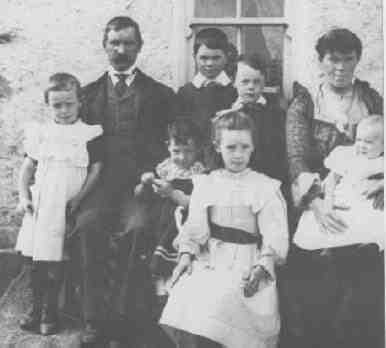
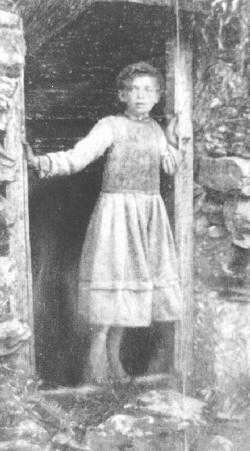
Througout the 19th Century boys were commonly outfitted in dresses until they were 12 or 13 years old. This practice was most common in rural areas, but it was not unknown in towns. Folk lore warned mothers to hide their boys from the "faries," so they were dressed as girls. Rural Irish boys often wore dresses until 12 or 13. The poverty of rural Ireland was one factor. The Irish superstition was that the farries would steal boy children and thus it was necessary to dress them as girls was another factor. The grandfather of the American novelist ????, for example, arrived in America at 12? still wearing a flannel dress. This practice was particularly commen in the wild western counties of Ireland where the Celtic tradition and Irish language persisted throughout the 19th century. The custom became less common in the late 19th Century, but was still prevalent in some areas until after World War I (1914-18).
Irish boys in the 20th century dressed much as British boys. It is very difficult to tell Ireland and Briain apart because the clothing was so similar. There were some limited differences in the early-20th century. We see the lingering custom for the first few decades when some boys still wore flannel dresses. Also we see boys more commonly going brefoot in Ireland. This was basically a reflection that Ireland was more rural and less prosperous than Britain. Of course Ireland was still part of Britain until after World War I. Irish boys at lest in the cities and towns dressed essentially like British boys of comparable economuc circumstances. In the rural areas some boys were still dressed in traditional frocks, especially in the more isolated western counties. Many Irish youths served with the British Army in France, many of whom had bever before been far from their home. The Easter Rebellion in 1916 began the struggle for independemce. We have little information about clothing trends in the inter-war period. While the World War ended in 1918, the IRA led by Michael Collins led a violent struggle for Independence and the English responded in kibnd with the Black and Tans. Britain finally granted indeoendence to the Irish Free State. Despite the animosity toward England, Irish boys continued to dress in almost ientical fashions that English boys wore. Fran McCord's autobiographical book, Angela's Ashes, has some excellent descriptions in the book on clothes worn in the 1940s by poor Irish boys. I would think that the descriptions would apply to any poor household in those days. HBC has not yet, however, been able to review the book. Both the ordinary everyday clothes worn by Irish boys and their school uniforms have generally followed British school uniform fashionsd. Boys
wore short pants and knee socks through the 1950s. One HBC contributor tells me that through the age of 12 he wore worsted flannel short pants to school and in the summer time "I wore beige cotton shorts which had legs that almost touched my knees". It was some time around the late 1960's that one Irish contributor tells me that he remembers reading an article in the Irish Independent, an national Irish paper, reporting on a
childrens' fashions, stating that for 1969 mini-shorts were in for boys. It was almost from that point onwards that Irish boys began wearing shorter shorts. While boys, especially younger boys, began wearing shorter shorts, many older boys in the 1960s began wearing jeans and other long pants.
Dunn, Waldo Hilary. James Anthony Frounde: A Biography (1818-1856) (Ocfotd University Press: Oxford, 1961).

Navigate the Boys' Historical Clothing Web Site:
[Return to the Main Irish page]
[Introduction]
[Activities]
[Biographies]
[Chronology]
[Clothing styles]
[Countries]
[Bibliographies]
[Contributions]
[FAQs]
[Glossaries]
[Images]
[Links]
[Registration]
[Tools]
[Boys' Clothing Home]
Navigate the Boys' Historical Clothing Irish pages:
[Return to the Main Irish page]
[Irish choirs]
[Irish dresses]
[Irish ethnic]
[Irish school uniform]
[Irish youth groups]
Navigate the Boys' Historical Clothing kilt pages:
[Main kilt page]
[Kilt suits]
[Scottish kilts]
[Scottish boys clothing]
[Scottish school uniform]
[Highland dance]
[Irish kilts]
[Irish step dancing]
[Pipe bands]
[Greek kilts]