
War and Social Upheaval: The Irish Potato Famine
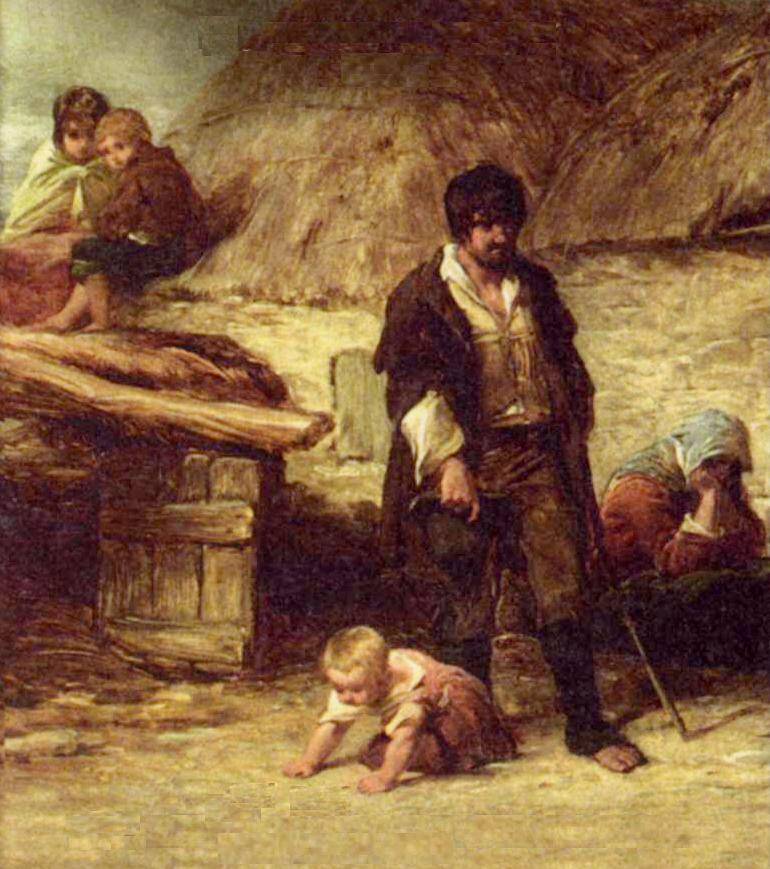
Figure 1.--Some one million Irish perished in the Potato Famine. Another one million were forced to flee their country, many packed into decrypt coffin ships. The blight and Famine gradually declined beginning in 1849. The long-term consequences, however, were a very different matter. Ireland and the relation with the English would never be the same. We are not sure who the artist here was or when the painting was done.
|
|
The Irish Potato Famine began with a blight of the potato crop. The Irish had come to depend on the potato as a mainstay of their diet. No other crop produced so much food per acre of land. The blight was devestating and spread with amazing speed. Within a year a bountiful crop was reduced to rotting fields. Vast expanses of Irish fields were ruined by black rot. It would have not been as bad if the Irish diet had been more diverse, but the poor Irish peasantry survived on the potato harvest. Potato crops accross Europe failed, but nowhere in Europe was the poopulation so dependant on the potato. Not only was the potato gone, but the crop failure caused the price of other food crops to soar, placing substitute foods beyond the purchasing power of the destitute Irish peasantry. The Irish peasantry were tennantv farmers who eked out a subsistaence existance with the potato not only found their food stocks roting, but were unable to pay their rents. Soon their British and Irish Protestant landlords were evicting them from their homes. Some of the Irish peasants out of desperation attempted to eat the rotting potatos. Whole villages were devestated by cholera and typhus. Parish priests desperately tried to tend to their congregtions and feed the starving. Inn some cases the dead went unburried. Many were burried without caskets. English relief efforts wre inadequated and even these wereec abandoned in the midst of the famine. Work houses because of inadequate nutrition and unsanitary conditions were death traps. The Irish famine has been seen by many as the greatest humanitarian disasaster of the 19th centuy. This was in part because so many died and others forced emmigrate. Over 1 million are believed to have actually sucumbed to statvation and disease. But most tragic of all was that it was preventable. Throuhout the Famine, Irish, and English landowners were exporting food. One author points out that a quarter of the peers in the House of Lords owned land in Ireland and failed to act. [Wilson] As the 19th century moved on, independence became a possibility, but not an inevitability. The central development in the 19th century was the Irish Potalo Famine (1845-50). The reforms of the 19th century could have succeeded in integrating Ireland within the rest of the United Kingdom. This did not occur and the central reason was the Famine. The potato famine and more importantly the British reaction to the Famine resulted in a Holocaust of horendous proportions. After the Famine, Irish independence was inevitable.
English Conquest
After securing England from the Saxons, the Normans launched the conquest of neighboring Ireland in 1169 and by 1300 the English had secured control over sizeable ares of Ireland which did not have a unified national political structure to effectively resist. government to resist. uthwest and northwest, was complete by 1300. Even so the Irish people continued to resist and retook during the 14th and 15th centuries much of the territory seized by the English. The Irish by the 16th century had reduced the area of English rule to a small area around Dublin which became known as English Pale. (It is the inspiration for the expression "beyond the pale".) The Irish conquest was resumed when Henry VIII became king in 1541. Queen Elizabeth continued the struggle as part ofher strugle against Catholics, many of whom were hostile to her reign. Unlike the English ungradually accepted Anglicism, the Irish remained devoutly Catholic. The English monarchy supported the plantations of Ireland in the 16th and 17th centuries, in effect the colonization of Ireland by English and Scottish families as a means of anglicizing the country and securing it's allegiance. The Protestant population of northern Ireland (Ulster) originated with the plantations. The Catholic Irish peasantry was gradually dispossed of their land. After organized Irish resistance collapsed with the fleeing of the earls in 1607 most of Ulster was confiscated. The plantations in Leix and Offaly and parts of Munster did nit have sufficient Protesant settlers. The Ebglisg carried out additional land seizutres during the 17th century in Wexford, Longford, and Leitrim, but unlike the situation in Ulster, there was no accompanying large-scale immigration of Protestant settlers from Britain.
Catholcism
While the settlers in Ulster brought Protestantism with them, the English crownn never succedded in converting the Irish peasantry which remained devoutly Catholic.
Land Laws
Two massive land transfers as a result of anti-Catholic legisaltion by the English Parliament in the 17th century created a landless Cathholic peasantry in Ireland. Parliament between 1695 and 1727 enacted the Catholic Penal Codes. These laws were intended suppress Roman Catholicism by limiting the material wealth and the ability of Catholics to participate in public life. They affected both Irish and English Catholics, but as the vast bulknof the Irish population was Cathloic, the impact was especially severe in Ireland. Most of these laws were repealed in the late 18th century, but land was not returned to the peasntry. The land remained in the hand of often absentee English and Irish Protestant landlords. Some of the laws were no repealed until the 19th century. Catholics were, for example, not allowed to sit in Parliament until 1829.
Resistance
The English suppression of the Irish people and attempts to irradicate Catholocism inspired a series of rebellions as well as passive resistance. The Gaelic Irish in Ulster which had been dispossed by the Protestant plantations rebelled and massacred thousands of Protestant settlers (1641). Oliver Cromwell brutally suppresed the rebellion (1649-1650). Wolfe Tone, inspired by the French Revolution, founded the Society of United Irishmen in 1791. They promoted an an independent Irish Republic as had been declared in France and were supported by the Defenders, a Catholic agrarian organization agitating for the landless peasantry. The Government penetrated the movement with informers. The United Irishmen staged a rebellion (May 1798) centered in Wexford and Ulster, but it failed to generate support in other areas and was quickly crushed by English troops.
Union
Pitt the Younger saw Ireland as a danger and pushed a forced union with Great Britain in 1801. He saw this as solution to the Irish problem. This meant some MPs were elected in Ireland, but Catholics could not be elected until 1829 and even then most of the population was landless and thus disenfranchized. Throughout the 19th century, England's essentially colonial administration of Ireland was obscured by a thin veneer of democracy.
The potato originated in South America's Andean Mountains. The Aymara Indians developed over 200 different varieties of potatos on the Titicaca Plateau where they grew at elevations above 10,000 feet. The potato not only had a major impact on native American cultures, but was to fundamentally transform European society. The Spanish were after gold, but it was the potato that was ton change Europe even more than the trasure ships laden ewithngold and silver. The population of Europe was still quite small at the time of the Spanish conquest of the Inca in Peru during the mid-16th century. The Spanish Conquistador Pedro Cieza de Leon in his “Chronicle of Peru” is the first European known to describe the potato. No one knows when potatos were first brough to Europe and planted. Potatoes despite their importance as a shipboard food that could prevent scurvy was not immediately adopted by European farmers. Spanish farmers appear to have begun planting them by the 1570s. Potato cultivation next spread to the Low Countries, then partb ofv the Spanish Crown, and Switzerland. They were introduced to Germany in the 1620s. The nutritional value of the potato became widely accepted. Frederick the Great of Prussian ruler ordered his people to plant and eat them as a valuable food source. The potato by time of the Seven Years War (1756-1763) was a basic staple of the Prussian diet. By the time of the French Revolution (1789), the potato was becoming popular in France. The potato within inn a century had become an essential part of the European diet. Not only was it nutritious, but it was more reliable than wheat which did not grow well in damp climates. European farmers found that thry could harvest a larger yield of potatoes than any other crop per acre. The result was that farmers could feed a much greater population than ever before. The population increase in Europe during the 17th and 18th centuries was in large measure duie to the potato. The potato helped generate signifivcant population increases througout Europe. This was one of the many contributors to the European Industrial Revolution. As European agriculture became more productive, farmers could support the increasingly large numbers of industrial workers in Europe's rapidly expanding cities.
It is thus ironic that the hearty potato which fueled a population explosion throughout Europe would be responsible for one of the most devestaing famines in European history and resuklt in the signifiant depopulation of Ireland.
The Potato Crop in Ireland
The potato came to Irelamd much later than other areas if Europe. English landlords introduced the potato tom Ireland in the mid-18th century. It proved to be an ideal crop for the wet Irish climate. Ireland receives an average 60 inches of rain annually. Ratherv than hard downpors, precipitation in Ireland is often soft mist showers that cool the air keep the soil moist. This is perfect growing conditions for the potato. Within a few decades Irish peasants by the turn of the 19th century were consuming on average 10 potatoes per person daily. The potato came to provide 80 percent of the calories in the Irish diet. In addition, Irish peasants used potato fodder to feed the animals which provided milk, meat and eggs to supplement their diet. The Irish peasants within a short period had become depebndant on one crop. And for a century, the annual potato crop proved reliable, more relaiable than any other crop. The Irish had come to depend on the potato as a mainstay of their diet. No other crop produced so much food per acre of land. Half of the population of Ireland was almost totally dependant on the potato for their sustanance. They were tennant farmers and were allowed small plots of land to grow their food. The potato was the most bountiful crop and was thus what most Irish grew on their small plots. Even before the Famine, the situation of the Irish peasantry was precarious at best, leading a meagre existance and the subsistence level.
The Blight: 1845
The Irish Potato Famine began with a blight (the microscopic fungus Phytophthora infestans) of the potato crop. The blight was devestating and spread with amazing speed. The potato blight first appeared in Ireland during fall 1845. The blight partially destroyed the 1845 potato harvest. About half of population, which was almost entirely dependant on the potato were distressed. The condition of the Irish peasants worsened in 1846. The blight spread throughout Ireland during an especially wet spring and summer. There was an alkmost total failure of the 1846 crop. Within a year, Ireland's once bountiful potato crop was reduced to rotting fields. Vast expanses of Irish farm land were rendered desolate by the black rot. It would have not been as bad if the Irish diet had been more diverse, but the poor Irish peasantry survived on the potato harvest.
Food Prices
Potato crops accross Europe failed, but nowhere in Europe was the poopulation so dependant on the potato. Not only was the potato gone, but the crop failure caused the pricev of other food crops to soar, placing substitute foods beyond the purchasing power of the destitute Irish peasantry.
Starvation: 1846
The blight which desimated the potato harvest in 1845 resulted in the total failure of the crop in 1846. It caused a kind of numbing shock with the peasantry. One historian writes, "The failure of 1845 had been partial , and it had been many months befiore its full extent was apparent. This time the destruction was near-total, with over ninty per cent of the growing potatoes being ruined, early and late crops alike, over a very short space of time, hadly a month in all .... If the failure of 1845 had been unprecedented in scale and verty difficult to come to terms with, this time the people were left either numb with disbeklief and unabkle to take in the scale of what had happened, or uin a similar state iof mindto those 'wretched people' found by Fr. Mathew, 'seated on the fences of their decaying gardens, wringing their hands and wailing bitterly [of] the destruction that had left them foodless.' Failure of the opotatio on this scale meant that one of the two crops on wg\hich hopes for recoverty from the grinding miser of the previous twelve months had rested was now gone." [ÓMurchadha] The shortage of food combined with the failure of the British government to provide adequate relief resulted in the death of an estimated 1 million people Irish peasants. This at a time when Irish landlords continued to export food to England.
Disease
Some of the Irish peasants out of desperation attempted to eat the rotting potatos. Whole villages were devestated by cholera and typhus.
The Church
Parish priests desperately tried to tend to their congregtions and feed the starving. In some cases the dead went unburried. Many were burried without caskets.
Relief Efforts
The potato blight left much of the rural population was left without food. A substantial portion of the rural population survived largely on the potato. Not other crop produced so much food. A relief effort was needed on a large scale. English relief efforts were inadequate and even the limited efforts at relief were abandoned in the midst of the famine. Most Irish came to see Britain's relief efforts as inadequate and viewed centuries of political and ecomic oppression as the root causes of the Famine. British politicians at this time, including Prime Minister Robert Peel were committed to laissez-faire economics and opposed state intervention in economic affairs. The problem was of a dimension that only Government action could prevent dussaster. Private charity raised considerable sums. Americans contributed to the relief effort. Queen Victoria made donations. British inaction, however, spelled death for over a million Irish. Whole areas of Ireland were depopulated.
Work houses because of inadequate nutrition and unsanitary conditions were death traps. Ireland was part of the United Kingdom until the formation of the Irish Free State in the 1920s. Thus British law was in force during the 19th centurirs. Conditions at
Irish workhouses could be wretched, even worse than in England. This was of course especially the case in the 1840s during the Great Famine. The following is a description of conditions in the Clifden Workhouse on Christmas Day 1847, taken from a report by John Deane, Poor Law Inspector for the Clifden Union, to the Relief Commission dated 25th December, 1847 and reproduced in Connemara's own Kathleen Villiers-Tuthill's book "Patient Endurance: The Great Famine In Connemara."
Humanitarian Disaster
The Irish famine has been seen by many as the greatest humanitarian disasaster of the 19th centuy. This was in part because so many died and others forced emmigrate. Over 1 million are believed to have actually sucumbed to statvation and disease. But most tragic of all was that it was preventable. Throuhout the Famine, Irish, and English landowners were exporting food. One author points out that aquarter of the peers in the House of Lords owned land in Ireland and failed to act. [Wilson] The Liberal public works program led to mortality. The wiorkhouses were overweaklmed with those who had been syrviving on public works and soup kitchens. They converged in ragged crouds on the work houses and died there in huge numbers.
Evictions: 1847
The Irish peasantry were tennant farmers who eked out a subsistaence existance with the potato not only found their food stocks roting, but were unable tom pay their rents. Soon their British and Irish Protestant landlords were evicting them from their homes. Many landlords at first attempted to aid their tennants, but thec crisis was so devestatig that some as a result faced bankrutsy themselves and eventuall turned to evictions. If the Famine itself ws not bad enough, the onset was followed by the evictiions. Landlords which had been losing money, began evictions on a massive scale (1847). This set off the mass exodus from Ireland. [ÓMurchadha] One of the first landlords to evict his tennants was a Captain Boycott who was to lend his name to a new word in the English language. Landlords evicted hundreds of thousands of starving peasants. Many crowded into disease-infested workhouses. Other landlords paid passages so their tenants to emigrate.
Immigration
For many Irish the only choice was immigration. It was either that or starvation. A million Irish men and women emigrated during the Famine years, many on coffin ships (1845-49). Another million immigrated the followingv decade (1850s). In some cases the landlords paid the passages. But immigration posed dangers. Many of the immigrants were in poor health to begin with weakened by malnutrition and disease. Shipowners attempting to maximixze profits and over crowded and poorly provisioned rickety vessels which became known as "coffin ships." There were ships that reached America and Canada after losing a third of their passengers to disease and hunger. One ship, the Jeanie Johnson managed to deliver all of its passengers to America alive. [Miles] Immigrants destined for the longer voyage to Australia fared even worse. The single most important destination was America. The wave of Irish immigration that swept into Amrerica during the 1840s was in large measure caused by the Potato Famine. For a genration, the Irish were the most imnportant immigrant group. Irish immigrants had come earlier, many were the Protesant Scotts-Irish such as Andrew Jackson's family. The Irish that came as a result of the Potato Famine were the poor Catholic Irish peasantry. Soon thaere were more Irish living in America than ever lived in Ireland. Irish is virtually the only country which declined in population during the 19th century. The Irish were the first large Catholic immigrant group that came to America. Smaller numbers of Irish went to other vounties, including Canada and Australia.
Famine Wains: 1849
The blight and Famine gradually declined beginning in 1849. The long-term consequences, however, were a very different matter. Ireland abnd the reation with the English would never be the same. [ÓMurchadha]
Impact
The Potato or Great Famine as it is known in Ireland was a watershed in Irish history. As the 19th century moved on, independence became a possibility, but not an inevitability. The central development in the 19th century was the Irish Potato Famine (1845-50). The reforms of the 19th century could have succeeded in integrating Ireland within the rest of the United Kingdom. This did not occur and the central reason was the Famine. The potato famine and more importantly the British reaction to the Famine resulted in a Holocaust of horendous proportions. After the Famine, Irish independence was inevitable. More than 1 million of Ireland's 8 million people perished of starvation or disease. Another 2 million Irish emigrated. The population of Ireland was this reduced by nearly a half, this at a time that thepopualtion of nearlyb all other European populations were rapidly expanding. As nothing before in Irish history in created a burning hatred toward the English, both among those who survived in Ireland and the immigrants who faned out around the world. Stories and songs faned that hatred among their descendants and led to a renewd commitment to an independent Ireland. James Stephens, a survivor of Young Ireland's abortive 1848 rising founded the Fenian Society in New York during 1858. The Fenians became known as the Irish Republican Brotherhood (IRB) and devoted themselves to an independent Irish Republic. Their organization in Ireland was also penetrated by the English security forces and an attempted rising in 1867 failed. The most famous rebellionn was the Eastec Rising during World War I in Dublin (1916). The IRB under Patrick Pearse and the Citizen Army under James Connolly seized buildings in Central Dublin. Pearse proclaimed the Irish Republic. The British sent 20,000 troops to Dublin to supress thec rebellion. There was no general rising outside of Dublin, but after the Easter Rising the Irish Republican Army's increasingly effective terror tactics eventually forced the English to allow the creation ofv the Irish Free State which evebntually brcame the Republic of Ireland.
Sources
Miles, Kathryn. All Stabnding: The True Story of Hunger, Rebellion, and Survival aboard the Jeanne Johnson (2012).
ÓMurchadha, Ciarån. The Great Famine: Ireland's Agony, 1845-1852 (2011), 280p.
Wilson, A.N. The Victorians (Norton), 724p.
CIH

Navigate the Children in History Website:
[Return to Main 19th century war and crisis page]
[Return to Main Irish 19th century chronology page]
[Return to Main English page page]
[About Us]
[Introduction]
[Biographies]
[Chronology]
[Climatology]
[Clothing]
[Disease and Health]
[Economics]
[Freedom]
[Geography]
[History]
[Human Nature]
[Ideology]
[Law]
[Nationalism]
[Presidents]
[Religion]
[Royalty]
[Science]
[Social Class]
[Bibliographies]
[Contributions]
[FAQs]
[Glossaries]
[Images]
[Links]
[Registration]
[Tools]
[Children in History Home]
Created: June 27, 2003
Last updated: 9:57 PM 2/9/2013