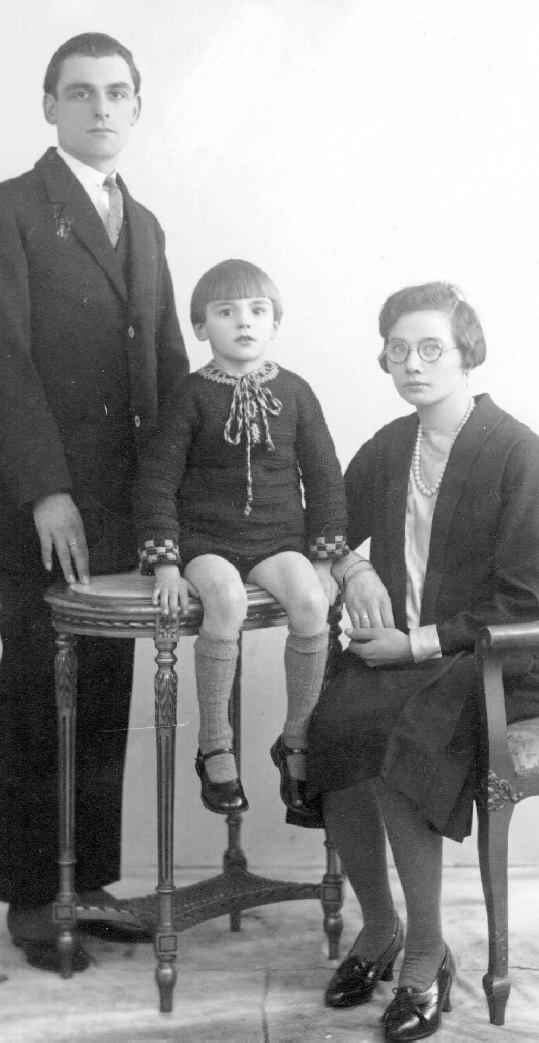
Figure 1.--This unidentified Dutch photograph shows a young Dutch family about 1930. Notice the boys bangs, knit outfit, knee socks, and strap shoes. Knit outfits were very popular for younger boys. |

|
A view of Dutch families over time provide an interesting overview of clothing trends. These images are especially helpful as they provide
some idea of the type of family the boy came from and thus an indicator of which boys were wearing specific styles. These family images hlp to put boys' fashionsin context. Familiy photographs also provide information on what type of clothing other members of the family were wearing at any given time, including brothers of other ages, sisters, and parents. This will also help date some of the unidentified images that HBC has required.
We notice a masterly portrait by Thomas de Keyser of three brothers from a well-to-do family of three brothers, to of them elegantly dressed in black and aace and ruff collars.
This photo shows a large Dutch family in 1910. Tosay this fmily is almost unbelievable, but eas not all thsat common in the early-20th century. Farm families in particular were often quite large. Petrus Gerardus Jacobs and Joanna Quirina Buijs had 19 children. In the photo we can see 15 of their children. Three sons died as a babies and the last daughter, Maria, was born in 1911. The Jacobs were probably a Catholic family, not only because of the size of the family but because Maria became a nun and worked in Indonesia.
A Dutch reader tells us, "I've been able to resurrect some family snapshots photos that were handed down to me after my mother died. The pictures have my mother and her two older brothers (Rie [short for Maria], Jan, and Peter) with one having my mother's mother (Martha). My mother was born in 1919 in The Hague (Den Haag, Nederland), so I think the earliest one is from about 1921 and the other two a year and two years later. The children look to be about 4-10 years old. As you can see, in all three pictures, the boys wear sailor suits. This was very common fior middle class famikies at the time. Rie has a bow in her hair. Unfortunately, I never saw these while my mother was alive and didn't have an opportunity to ask her about them, so other than the names, the approximate date, and location, I have no further information on the snapshots. My apologies for the poor scans, but the originals are in very poor shape. I have done some gamma correction to bring out the contrasts but that washed out the photos some."
We note a formal studio portrait of the Veldcamp family. Mrs. Veldcamp is pictured sitting with her two sons and daughter. We do not know their first names. The children look to be about 10-16 years of age. Mother and daughter for some reason are wearing their coats. Both have stylish helmet-like period hats. The younger boy is weaing a short trousers suit with knee socks and a dark flat cap. This is a good example of the rather long short pants that were commonly worn in the 1920s. The older boy is similar dressed and obviously wears either short trousers or knickers. His flat cap matches his suit better. The flat cap was the standard boys' cap in America and while worn in Europe, was not nearly as common as in America. The boys suits are similar, but not identical. Both show Norfolk influences. We can't see the older boy's knees, so we don't know whether he is wearing knee socks or long stockings. Either is quite possible, but as his little brither wears knee socks, it is likely that he also dies. The photo is undated but pretty obviously comes from the mid-1920s in the Netherlands.
Frans Leferink was a 16-year old Dutch boy wuith an older brother. We see him in 1927 wearing a double-breasted knee pants or short pants suit. As we don't see the buttons at the knee hem, it would probably be best described as a short pants suit. We still see boys wearing formal knee pants suits in both Belgium and the Netherlasnds during the 1920s. And the short pants boys wore were often qyuite long at the time. Frans also wears a natty stripped tie and botinaire. Note the formal black long stockings. Frans is rather elegantly dressed. We suspect he came from a well-to-do conservative family. Frans Leferink was the youngest son of the B. J. Leferink family of the Netherlands. The family lived in the Twente section of eastern Holland near the German border. The family were farmers, shopkeepers, and tradesman. Frans's father seems to have owned a tobacconist's shop (which was called "Cuba" because of the imported tobacco).
We have begun to collect some 1930s family ages. We see a lot of boys wearing short pants, both with suits as well as casual outfits. They tended to be long cut shorts, especially in the early-30s. Yonger boys commonly wore shorter-cut shorts, especially pre-school boys. Knit outfits were popular. Many suits seem done with knee pants rathr thn short pants. Other than with some conservative suits we normally see short pants. Shorts tended to become shorter as the decaded progressed. Girls wore dressess in various styles cut just below the knees. Hair bows seem popular in the early-30s. We see children both boys and girls wearing long stockings, often black long stockings for formal occassions. Knee siocks becanme increasingly popular during the decade. Younger boys and girls might wear strap shoes, Low-cut oxfords becamje standard footwear durung gthe decadfe. Country boys might go barefoot during the summer, but it was not very common. We note the children of a well-to-do Amsrdam family wearing smocks, but it was not very common.
The 1940s was a very difficult year for Dutch families. The Germans during Wold War II occupied the Netherlands (May 1940). The defeat of the Dutch Army was accomplished in only a few days and except in Rotterdam very little damage done. Except for Jewish families, Dutch families were not at first greatly affected. As the War dragged on, shortages of food and consumer goods like clothes and shoes developed. In this enviroment there was virtually no change in fashion, sty;es from the 1930s persisted. While little damage was done during the German 1940 offensive. the same was not the case with the Allied liberation. The Allies liberated the Netherlands south and west of the Rhine (September-October 1944), but the failure of Operation Market Garden left the Dutch beyond the Rhine still in German hands. Abd to punish the Dutch for their Allied sympathies, the Germans cut off food supplies. By the times the Allies finally crossed the Rhine and reached the Dutch (March 1944), they were starving. The immeditate post-War years afyer linration, continued to be diddicult with clothing scarce and families without adequate incomes. This did not begin to chnge until the end of the decade with the Marshall Pln (1948) and the first tenative steps toward European integration.
Conditions in the Netherlands began to improve with the Narshall Plan and the first steps toward European integration. Despite the huge duislocations and destruction of World Wae II, the Dutch economy recovered mazingly quickly. This ws reflected in living standards and the clothing worn. Incomes rose and families could affor to dress better than ever before. While boys acquired large wardrobes, fashins became much more casual than ever befire. Boys continued to wear short pants, although by the end of the decade knee socks were not as common and we see more boys wearing long pants. We see boys wearing open-toe sandals which were not common befoire the War.

Navigate the Boys' Historical Clothing Web Site:
[Introduction]
[Activities]
[Biographies]
[Chronology]
[Cloth and textiles]
[Clothing styles]
[Countries]
[Families]
[Girls]
[Topics]
[Bibliographies]
[Contributions]
[FAQs]
[Glossaries]
[Images]
[Links]
[Registration]
[Tools]
[Boys' Clothing Home]
Navigate the Boys' Historical Clothing Dutch pages:
[Return to the Main Dutch family page]
[Maiken Island]
[Dutch choirs]
[Dutch royalty]
[Dutch scouts]
[Dutch school uniform]
[Dutch boys bangs]
Navigate the Boys' Historical Clothing national pages:
[Return to the Main Dutch page]
[Australia]
[Belgium]
[England]
[France]
[Germany]
[Ireland]
[Italy]
[Japan]
[Korea]
[Mexico]
[Scotland]
[United States]