World War I: The American Expeditionary Force (AEF)
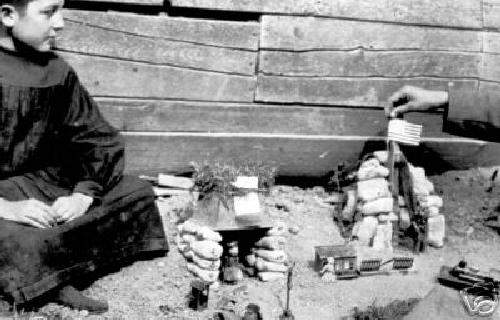
Figure 1.--This is a U.S. Army Signal Corps photograph (number 22801). The photograph was taken while the Allied Hundred Days Offensive was underway (August 19, 1918) in Lucy, France (Toul sector). A 10 year old French boy wearing a smock is playing war game with discarded war items and an American Soldier/Doughboy (89th Division) placing American Flag. The photograph is captioned "A 10-year old boy's imagination. He has empty cartridges for his antiaircraft guns, loosened bullets for his shells, barrel of an air pump for his heavy artillery, tobacco sacks filled with sand, camouflaged dugouts, narrow guage railroad, subterranean ordinance pits, sentries and barb wire entanglements." Click on the image for a close up.
When Pershing arrived in France, the French were shocked. They had expected a large American Army. Pershing did not bring an army with him because there was no such army. The French were stunned that a country the size of the United States would have such a pitifully small army. The Allies made it very clear that what was needed was men, A large America Army was critically needed. America as late as Spring 1917 only had a small volunteer force. The United States would have to recruit, train, and equip its army and this would take some time. The Germans knew this and gambled that the U-boat campaign and their massive Spring 1918 offensive would win the War before the Americans could intervene in force. Pershing reached France with only a smll staff. For months only a small trickle of troops followed. There were, however, American troops in France by the time the Germans launched their vaunted Sring 1918 Offensive and the AEF had reached 0.5 million (May 1918). The arrival of the Americans was critical. They played an important role in stopping the Germans. The Germans almost succeeded in breaking the Allies Western Front. Thus the AEF while still relatively small, was crucial. Pershing respponding to the urgent pleas from the Allies committed available U.S. units to help the French hold the Western Front. U.S. troops fought at Aisne Offensive (May 1918) and on the Marne (June 1918). Pershing insisted that the AEF, however, be deployed as an army and not piecemeal within British and French armies. Significant numbers of American soldiers did not begin to arrive in France until the summer of 1918. At that time about 10,000 Americans arrived daily, unimpeded by the U-boats. And by Summer 1918 American soldiers were arriving in large numbers.
As the Allies after stopping the Germans began to think about their offensive, the AEF had begun to reach sizeable numbers, over a million men (July 1918). Pershing launched the first AEF offensive at St Mihiel (September) and Meuse-Argonne (October). The United States sent over 2 million men to Europe, mostly to France. And more were being trained in America had they been needed. Many of the men who reached France were never committed because the Germans requested an armistice before they were needed. The AEF sustained 264,000 casualties which including nearly 51,000 killed in action and an additional 25,000 who died as a result of disease. About 10 percent of the AEF were segregated black units. They were mostly used in non-combat roles. About 40,000 were trained as combat soldies. They were assigned to fight with French units.
Allied Need for Men
The Allies made it very clear that what was needed was men. Within days of the declaration of war, a British mission led by Secretary of State for Foreign Affairs Arthur J. Balfour and Lieutenant General Tom Bridges departed from Liverpool (April 13). The French sent a mission headed by former Premier René Viviani and Marshal Joseph Joffre. The two delegations had separate meetings with American officals. The made a number of requests and suggestions. Chief among them was the immediate need foe American troops to bolster the Western Front.
General Pershing
Wilson chose Major General John J.'Black Jack' Pershing to lead the American Expeditionary Force (AEF). He had planned to give command to General Frederick Funston, but when Funston died unexpectedly, the President turned to Pershing (May 1917). Pershing had commnded the Expeditionary Force in Mexico (1915-16). When Pershing arrived in France, the French were shocked. They had expected a large American Army. Pershing did not bring an army with him because there was no such army in existence. The United States would have to recruit, train, and equip its army and this would take some time. General Pershing and his staff at that stage of America's involvement in the War. Pershing reached France with only a small staff. For some months only a small trickle of troops followed. This ws largely because OPershing wanted the mnen trained in America before reaching France. This meant that throghout 1917 relatively few American troops arrived in France and the First Division was not moved up the trenches intil the end of the year (October 1917). Even more importantly, Pershing was adament that American troops would not be fed piece meal into combt to replenish decimated British and French units. This was whast the Allies wanted abd it caused a great deal of difficulties with Allied commanders. Pershing would not compromose on this and President Wilson backed him up. American troops would fight in American units under American commanders. The British and French not only wanted replascements, but were also extemely worries about the combat performance of an intested army in any major action. A German break through could doom the entire war effort. The British argued foircibly against Perhing's policie and even used shipping to brter on the issue.
American Army
The European powers in the years leading up to World War I had engaged in a massive arms race, building powerful navies and huge conscript armies. America built a creditable navy, but the army barely existed. Even after 3 years of fighting in Europe, the United States had not significantly expanded its army.
America as late as Spring 1917 only had a small volunteer force. The United States would have to recruit, train, and equip its army and this would take some time. President Wilson's message to Congress requesting a declaration of war contained no specifics about how the war would be waged--least of all any indication of sending a large land army to France. Many of the Congressmen who voted for war did not fully understand that America would need to send a large land army to Europe. Senate Finace Committee Chairman Thomas S. Martin of Virginia when told by an Army officer testifying before his committee on April 6, 1917, that funds might be needed for operations in France, exclaimed "Good Lord! You're not going to send soldiers over there, are you?" And this was not what Wilson had intended. Wilson had hoped that American war supplies would be sufficent. He appears to have thought that the mere threat of an American army would bring the Kaiser to his sences. [Burk, p. 234.] When this did not occur and the British and France clamoring for reinforcements, the President had to ask Congress for a miitary conscription law. The American Expeditionry Force was born.
German Gamble
The Germans knew that the United States did not have an army in being. Unlike European armies, the American Army was very small. There was no conscription in America. They Germans decided to gamble that the U-boat campaign and their massive Spring 1918 offensive would win the War before the Americans could build an army, let alone transport it to France. Both were necessary before America could intervene in force. The German Navy believed that they could intercept the troop transports and assured the Reichstag that the U-boats would prevent the Americans from ever arriving in force. Crown Prince wilhelm urged his father for more aggrssive action, including the resumption of unrestricted submarine warfare. It would prove to be the most disasterous gamble in German military history, perhaps all of European military history. And incredably one that another German leader would repeat a generation later.
The war exhausted Allies were elated with the American declaration of war. Few Europeans who maintained large standing armies understood that America did not have an army in being to commit to battle. Declaring war was one thing, creating an army was a very different matter that would take time, time that the hard pressed Allies could scarsely afford. The outcome of the War would hinge on whether the Germans could shift forces west from Russia for a final massive offensive faster than the Americans could form and transport an army to France. The Kreigsmarine had assured the Reichstag that American troopshops could never get through the U-boat screen. General Pershing and a small staff were dispatched to France, but it would be many months before an American Army of any size could be trained and transported to France. The European countries that went to War (except Britain) had large well-armed, conscript forces that could be committed to battle in a short period of time. The United States did not. Camps were opened all over the country. The South was a preferred location because of the warmer weather. Trainuing was complocated in a snow drift. Given the size of the army American was to build. Many new camps were set up and opened. Baracks began going up, but this took time. In many camps tents had to be used because there were no barrcks. Some men were shipped to France without training, to be trained by Pershing in France. Men volunteered for service. This included men of all social classes, including young men from the elite. Some 11,000 men from virtually every Harvard class (1887-1921), for example, served in the War, many as volunteers. The motivation was patriotism. [Nelson] It soon became evident, however, that a draft would be needed to build the massive army that would be needed to to have an impact on the Western Front. Fighting the Germans was not like the war with Spain. A massive well-equipped and trained army would be needed. Congress enacted only the second draft in American history. The lack of a conscription law had been one of the attractions that brought immigrants to America. The Germans had, however, managed to significantly shift American public opinion. Against all odds, the Germans had managed to turn a country desiring to stay out of the War and with immigrant groups even more strongly opposed to war into an enraged enemy that would turn the tide on the Westen Front. Amazingly even conscription did not prove an impediment because of incredibly obtuse German actions. German mishandling of its relationship with America was even more starteling because America had a huge German mimority opposed to war, as well as a large Irish minority hostile to the British. Unlike the British, hoever, the Germans just could noy envision America as a potentially important player im the War.
After conscripting an army and beginning the training, the next step was getting the AEF safely to France. The Army made the decission to begin transporting before the men were trained. Training would go on both in America and France. Unlike European countries, there was no large body of men with military traiing available. It was decided that training could be conducted in France. The German Kreiegs Marine (KM) was convinced that their U-boats could prevent the AEF from reaching France. They assured the Government and Kaiser that they could not only sink some troop trans ports, but essentilly prevnt the AEF from reaching France. It was on that basis that the Kaiser decided to resume unrestricted submarime warfare bringing America into the War. This proved to be a disterous miscalculation and mazingly another German leader would repeat a little over two decades later. Not just any ship could be used for transporting troops. They had to be fast transports, not slow mercgantmen. Getting through the U-boats, however, once the ships were found proved to be a fairly simple matter. Fast ships like oceanliners were faster than the U-boats. Such transports were at first reltively scarce. The U.S. Navy did not have many such ships. The U.S. Army pressed into service a variety of ships for the purpose. They used oceanliners, seized German ships, and borrowed Allied ships. The ships sailed from New York, New Jersey ports, and Newport News, Virginia. It was a major effort to transport a million-man large army. The problem was eased somewhat in that the Allies were to provide much od their equioment. The United tates did not have a large arms industry and it would take some time to gear up for war production. In sharp contrast to what the KM promissed, the U-boats did not sink a single American troop transport laden with troops. Thedid sinn two transports returning empty. They AEF was landed primarily at Bordeaux, La Pallice, Saint Nazaire and Brest. From their the efficent French railway system which brought the American forces to training and assembly areas and eventually the Front. American engineers significantly expanded the French infrastructure for this effort. This inckuded 82 new ship berths, almost 1,000 miles (1,600 km) of additional rail lines, and 100,000 miles (160,000 km) of telephone and telegraph lines. [Coffman]
Billeting
France wa not overun by the Germans in World War. Thus the AEF landed in France niot Britain in World War I. Billeting for the AEF was very different than would be the case for the U.S. Army in Britain during World War II. The Americans in Britains were billeted and trained in bases and did not integrated with the civilian population. Barracks were built and there was very little day to day contact with the British people. Soldiers could not leave these base without permission. Thiswas very different for the AEF. There wre some bases, but many American soldiers were billited in French villages and lived with the French population. The World War I Doughboys had a level of intimacy with the local population, unlike World War II GIs. There are countles descriptions in the letters home. A good example is, "Many many customs differ from those in the States but we are all trying to adjust ourselves to circumstances and at the same time pick up a little French. In fact I get right out among the French for I find that is the best way to learn the language a ‘wee’ bit. At present I know two of the nicest kiddies across the river—a little lad of thirteen—but small for his age, and a demoiselle of eleven years. I had them out to a ‘movie’ show one night and they enjoyed themselves immensely. There I carry them little dainties such as candy, gum, chocolate bars etc., such as can not be obtained by the French people in France. Another comerade and I almost consider them our proteges. There are any numbers of little French children here who have been adopted by different companies who pay so much a month for their care. It is a very common sight to see some little fellow about 7 or 8 years dressed in a wee U.S. army outfit—complete even to leggings." [Wagner]
Training
Weapons
The United States had only a small arms industry. The U.S. Army' primary function after the Civil War (1861-65) had been as a small constanualory force to patrol the Western Frointier and more recently to chace banditos around northrn Mexico. For these roles, not much in the way of modern arms were needed. In the clash with Spain (1898-99), the Army found itself outgunned by the Spanish infantry. Contrary to Marxist professors in universities, American capitalists after the outbreak of World War I had little interest in manufacturing weapons for World War I combatants. It was very expensive to set up manufacturiung plants to mass produce advanced weapons and after the War there would be no market for them. When Ameica declared war on Germny (April 1917), the country's vast industrral might could be mobilized for war, but because the arms industry was so small, this would take time. The Allies desperately needed the AEF to repel the war- winning offensive the Germans were planning after defeating the Russians on the Eastern Front (Spring 1918). So the AEF would have to rely on Allied-supplied weapons, both British and French. Bernard Baruch was put in charge of industrual mobilization, but this would take more than a year to accomplish. The Germans were gambling that the War would be decided before American men amd material could be brought to bear. They were right about American arms poriduction, but not about American men. The American Springfield .30-06 caliber rifle was the preferred rifle by the AEF, but it was in short supply so the United States equipped much of the AEF the relioble British Enfield .303 caliber. These were the best rifles of the war for both range and accuracy. The Springfield wa heneraly regrded as a 'great weapon'. It was accurate and rarely jammed. The mass produduced French Chauchat was the most commonly used submachine gun of the war. It operated on recoil and had a twenty round crescent-shaped magazine. American soldiers desposed it. Here the Americans actually had a far superior weapon--the Browning .30 caliber automatic rifle (BAR), but it was not available in quantity and actually was withheld by General Pershing until the Meuse-Argonne offensive. He feared that it would fall into German hands. The Americans did not hve a heavy machine gun. They used both the British Vickers .303, which was mainly mounted on American flown aircraft, and the French Hotchkiss. The .315 caliber Hotchkiss was the primaruly one used by the AEF. It was heavy, but it was air-cooled and the most effective for anti-aircraft fire. Tanks made there appearance on the World War I battlefield, but the Allies gave very few to the Americans. And even fewer actually were committed to combat. American industry began producuing Allied designed tanks, but none reached the AEF before the Germans requested an armistice. A young George Patton would lead the Ametican tank corps and very nearly got killed. A great deal is written about the mnachine gun in World War I, but artillery was the real killer. One author writes, "Over hundreds of years, artillery evolved to be more accurate and dangerous, but nothing prepared the belligerents of the First World War for the carnage the new artillery pieces inflicted on the battlefields of France." [Jameson, p. 37.] The French 75s were the most common artillery piece on the battlefield because of their great mobility, but some commanders preferred the heavier 155mm and the 105mm for their greater impact. The French 155mm was a medium-sized gun which would be a model for the the American Long Tom of World War II. The Americans retooled many Allied artillery pieces to create their own versions. The French three-inch became the US M1916 75mm. The British 18 pounder became the US M1917 75mm. A young Harry Truman was an Americana artillery officer during the War, we believe his battery was equipped with French 75mm guns. One author suggests that American industry was producing artillery for the Allies so 'conversion was easy'. As far as we can tell, however, the United States produced munitions for the Allies, but arms manufacturing including artillery was limited. This is something we need to confirm. With the declaration of War, the United States geared up to produce artillery, but mostly used Allied-produced artillery. [USA artillery] Again the War ended before American-produced artillery reached the AEF in quantity.
American troop transports did begin reaching France in numbers. There were American troops in France by the time the Germans launched their vaunted Sring 1918 Offensive and the AEF had reached 0.5 million (May 1918). The arrival of the Americans was critical. They played an important role in stopping the Germans. The Germans almost succeeded in breaking the Allies Western Front. Thus the AEF while still relatively small, was crucial. Pershing respponding to the urgent pleas from the Allies committed available U.S. units to help the French hold the Western Front. U.S. troops fought at Aisne Offensive (May 1918) and on the Marne (June 1918). Pershing insisted that the AEF, however, be deployed as adescrete field and not piecemeal within British and French armies.
Bellau Woods (June 1918)
Bellau Woods was fought because of the advances made by the Germans in what the believed would be their war-winning Spring Offensive. Some 50 German divisions had been brought west following their victory in the East. Without the americans, this may well have been enough. Allied commanders pleaded for support from the sizeable, but still poorly trained AEF. Paris was again threatened as was the case in the heady days of their 1914 drive as they had reached the Marne. The new German drive penetrated the allied lines, reaching the north bank of the Marne River at Château-Thierry, only 95 kilometres (59 mi) from Paris (May 27). There the outnumbered American 3rd Division held the German advance at Château-Thierry (May 31). This bought time for the Allies to bring up reserves, including more Americans. The German advance turned east towards Vaux and Belleau Wood. The Battle of Belleau Wood (June 1-26) was fought to defend the Marne River which played such an important role on the Western Front. The U.S. 2nd Division commanded by Major General Omar Bundy supported by French and British units joined the fight. Several different German units including elements of the from the German 10th, 28th, 87th, 197th, and 237th Divisions. In a historical irony, Crown Prince Wilhelm who had played a major role in bringing America into the War by arguing for the resumption of unrestricted submarine warfare, played a major role in commanding the German units fighting the Americans. The battle has become a legendary in the history of the U.S. Marine Corps. The Germans managed to take Château-Thierry and Vaux (June 1). It is at this time that the Germans moved into Belleau Wood. The U.S. 2nd Division, which included a brigade of U.S. Marines, reached the front over the Paris-Metz highway. The 9th Infantry Regiment was placed between the highway and the Marne. The 6th Marine Regiment was deployed on their left. The 5th Marine and 23rd Infantry regiments were held in reserve. The Americans played a key role in stopping the German drive. Pershing ordered the american forces to retake Bellau Woods (June 6). American Marines for 3 weeks supprted by artillery struggled to retake Bellau woods, attacking into forested areas. German General Erich Ludendorff did not see Bellau Woods as of major imporance, he did see think it was important to deny the Americans a victory in their first engagement. Ludendorff as a result, continually fed reinforcements into the struggle. The Germans used machine guns, artillery, and poison gas. It is in Bellau Woods that the Germans began calling the Marines, the Devil Dogs. The Americans finally prevailed at the cost of nearly 10,000 dead, wounded, or missing in action (June 26). The high casualty rate was in part the result of Pershings lack of appreciation of the modern battlefield and German fire power. [Roberts, pp. 64-65.]
Significant numbers of American soldiers did not begin to arrive in France for some tome after the United states declared war. This was because the United States, unlike European countries, did not have a large army in being that they could immediately send over. The American standing prifessional army was only 127,500 officers and men. Pershing immediately went to France after his appontment (May 1917). He did not have an arnmy to take with him. The task of creating an army was assigned to others. The first troops, a mere 14,000 men arrived (June 1917). They were called 'Doughboys', the origins of the term sre still debated. For several months only a trickle of American followed. The numbers gradually increased. The 1st Division was the first American Division to be moved up to the front (October 1917). This was the only American dividsion composed of experienced regular Army soldiers. It aws thus the first division to be transported to France. They were deployed near Nancy. Throughout the rest of 1917 and early-1918, American divisions were primarily deployed to support French and British units who soon hard pressed to hold the line against the German Spring Offensive. The 1 million man figure was reached (May 1918) and more troops were on the way. Large numbers of troops arrived monthly. In the peak month over 300,000 Americans arrived in France (July 1918). Pershing finally had the numbers he needed to opperate independently from the British and French. About half of the AEF had been moved up to the front line at this time. They plyed an important role in stoping the German Spring Offensive. And they soon had the combt experience needed to play a central role in the Allied war-winning 100 Day Offensive. By the time of the Armistics more than 2 million Americans had arrived in Europe (November 1918). And more than 40,000 civilians were serving in various capacities such as ambulance deivers. Nearly 200,000 were Afro-Americans. Most of the AEF was deployed to France, but a few were also sent to northwestern Russia and northern Italy. Another 2 million Americans were still training in the States. Few Germans who had to face the AEF in combat were aware that such a massive force had not even arrived yet. The NAZIs who manufactured thec 'stab in the back' charge never mentioned those 2 million additional Americans yet to arrive in France.
France after 3 years of war had mamy orphaned children. The war on the Western Front was fought primarily in Belgium and northern France. This left thousands of orphaned Belgian and French children. The Belgian front as in the Btitish zone of the front, so American soldiers saw mostly French orphans. Some of the children lost both parents or wee separated from them. Many children lost their fathers at the front and their mothers had difficulty supporting the family. Many of the boys were drawn to the strangers from America. And the GI's in turn were enchanted by the charming little French boys who idealized them. There were orphanages, but some of the boys preferred the less strict regime outside the orphanages and attempted to attach themselves to the Americans. Not only did they prefer the GIs to the nuns, but the food was better. Americans GIs adopted many boys as mascots. And when the units were committd to stop te German offensive, the boys stayed with the GIs as they entered combat. The Americans were so fond of adopting French war orphans as mascots and taking them into the lines that the AEF GHQ had to issue a General Order forbidding the practice, an order variously followed. We have not been able to find much written information on this phenomenon. The photographic record, however, shows that is was not rare.
Unlike World War II when many American soldiers and airmen spent considerable time in Britain, the AEF was primarily deployed to France. Many AEF mem trained in Frenh camps during 1917 and early 1918. They were first deployed during the German Spring 1918 Offensuve and the War ended about 6 months later (November 1918). Some men stayed in France until the final War settlement. Most of the AEF was slated for transport home, but it took some time find the shipping to get them home. As a result, there was considerable time for AEF soldiers to meet the French. For most it was the first time away from him. Most of the soldiers had not traveled widely in the United States, let alone Europe. We do not yet have much information about French experiences with the Americans or the Americans with the French. There seem to have been relaively few French war brides. I'm not precisely sure why that was. Interestingly, France was one of the few countries from which peope did not emigrate to America in large numbers.
The AEF played an important role in the Allied Hundred Days Offensive that won the War. The Allies struck all along the entire Western Front which meant the ermns were unable to shift forces from quiet sectors. The American part of the Allied Hundred Days Offensive was the Meuse-Argonne. Some Americans fought at Bellau Woods using the insane tactics of 1914 (June 1914). The major American commitment came in the Meuse-Argonne, a joint operation with the French. Pershing oversaw the first and only major AEF offensive. The Americans struck first at St Mihiel (September) and then moved into the Meuse-Argonne (October). The United States had over 2 million men in Europe, mostly in France. And another 2 million more were being trained in America had they been needed. The Meuse-Argonne still ranks as the bloodiest single battle in American history. (Civil War battles where casualties on both sides are included are the bloodiest days, but because they were so debilitating only lasted 1-2 days. Gettysburg lasted 3 days.) Many of the AEF men who reached France were never committed because the Germans requested an armistice before they were trained and needed. The numbers were overwealming to a Germany that had been bled dry by 4 years of war. The AEF completely undid the expected benefit of knocking Russia out of the War and now having one major front on which it could focus. Had the Germans not asked for an armistace in November. They would have faced a 4 million-man, increasingly experienced AEF. The AEF sustained 264,000 casualties which including nearly 51,000 killed in action and an additional 25,000 who died as a result of disease. While the numbers were low by European standards, this was largely because the AEF only fought intensley for 3 months. Adjusted for the time engaged, American casualties were very high, in part because Pershing believed in the rifle and bayonet. The U.S. Army before entering the war had military observers on both sides of the trenches. Pershing appears to have learned nothing from their reports. Disaster was averted by the competence of his staff (including George Marshal) and divisional commanders and dogged determination of the American infantry. [Roberts, pp. 64-65.] Over 10 percent of the AEF were segregated black units. They were mostly used in non-combat roles. About 40,000 were trained as combat soldies and were were assigned to fight with French units. They thus participated in the Meuse-Argonne, bu as part of french operations. Pershing despite his Frontier expereience with Buffalo Soldiers and insistance on the AEF fighting under the American flag and commanders was satified with this arrangement. The French were glad to have them and impressed with their fighting skill. They returned to America with a host of French battle medals.
The Götterdämmerung begun as the Allies began to crack open the vaunted Hindenburg Line. Allied offensives on the Western Front cracked the German front forcing them back toward Germany. The German Navy mutined. Riots broke out in Germany cities. A German Government was hastily formed and asked for an armistice based on President Wilson's 14 Points. After determining that the request came from a civilian German Government and not the Kaiser or German military, the Allies accepted the German offer. The gun fell silent after 4 years of vicious fighting at the 11th hour of the 11th day of the 11th month (November 11, 1918). There had been over 8.5 million soldiers killed and 21.2 million wounded. The General staff informed the Kaiser that they could no longer guarantee his saftey. He abdicated and fled to the neutral Netherlands (November 28).
Some 4.7 milliom Americans were mobilized for World War I. And this was only a part of the potential draft pool. Only half of the expected AEF reached France before the Armistice. the rest were still training in America. The AEF units in France and Flanders deployed along 83 miles of the 392 mile long Western Front. There were Douugboys stationed all over France. The combat force was in northern France, but training and support groups were located all over the country. Before the Armistic they had some free time. After the armistice most of them had very lottle to do. The Armistice was not a formal peace treaty, just a cease fore. As a result, military units at first continued a high degree of readyness. The AEF could not begin to return to America until the Allied Command were sure that the Germans were adhering to the terms of the Armistice.They continued to train, although leaves were permitted. As it became clear that the Germans were not goig to resume the war, the AEF gradually relaxed military duscipline. Leaves became relatively easy to get. This meant that there was considerable time for Americans to get to know France. At the time, while large numbers of Europeans had emigrated to Europe, few Americans except for the well-to-do, had traveled abroad. So whilr transport was being organized, many Americans had a chabce to get to know France. American divisions began to get orders to return to America (January 1919).
As this would take some time, efforts were launched to occupy hem before they could be transported hime. Men with good conduct records were granted 10-day leaves to sight-see around France. Some evn went to London. For men in unit encampments, post schools were also established to provide educational opportunities for the men. This included classes in reading, writing, mathematics and history. Selected officers and men possessing at least a high-school education might attend classes at the AEF University in Beaune.
One development during this period was the foundation of the American Legion. AEF veterans organized the Legion in Paris (1919) and became a valuable support pillar for returning veterans.
It took more than a year to mobilize and transport the AEF to France. It would take some time to get the AEF back to America. It was an eye-opeming experience in many waus for both the Doughboys and the French. Troopships, as well as ships seized from Germany, were used to return troops from Europe, mostly France, bacj\k to the United States. There were also several foreign-flagged ships used to get the AEF back home. Camps were set up near French Atlantic ports for the unis preparing to embark. Brest ws a paricularly important embarcation port. Most of the AEF got home in 1919 except for those units asigned for occupation duty in Germany.
The Allied World War I occupation of Germany, in sharp contrast to the subsequent World War II occupation was limited. The Armistice (November 11, 1918) provided for the rapid withdrawl of German forces from Belgium, Luxembourg, and northern France as well as the German Rhineland. There were also restrictions on the right (eastern) side of the Rhine. The Allied occupation was basically limited to the Rhineland with a few exceptions. The occupation was conducted by American, Belgian, British, and French forces. As the Germans military crossed the Rhine, the Allied troops moved into the Rhineland. The initial Armistice was for a month. There were three subsequent prolongations (December 13, 1918 - January 16, 1919), (January 16 - February 16, 1919), and (February 16, 1919 - January 1920). The Inter-Allied Rhineland High Commission provided for by the Versailles Treaty (paragraphs 428-431) was set up in 1920. Although not occupation, a related Allied Control Commision was established in Berlin to ensure that the Germans observed the terms of the Treaty in the much larger unoccupied areas. It proved ineffective. And there was widespread disarmament evasion even before the NAZIs seized power. When the Germans failed to pay the reparations required under the Versailles Treaty, France and Belgium occupied the industrial Ruhr. The Ruhr flows into Rhine and thus much of industrialized Ruhr was just across the Rhine. To punish the Allies, Weimar authorities unleased the devestating inflation on the German people. The French and Belgians withdrew from the Ruhr (1925). There were a range of incidents between the occupation troops and German protestors. The Germans were particularly incensed about the French use of African colonial troops in the occupation. There were incidents, but they were blown up out of all proprtions by the German press.
France Our Ally is a World War I booklet written by V. Van Vorst. The 44-page book was published by the National War Work Council of the Young Men's Christian Associations (YMCA) in 1918. It was given to men of the AEF to provide some information about the country they were on their way to defend. This book is a brief account of France, its people, and their part in the War. There were special pointers to help to the AEF soldiers. This booklet contains customs, money exchange information, and other useful tips for the American soldiers. The booklet was apparently passed from soldier to soldier or shared. This particular booklet apparetly was used by men in an Illinois unit. Several AEF divisions were Narional Guard units. Harry H. Orr? from Hillsdale and Wilbur Snyder from Cooksville ere two the men who used the booklet. Tucked into the book was a postcard-back photograph of two unidentified boys. We thought they might be war orpjans, but apprently the boys were family members because there was an American postcard back. The boys are well dressed in overcoats and caps. The photo was tucked into a page with writting about the fallen youth of the land. It is very touching.
Sources
Coffman, Edward M. The War to End All Wars: The American Military Experience in World War I (1998).
Jameson, Sarah K. "American soldiers' use of weaponry in World War I," Nasrers Thesis (Western Kentucky University: Spring 2016).
Nelson, James Carl. Five Lieutenants: The Hertbreakung Story of Five Harvard Men Who led America to Victory in WWI (2012), 384p. Nelson delves into the motivations of five young officers as wll as their experiences and fates.
Roberts, Andrew. "Battle scars: A bold new history of the eppic Battle of the Somme -- and the pointless deaths of thousands of American doughboys afterward," Smothsoniam Magazine (July-August 2016), pp. 56-65.
Wagner, Fred C. July 1, 1918. Somewhere in France. Wagner was a Marine, killed in the Château Thierry offensive a couple weeks after he wrote this lerter to his aunt. In William L. Clements, ed. World War One Letters and Documents Collection (DNDC)