|
World War I began as a war of movement, but after the Miracle on the Marne became a war of attrition as the Allies and Germans built a parallel system of trenches from the Swiss border to the English Channel. New weapons such as the machine gun, poison gas, tanks, and airplanes appeared, but the war was largely an infantry war, decided by the superior resources of the Allies and the arrival of the American infantry. The horrors of trench warfare caused military planners to focus on new weapons to restore mobility and to avoid a future war resulting in mass losses of foot soldiers. It was the Allies that developed tanks and won the World War I air war. It was the Germans, however, that after the War gave the greatest attention to developing new weapons, especially the tanks and air planes that would dominate the World War II battlefield. German commanders also conceived of an innovative method of effectively employing the new weapons, a combined arms tactic which has come to be known as Blitzkrieg. Naval commanders in a tradition firmly implanted by Nelson at Trafalgar were wed to the idea of a major decisive fleet action. The Germans in World war I called it Der Tag--the Day. The German Navy was no longer capable of a major fleet actin when World war II broke out. The British did not think the German U-boats were a threat. The ASDIC (SONAR) developed in World War had helped defeat the U-boat threat and British commanders were convinced that it made the submarine obsolete. The major navies had each planned their war winning fleet action, all based on the big-gun battleships. The Japanese termed the action Kantai Kessen--Decisive Battle. The American plan to respond to a Japanese attack on the Philippine Islands was War Plan Orange. The Germans began World war II with the word's most modern air force. It was, however, a tactical air force designed to support the Wehrmacht's land offensive as part of Blitzkrieg. Germany did not have the industrial capacity to build a strategic air force and had no plans to wage an air war. America and Britain did have the industrial capacity to build a strategic air force. World War was the first real air war. Both the British and Germans were preparing a strategic bombing campaign in World War I, but the War ended before it had begun. Thus air commanders when World War II had no real idea how to wage an air campaign.
There are three principal combat environments: land, air, and sea. Land combat is probably as old as mankind and sea combat extends back to ancient times. As in most wars, World war II was settled by in the modern vernacular by 'boots on the ground'. The military forces of the world closely studied World War and developed weapons and war plans designed to avoid the costly stalemate of World War I. In this they succeeded. The German Wehrmacht was the first to perfect modern mobile warfare and combined forces. This was partly because it was essentially and update of Prussian/German military doctrine with modern weapons. And the Wehrmacht received strong backing from a national leader who was determined to launch another war. The modern doctrine and commitment to war explains the early German victories over poorly prepared enemies that desperately wanted to avoid war and sought to appease the Germans. As the central area of combat was a titanic land struggle on the eastern Front between the Soviet Union and NAZI Germany, sea combat was a secondary combat environment, but one of critical importance. The Soviet victory on the Eastern Front was supported in many ways by the the naval war. The British Royal Navy helped keep Britain in the War and this was a distraction to Hitler's central goal of seizing the resources of the East which would give Germany a resource base from which it could pursue global dominance. And command of the sea ensured that a massive flow of Lend Lease supplies and equipment reached the Red Army. Command of the sea also allowed the Anglo-American alliance to reenter Europe and ensure that Western Europe would not become part of the post-War Soviet Empire. The Pacific war was a naval war, but even before Pearl Harbor, American and Britain agreed that the priority had to be against Hitler and the NAZIs. Air combat was new. It first appeared in World War I, but played only a minor role because of the still basic technology. By World War II the technology had developed to the extent that the air war was a major factor. With the entrance of America into the War, the Germans were denied one of the key elements of Blitzkrieg, close air support. The strategic bombing campaign at first had only a minor impact on German war production, but it forced the Germans to shift resources from the Eastern Front and the French beach defenses to the skies over Germany. And it impaired important German programs such as U-boat construction and the V weapons. The air war also helped destroy Japanese war industries and ultimately forced the capitulation of an enemy that showed every intention to fight to the death.
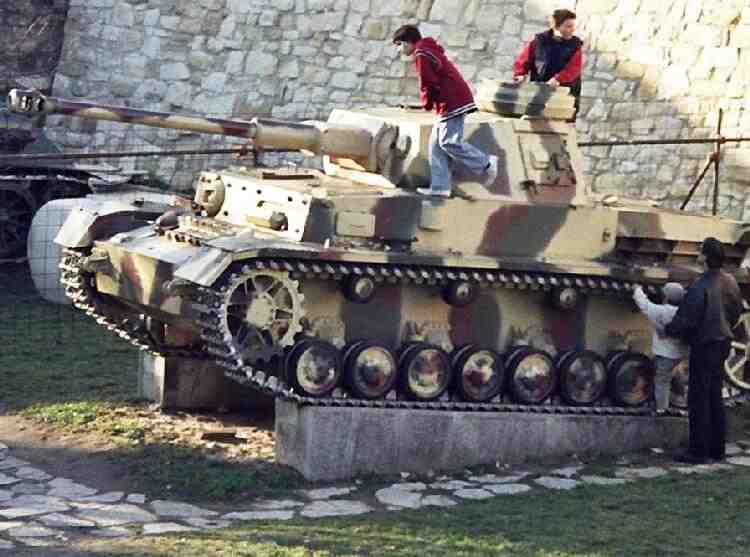
Each of the major belligerent countries had weapons that became legendary. Noe more so than the Germans. German Panzers cut swath across virtually all of Europe, but never crossed the Volga in the East. The Germans managed to make due with both a small number of Panzers and ones of limited capability. Eventually they produced perhaps the best tank of the war--the Mk. V Panther. They also produced the fearsome Mk. VI Tigers. The German 88 was one of th best tank killer of the War as well as an effective anti-aircraft gun. The Luftwaffe Stukas were terror inspiring dive bombers, but vulnerable. The principal German fighters were the legendary ME-109 and FW-190. The first effective jet was the ME-34 Swallow. The British fought off the Luftwaffe with the Hawker Hurricane and the Spitfire, one of the most admired fighters of the War. The heavy Avro Lancaster was one of the best bombers of the War. The Mosquito was an extremely effective medium bomber. For some reason, the British never developed an effective tank. The Soviet T-34 probably saved the Soviet Union, arriving on the battle field at a crucial point of the War. The Luftwaffe destroyed the Red Air Force at the onset of Barbarossa. Gradually the Red Air Force was reconstituted and the Ilyushin IL-2 Sturmovik developed a reputation as a tank killer on the Eastern Front. The best known American aircraft of the War were the B-17 Flying Fortress and the legendary P-51 Mustang that destroyed the Luftwaffe. The M-4 Sherman tank was inferior to the German tanks it faced, but it had its attributes as well as air and artillery support. The best rifle of the war was the M-1 Garand. The American 2 1/2 ton truck played a major role in both the East and the West. The Japanese fought the war with largely inferior weapons except for the Imperial fleet. The most legendary Japanese weapon was the Mitsubishi A6M Zero which dominated the Pacific for the first year of the War. The Japanese limited research and industrial capacity meant that they were still using the Zero at the end of the War.
Science and industry are inextricably linked. Science had played a critical role in the industrial revolution. At first the industrial revolution occurred largely as part of the textile industry. Gradually science became increasingly important such as the development of dyes to be used on textile. Germany proved to be a leader in the chemical industry and dyes were an important part of the developing industry in early years. As industry demanded answers to a wide range of problems connected with industrial production, more financial support was lavished on science. Education began to shift away from pure classicism to include the sciences. Research institutes were established, often connected to major universities. Americans interested in science often went to Europe to study. Many studied in Germany because of the prestige of German universities. One of those individuals was Franklin Roosevelt's half brother who was studying engineering. France, England, and Germany were the leading countries, but smaller countries like Belgium, the Netherlands, Sweden, and Switzerland also made important contributions. Italy was a large country, but had a smaller scientific establishment and industrial base than the other large countries. And America's expanding university system and demand from growing industries steadily expanded its scientific establishment. The Soviet Union inherited a substantial Tsarist scientific establishment, but Stalinist interference and restrictions on free exchanges limited its effectiveness. A major development begun after the NAZI take over. The persecution of Jews and anti-NAZIS caused large numbers of scientists to flee the country. Many found refuge in the United States. America at the time was developing an important scientific establishment and the influx of refugee scientists, in some cases leaders in their field, significantly aided this process. At the same time, NAZI dilution of academic standards undermined the future of science in the country. These trends can be observed in Nobel Prize awards. Science played a greater role in World War II than in any other previous war. This was because of the tremendous advances in scientific disciplines and the proliferation of combat applications for electronics. Several countries had important scientific established at the time of the War, but as it transpired only three countries (America, Britain, and Germany) made full use use of their scientific communities to play critical roles in the War. It was primarily Britain and Germany that mobilized their scientific communities as World War II approached. Here the Germans had a lead because because Hitler even before becoming Chancellor was planning the War. The British responded only when it became clear that Hitler was going to launch another War. Here Winston Churchill while still a back bencher played a crucial role. The Americans were at first far behind, but Prime-Minister Churchill's decision to turn over Britain's work on advanced weaponry quickly revolutionized American arms production. And America had what both Britain and Germany lacked, the resources and industrial base to manufacture weapons in unprecedented quantities.
Wireless communications or radio was developed just before World War I. It only played, however, a minor role in the War. The role of electronics in World War II was very different. Radio and other electronics including sonar, radar, navigational beams, and proximity played major roles in the War. Command and control is important in any military campaign. This is true whatever the combat environment. It is especially important in mobile warfare so a commander can direct fast moving mechanized units. And of course radio gave commanders just such a capability. Only the Germans at the onset of the war had fully thought this through and had a military force prepared to operate with modern command and control methods. Radios were an important part of that, but not the only electronic equipment which appeared on the battlefield. Radar was a key element leading to the British victory in the Battle of Britain. Part of the Battle of Britain was the less well publicized Battle of the Beams. Both radar and sonar were vital in the Battle of the Atlantic. Germany's industry, however, was not capable of fully equipping their army with needed weapons, including radios, and other electronic equipment. German scientists invented a range of weapons that the country's industry could not produce in large enough quantities to affect the War. Britain was the only country to begin the War with a fully mechanized army. And America was the only country with the industrial base and resources to produce the implements of war, including electronic equipment in the quantities required by its own military as well as that of Allied countries. One important area was electronics. The America radio industry provided the basis for a huge output of radio equipment and other electronic equipment such as radar and sonar. Radio while it enable commanders to direct mobile units was also inherently insecure. Thus signals intelligence became a vital aspect of the War. The Germans thought they solved this problem with their Enigma Machine. They were wrong. With signals intelligence the Allies proved much more adept than the Axis, although the Germans did have their successes as well.
Many of the innovative weapons of World War II were high-tech weapons, but not all. The Allies blasted their way through the Bocage country of Normandy, because a sergeant came up with the low tech 'rhinoceros', a standard Sherman tank with a scrap iron blade welded onto the front. Most World War II weapons were refinements of World War I weapons which made them more lethal. Here the Germans were particularly successful. There were, however several entirely new weapons and devices. The Germans created some high technology weapons, but the German weapons (missiles and jets), while technical marvels, for a variety of reasons had little impact on the War. The Allies on the other hand developed new weaponry that had a very significant impact on the War. These weapons included the atomic bomb, radar, the VT proximity fuse, the hedgehog, primitive computers, and much else. And the Allied weapons did change the course of the War. The German V-1, V-2, and other missiles were weapons of the future, but unfortunately for the Germans just that--the future. They had little real impact on the War. The German jets might have had a significant impact, but Hitler's interference delayed and misdirected the project. The Allies also were working on jets, but were behind the Germans. The atomic bomb was the supreme technological achievement of the War and helped end the Pacific War. Radar was developed by both the Allies and the Germans, but significantly aided the British in the Battle of Britain before the Germans were fully aware of its importance. And because the Germans held back their technology, played an important role in the Pacific War because the Japanese were far behind the Allies. Of all the major technical innovations, perhaps the most important is the VT proximity fuse. It played a major role in the Pacific War after it was introduced (1943). The Japanese Kamikaze attacks would have been much more difficult to beat off without the VT fuse. Because of fear that the secret might be compromised it was not used in ground operations, but was finally introduced in Europe after the surprise German Bulge offensive (December 1944). The British developed a primitive computer (called a bombe) to help crack the German Enigma machines.
Chemical weapons were extensively used during World War I. They were introduced by the Germans on both the Eastern and Western Front. The Western Allies retaliated by using them as well. The primary ordinance was artillery shells. Most observers believed that they would be used again when World war II broke out and would be used against civilians in aerial attacks. This did not occur, one of the few horrors which did not materialize. There were a few isolated incidents in Europe. Even though the Germans developed nerve agents that were far more deadly than World War I chemical agents, Hitler decided not to use them. Historians are not entirely sure why. German sources suggest that chemical experts assured him that the Allies probably had similar weapons or could easily produce them and no real advantage could be gained. There may also have been personal reasons for Hitler's decision. World War I belligerents also developed biological weapons. The two most important seem to be anthrax and typhus. Typhus was not weaponized, but the disease itself killed millions of people during World War I and the Russian Civil War. The development of DDT managed to contain it after the War. The Germans, however, remained very concerned about it. Typhus may have been used to a limited extent on the Eastern Front. The British did a great deal of work on anthrax. The Japanese appear to have been the World War II belligerent country that most extensively used both chemical and biological weapons, primarily in China. The Soviets launched a major biological warfare program after the War.
Tragically although not thought of as a weapon, food since the dawn of civilization has been a weapon. And perhaps more than any other war in modern history, food was used as a weapon. This was especially true of the Axis. This was because food production was a weakness for all three Axis countries and they were vulnerable to attacks on the food supply. This might have caused more rational policy makers to refrain from making war, but for all three Axis countries they seemed to have decided to use military expansion as a way of guaranteeing their food supply. And because the Germans and Japanese decided to use food as a way of reducing population of people they deemed genetically inferior or people thy saw as hostile. This tragically resulted in famine and mass starvation in both Asia and Europe and the death of millions. And the war and incompetence also resulted famine and starvation. At the end of the War, all three Axis countries were on the verge of starvation. Only the magnanimity of the Allied nations, primarily the United States, prevented millions from perishing in these aggressor nations.

Navigate the CIH World War II Pages:
[Biographies]
[Campaigns]
[Children]
[Countries]
[Deciding factors]
[Diplomacy]
[Geo-political crisis]
[Economics]
[Home front]
[Intelligence]
[Resistance]
[Race]
[Refugees]
[Technology]
[Bibliographies]
[Contributions]
[FAQs]
[Images]
[Links]
[Registration]
[Tools]
[Return to Main World War II page]
[Return to Main war essay page]