|
World War II created the greatest refugee problem in human history. The problem began before the actual fighting broke out. And by the end of the War, millions were dead and the survivors on the move all over Europe trying to retirn home, although for masny this was not possible. The problem was concentrated in Europe, but not entirely confined there. There were refugee problems after and during and after World War I. The numbers of refugees were significant, but the refugees and displacements help to create bitterness that led to much more extensive and brutal operations during World War II. The problem began with with the NAZI take over in Germany (1933). Political opponents fled Germany as did many Jews. The NAZI regime's focus on biological racism was to play a major role in the World War II refugee problem. Refugees from the fighting were a small pat of the overall refugeee problem. The NAZIs were determined to remake not only the political map of Europe, but also the ethnic map. And to do this they decided not only to create a colonial empire, but to use genocide. There were forced deportation, mass evacuation and displacement, perscecution based on ethnicity, mass killing, conscription for forced labor, anti-partisan operations, intra-ethnic violence, stategic bombing and evacuation from the cities. The NAZI approach to many refugee groups shifted toward genocide as the War progressed. There were refugee problems in most of the countries involved in World War II. And the boirder chasnges at the end of the War caused additional refugees. The refugee crisis in Europe, especially Germany, resulted after the War in the creation of an international refugee and human rights infrastructure which is the basis of how refugee problems are handeled today. We have focused on the problem od displaced children, but the overall refugee problem is important to understand. NAZI Germany was at the heart of the refugee problem, but the Soviet Union also played a major role. Other countries were involved in a variety of ways both in creating and attempting to assist refugees.
World War II created the greatest refugee problem in human history. The problem began before the actual fighting broke out. And by the end of the War, millions were dead and the survivors on the move all over Europe trying to retirn home, although for many this was not possible.
A refugee is traditionally seen as an individuasl who flees his home to escape conflict, persecution or natural disaster. NAZI, Soviet, and other regimes persecuted people on the basis of race, religion, nationality, social class, political orientation, and other reasons. This traditional concept does not, however, even begin to cover the World War II problem. A term adopted which is more comprehensive is displsaced persons. This includes the people confined in concebntation camps, labor camps, and POW camps. It thus seems to fit the World War II crisis berter than refugee. And ther were large numbers of people evavuated from the cities as a result of the bombing. All of these groups have to be considered to fully understand the World War II situation.
The problem was concentrated in Europe, but not entirely confined there.
There were refugee problems after and during and after World War I. The numbers of refugees were significant. The bestknown group were the Belgians, created by the Germans at the beginning if the War. Amother group wee the Serbs, in this case resulting from the Great Serbian Retreat. Both the Serbian Army and the civilins who accompanied them were in a desperate stte when theyvreached the Adritic coast. The most trahic group were the Armenians, many of whom were murdered in the Turkish Genocide. The refugees and displacements help to create bitterness that led to much more extensive and brutal operations during World War II. Many new states were created which as a consequence created large numbers of minority groups who found themselves disadvantaged in a variety of ways from education to job opportunities. This was especially the case in eastern and central Europe. Many of the new states initiasted land reform programs to turn oiver land to the majority group. Often adversely affected were German land owners. In many cases this was the iwbners of lasrge estates. But in Poland even small-scale farmers were adversely affected. Those dispossed are expelled were bitter and many had the opportunity to seek revenge.
The European refugee problem began with with the NAZI take over in Germany (1933). Political opponents fled Germany as did many Jews. Immigration becamne a major issue. The NAZI regime's focus on biological racism was to play a major role in the World War II refugee problem. Refugees from the fighting were a small pat of the overall refugeee problem. The NAZIs were determined to remake not only the political map of Europe, but also the ethnic map. And to do this they decided not only to create a colonial empire, but to use genocide. The World War II Holocaust except for a brief initial phase did not create refugees because the Germans began rounding them up and creating ghettoes or intenment capms where they where they were fed starvation rations until the killing began. The Holocaust against the Jews, however, was just part of the German plan. The Jews were to be killed right away. Their larger plan of reshaping the ethnic map of Europe would take more time. They wanted to turn the East into a vast German colonization zone of farming communities. The existing population was to be killed, deported beyond the Urals or enslaved. This would iof course create millions of rrfugees. In pursuit of their goal they developed the Hunger Plan and General Plan Ost. There was thuus no effort to assist non-German refugees. In fact, as they planned on killing or deporting millions in Eastern and Central Europe, starvation was seen as a usefulm way of pursuing their plans. Himmler wanted go proceed with Generalplan Ost right away, and began just that in Poland, creating a huge wave of refugees. Hitler ordered him to slow down the process as it was interfearing with preparations for Operation Barbarossa, the invasion of the Siviet UNion. The Germans did implement the Hunger Plan. The only people to be fed in the Eat were those working for the Germans to support the war effort. And rations were curtailed in the ocupied West.
There were many causes of the refugee/displaced person crisis during World War II. It was much more complicated than the standarsd refugee crisis of World War I where the refugees were primarily, but not exclusively people fleeing invading armies. The concept of displaced persons is much more appropriate as in World War II, civilians were targeted to a far greater degree than any conflict in modern history. There certainly were people fleeing invading armies, the traditional meaning of refugees. But there was a serious new problem in World War II--mechanized warfare. This meant that invading moved much more rapidly than the refugees and thus refugees were less able to evade the invaders. Another problem was the success of aggressor nations (NAZIs, Soviets, and Japanese) early in the War. This mean that potential refugees had no where to fleet to or were unable to flee. Tragically this was just the beginning of the World War II tragedy. Another cause of refugee movements in World War II was fear of aerial bombardment or the actual bombing. Here there was a mixture of refuges and evacuations, bluring the differnce between the two concepts. Other World War II phenomnon generted larhe numbers of refugees/displaced persons. Much of this would fll into the category ofwar cromes bd crimes against humanity. Here NAZIs and Japanese would be procecuted, the Siviets would not. These phenomnon included: forced deportation, mass evacuation and displacement, perscecution based on ethnicity, mass killing, conscription for forced labor, anti-partisan operations, intra-ethnic violence, stategic bombing and evacuation from the cities. The NAZI approach to many refugee groups shifted toward genocide as the War progressed. There were refugee problems in most of the countries involved in World War II. And the border changes at the end of the War caused additional refugees. Many of these causes have been widely studied. Others are little known today.
|
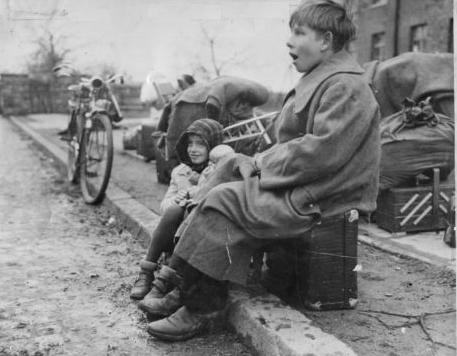
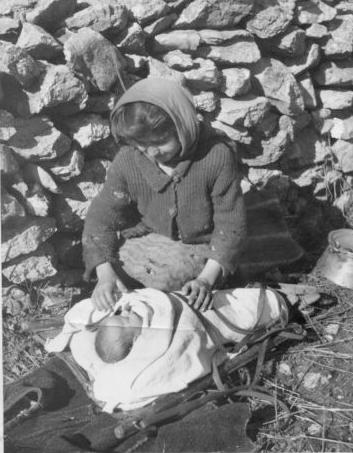
Children were involved in the refugee crisis in large numbers. And they were the most vulnerable refuf\gees. They were also a targeted group. World War II left large numbers of people homeless are far removed from their homeland. Millions of homes had been destroyed. Whole populations had been removed. The Soviets transported large numbers of people from the Baltic Republics to Siberia. Poles were moved west. Chechens and other peoles were also transported. The NAZIs of course targeted the Jews for death camps. Many Poles were transported from the areas of Poland incorporated into the Reich. The Germans brought millions to the Reich for slave labor labor. Many were young people without children, but some had children which were left behind. Many parents were killed in the bombing and shelling. Among the displaced were huge numbers of children. The children were of course the least likely to survive. If separated from their parents their chances were not good. Jewish children were among the first to be killed by the NAZIs because they had no economic value which could be exploited. One can not forget the images of the starving Jewish children in the Warsaw Getto whose parents had been killed and they were left alone. Even non-Jewish children were unlikely to survive without their parents. But many did survive and at the end of the war there were hundreds of thousands of displaced children. Adding to the human tragedy were millions of Germans streaming back to the Reich to avoid the Red Army. After the War German populations in Poland and other countries were forcibly transported to occupied Germany.
The World War II refugee/displaced persons problem is an emensley complicated topic involving a large numbers of people. NAZI Germany was at the heart of the refugee problem, but the Soviet Union also played a major role. Other countries were involved in a variety of ways both in creating, attempting to utilize the refugee issues, and efforts to assist refugees. Belgian refugees featured prominently in World War I discussions, but this time there were relatively few. There were large numbers of French refugees, but after there country surrendered to the Germans, most retuned home after a montyh or so of flight. The Germans created large numbers of refugees in Pland by deporting Jews and Poles from areas annexed in Western Poland. The Jews were first ghettoized and then murderd. The Poles were left to their own devices in the General Government, but syuffered greatrly because of the German Hunger Plan. The refugee problem was at first limited because the early German vicgtories were so overwealming and swift. People in these countries had little time to flee and no where to which to flee. The ensuing guerrilla war in Yugoslavia did create refugees. The Gernman invasion of the Soviet Union created huge numbers of refugees with which Soviet authorities had difficulty coping, largely because a substantial part of the contry's agricultural land was occupied by the Germans. The Soviets also created many refugees. Courtries varied greatly in how they addressed the refugee problem over time. After the German surrender, the orincipal refugee problem was getting the millions of people brought into the Reich for forced labor home. Poland had an esoecially severe problem as the Soviets deported large numbers of Poles in eastern Poland to western Poland. While the Germans created much of the problem, there were also large numbers of German refugees. First they were fleeing the advancing Red Army. Than after the War, the countries of Eastern and central Europe deported ethnic Germans.
Many deportations occured during World War II. Deportation is the expulsion of a person or group of people from a place or country. The Germans began this process even before launching the War. Many Poles including Polish Jews were deported to Polnd. German Jews were not deported, but instead were driven from the country by a comprehensive policy of persecution. The Soviet Union also engaged in deportations. Unlike Germany, it was a multi-ethnic country, althouhgh dominated by the Russians. With the start of the war, deportations increased in number and dimensuons, mostly conducted by the Germans and Soviets. Much of the German deportations focused on the Jews, but also Poles were a major target. Czechs were deported fom the Sudetenland and French from Alsace Loraine. There were smaller scale deportations from Memel (Lithuania) and eastern Belgium. The Soviuets conducted deportations from the Baltic Republics they seized before the War They also deported several ethnic groups deemed disloyal, beginning with the Volksdeutsche, but including many other groups like the Chechens and Crimean Tartars. And this did not end aftervthe War. The Soviets deported Poles in large numbers of people from former eastern Polsnd, essentially moving the Polish nation west. The largest of these deportations were the Germans living in Eastern Europe deported west, essentially mass expulsions often with great brutality.
|
Refugees connitates indivuduals fleeing invading armies. Sometimes they suceded in reacjing safety. Often they did not. There were also the more controlled movenent of civilians, commonly called evcuations. Here the civilians were moved by the Governments involved or received support and assistance from their governments. The best known evacuation wa the British evacuation of children and other endangered peoples from the cities to protect them from aerial bombing (1939-44). The French (1939), Germans (1942-44), and Japanese (1945) also evacuated children. A smaller evacuation, but very substantial in terms of a percentage of the popultion, was conducted by the Finns because of the Soviet invasion. The Soviets eventually evacuated children from Lenningrad. The Germans evacuated the ethnic Germans from the Baltics and nothwestern Romania (1939-40). The operation was known as 'Home to the Reich'. The Germans did not conduct organized evacuations in the areas as the Red Army approached later in the War because Hitler wanted a fight to the death and local NAZIs were afraid as being seen as defeatists.
Repatriation was primarily a process which took place after the War and it concerned the millions of workers brought into the Reich for war work. This included different groups of people from all over occupied Europe. Many were slave workers, mostly from Eastern Europe. Other were conscript workers, mostly from Western Europe. Other had voluntarily come to Germany from neutral countries, including some from Spain. Getting all these people home was areal problem. This was not only were their numbers of Germanscflooding into occupied Germny from eastern anbd central Europe, but also millions of Germans attempting to get home from where they were when the War endd. This included millions of Germans, especilly the children, who had been evacuated from the cities into the countryside. Now the problem of moving all these people home might have been manageable had the German transport system, espoecially the rail system, had survived the War. It had not. In fact the German transport system had been a primary target of the strategic bombing, part of destroying the German war economy. Europe, especially Germany, was awash with people. And with the destruction of the German transport system there was no easy or quick way for these people to get home. Thus Displaced Persons (DP) camps had to be set up to care for people until they could get home. Some were in such poor condition thst they need immediate medical care to be kept alive. Many were beyond help and could not be saved. There are other issues concerning repaitriations. Most of the displaced people wanted to go home. Not all people wanted to go home. Some of these people did not want to return to a Communist dominsted Eastern Europe. Some were forcibly repatriated. This was primarily the Soviet citizens who fought with the Germans. The Jews were a special problem. Many did not want to return home to eastrn Europe, in part because of the Comminiust take over, the murder of their families, and the prevlant anti-Semitism. Most wanted to go to either America or Israel. British policy to placate the Arabs severely limited Jewish access to Palestine. Ametrican emogration policy was changing, but immediately after the War was still restrictive. Another major reptariation effort was getting the Japanese home. Japanese civilians were located in the Marianas, Philippines, Taiwan, Korea, and Manchuria and had to be repatriated. This was done in an orderly fashion except for the areas occupied by the Red Army (Manchuria and North Korea).
Food would play an important role in World War II as it did in World War I. People have to eat and without food, war economies grind to a hault. War impairs a country's ability to produce food. Men drafted to fight reuce the agricultural work force and war production reduces imports like farm mchinery nd fertilizer. And the success of Axis armies early in the War. The Germans seized France (1940) hich gave them access to Frnce's agricultural bounty. And their Barbarossa offensive in the East, the Germans seized much of the Soviet Union's richest agricultural land (1941). And the Japanese did the same in China over a longer time frame. And the German U-boat campaign was launched to deny the British food and war supplies. There was only one country able to massivly increase food production to supply the gap in production crrated by the War. That was the United States. And thanks to the Royal Navy and U.S. Navy, food and other rlief supplies got through to Britain and the Soviet Union. In World War I the Allies were unable to get supplies through to Russia in the quantities needed. In World War II they suceeded. Tragically for Chins, the Japanese seized all of China's ports, making it impossible to get food through to China until after the Japanese surrnder. Food is not the only item needed for relief activities, but it is by far the most important.
United States food aid saved millions of lives in World War I. There was a special effort placed on feeding children. The same mission of mercy also occurred in World War II. The enormous productivity of American farms allowed it not only to feeds its people, but also provide food to the armies of its allies as well as civilian populations. This began even before America entered the War. The American Lend Lease Program approved by Congess (March 1941) is best known for providing arms and military supplies to World War II allies. Lend Lease aid also included large quatities of food. Food shipments to Britain and the Soviets Union. American and Canadian food aid was vital in keeping Britain in the War. American food aid was also vital in assisting the Soviet Union which was near staevation after the Germans seized much of the country's most productive agricultural land. Soviet agriculture was already weakened by Stalin's NKVD which he ordered to murder millions of Ukranian peasant farmers and their families before the War--many of the country's best farmers. Tragically it was not possible to get food aid to China because the Japanese controlled the ports. The American Army unlike the Axis armies brought its food with it.
The Allies, meaning primarily the United States, began organizing relief programs for the refugees created by the Axis aggressions even before entering the War. The United States had played a substntial role in World War I relief, saving million of lives. The same was the case during World War II. Two early American efforts were the Emergency Rescue Committee and the U.S. Committee for the Care of European Children. Once involved in the War, President Roosevelt began using the term United Nations. It was esentially the creation of Woodrow Wilson's League of Nations. Roosevelt had been a strong supporter of Wilson and the League. The League was so controversial and Roosevelt had such a know down drag out fight with the isolationists who hated the League that he came up with a new name and prepared for the creation of an actual organiation that would replace the League. The primary United Nations orgaization to assist refugees was the United Nations Relief and Rehabilitation Administration (UNRRA). This agency was created before the United Nations itself. During and in the immediate post-War period, it was largely financed and supported by the United States. Food was a priority. The Axis as a matter of policy sought to deny food to trgeted populations. The Allies as a result attempte to supply desperate refuges with food. Here UNRRA played a major role.
Some of the last Jews to get out of Germany were the children brought out through the Kindertransport. This was the transport of Jewish children out of Austria, Czecheslovakia, and Germany. The British Government, horrified at the outburst of violence in Kristallnacht agreed to eased immigration restrictions for certain of Jewish refugees. Two charitable groups help organize the program: the British Committee for the Jews of Germany and the Movement for the Care of Children from Germany. Together these groups persuaded the British government to permit children under the age of 17 to enter Britain from Germany and German-occupied territories (at the time what used to be Austria and Czecheslovakia). The limit on the number of children was that private citizens or organizations had to guarantee to pay for each child's care and education. The British Government refused to accept any financial responsibility. The Government also insisted that the children would have to eventually emigrate from Britain. Not the most hostpitable conditions, but at least they were out of Germany. The Government agreed to permit the unaccompanied children to enter on a simple travel visa. Parents or guardians were not permitted to accompany the children. There were also a few infants cared for by the older children. About 10,000 children were saved--the largest group of children to be saved from the NAZIs. Most were aided by Jewish charitable organizations, but Quakers and other groups also helped. The experience was traumatic for the children, especially the younger ones, who did not understand why they were being separated from their parents. The children had to say a final goodbye to their parents and families for a long train journey to England and numerous checks by NAZI authorities. Most were never reunited with their families who were murdered in the NAZI death camps. The older children were put up on hostels, many of the younger children were adopted.
TYhe British weere not in a poition to offer much assistance to refugees, esprcially after the trimphant German Offensive (May-June 1940). The few refugeees that made it to Britain were cred for. But food was a major issue for Britain as it was not self-sufficient in food prduction. And while the vaunted Luftwaffe failed to break Britain in the Battle of Britain (1940), Adm. Dönitz's U-boats attempted to cut off Bitain's North Atlantic life lines. There was no way Brtin could aid refugees on the Coninent. here was one areaa Britain could offer some aid--the Western Desert from their bases in Egypt. The Germans and Soviets as allies invaded Eastern Europe and the Balkans (1939-41). Refugees tried to escape the chaos and geocidal actions mneant thousands of refugees in motion. Some manafed to escape on boats across the Mediterranean. The only haven was the British position in Egypt and Paklestine. Those that made it were in desperate condition. British authorities attmpted to aid with limited resources on ad hoc basis. Britain seized Lebanon and Syria from Vichy Fance (1941). The Bitish then established the Middle East Relief and Refugee Administration (MERRA) which set up a series of camps in Egypt, Gaza, and Aleppo. American aid provided much of the neededresources. The MERRA camps provided havens for over 40,000 displaced Europeans. One very special vgroup was the Poles. After the NAZI invasion of the Soviet Union, Stalinm allowed Polish POWs he held to fight the Germans either with Soviet forces or the Allies. They made the way overland out of dreadful camps to Egypt. Some civilians that the NKVD had depoted, including children under the most difficult conditions managed to accompany them.
The needs of the World War II Displaced Persons were anticipated by the United States. American authorities were not fully aware of the enormity of the NAZI crimes in the occupied countries, but it was clear that there were large numbers of displaced persons. The United States thus helped established and fund the United Nations Relief and Rehabilitation Administration--UNRRA (1943). The purpose of the new agency was to provide services for the postwar refugees and to help repatriate them to their own countries. UNRRA was not created specifically to assist Jewish refugees, but refugees in general. Because of NAZI race policies, however, Jews were the group most affected by the War and in need of assistance. While established in 1943, UNRRA could not begin its principal work until NAZI occupied Europe was liberated. UNRRA opened camps in North Africa and began prepsrations for its work when after D-Day and Soviets offences in the East, the NAZI empire was rapidly dimantalled. UNRRA was in place when Germany surrendered (May 1945). The collpase of the NAZI war economy and the homocidal administration of many NAZI camps meant that huge numbers of people were in desperate straits when the Allies reached them. UNRRA had the task of saving millions of starving individuals and organizing the homeward journey of most of the refugees. UNRRA set up refugee camps in old schools, military barracks, even barns. These camps were meant to be short-term transit camps, and in fact most non-Jewish refugees within a year and a half had been returned to theit home countries, an amazing accomplishment. Jewish refugees, however, presented an especially difficult problem. [Greenfeld] In most cases they were unwilling or unable to go home. Returning people to Soviet occupied countries was another major problem.
The refugee crisis in Europe, especially Germany, resulted after the War in the creation of an international refugee and human rights infrastructure which is the basis of how refugee problems are handeled today. This has had both positice and negative consequences. Institutions were established to aid refugees. And there is commonly an outpouring of sympathy for refugees commonly resulting in the provision of humanitarian aid to care for them. Often it is barely adequate for the need, but certainly more is done for modern refugeees than refugees during earlier periods. One negative impact is that the aid being provided permit refugees and political groups to avoid adjustment and assimilation. The Palestinian refugees were not assimilated by the Arab statess. In contrast the larger number of Jewish were assimilated by a much smaller state--Israel. The result that now more than a cetury later, there are many more Palestinian refugeees than immediately after the War. The people we now call Palestinian refugees are not actual refugees, but the children and granhdchildren of the refugees born in the refugee camps. Humanitarian aid as in essence not solved the Palesirinian refugee pronblem, but perpetuated.
Greenfeld, Howard. After the Holocaust (Greenwillow Books/HarperCollins Publishers, 2001).

Navigate the CIH World War II Pages:
[Return to Main 20th century refugee page]
[Return to Main mass killing page]
[About Us]
[Biographies]
[Campaigns]
[Children]
[Countries]
[Deciding factors]
[Diplomacy]
[Geo-political crisis]
[Economics]
[Home front]
[Intelligence]
[POWs]
[Resistance]
[Race]
[Refugees]
[Technology]
[Totalitarian powers]
[Bibliographies]
[Contributions]
[FAQs]
[Images]
[Links]
[Registration]
[Tools]
[Return to Main World War II page]