|
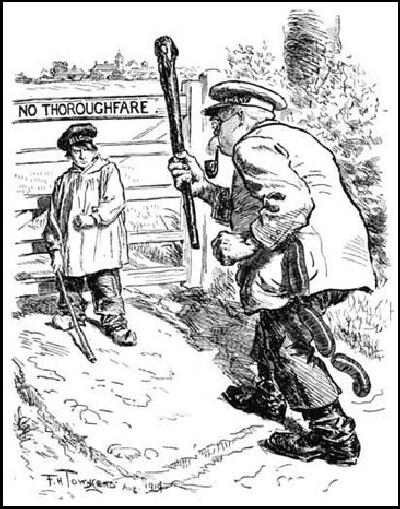
Germany with Russia allied with France conceived a war plan to rapidly defeat France before the superior resources of these two countries could be brought to bear on Germany. Because the French had heavily fortified the border, the German Schliffen Plan called for a massive stoke through neutral Belgium to avoid the French fortifications along the French-German border. The Germans invaded Belgium (August 4, 1914). This horrified the world because it was correctly seen as the Germans trampling the rights of a small neutral country in violation of international law. Thus from the beginning the Germans were seen in American and other countries as an unprincipled aggressor in the War. More importantly at the time, the German invasion brought Britain into the War (August 4, 1914). Britain had understandings with France and Russia, but there were not firm treaty commitments. Britain had guaranteed Belgian independence in the Treaty of London (1839). Britain may have entered the War anyway, but it was the invasion of Belgium that triggered the British declaration of war and the dispatch of the British Expeditionary Force (BEF) to stop the Germans. The Germans gambled that they could defeat the French quickly as they did in the Franco-Prussian War. They disregarded the Belgian Army and calculated that they could defeat the French army before the British could deploy a substantial force to aid the French. The Belgians put up and unexpectedly stiff resistance, slowing the German advance. King Albert I proclaimed, "Belgium is a nation, not a road." The BEF although at first small also slowed the Germans. A Russian offensive forced the Germans to divert forces from the drive on Paris. In the end the Germans were stopped by the Miracle on the Marne (September 1914). Although the Germans were stopped, they had overrun most of Belgium which remained in German hands for most of the War.
Belgium was a neutral country. It had declared its independence when it broke from the Netherlands (1831). Britain had guaranteed Belgian independence in the Treaty of London (1839). The signatories included the World War I belligerent powers. In the great power struggles such as the Franco-Prussian War (1870-71), Belgium had remained strictly neutral. The country did not participate in the series of alliances negotiated by the great powers in the late 19th and early 20th centuries.
Belgium was a small country. It consisted of the southern Netherlands, Flanders and the Walloon areas of Artois, It was thus a bi-ethnic country, the Dutch speaking Flemish and the French-speaking Waloons. The population in 1914 totaled about 7.5 million. It was an affluent, heavily industrialized country country with a prosperous economy based on trade and industry. Belgium had a steel industry with adequate coal and iron ore resources. There was an efficient railway system. Belgium prospered in the industrial revolution that transformed Europe during the 19th century.
Like several Western European countries, however, it was a net food importer. This did not pose a problem before the War. The country's booming industries generated the foreign exchange need for food imports. The major ports were Antwerp and Ostend. The country had a constitutional monarchy. There was universal male suffrage but there was a voting system by which the well-educated and wealthy were allocated up to three votes each. Parliament at the time of the German invasion was controlled by Baron Charles de Broqueville and his Catholic Party. Both the Flemish and Waloons were Catholic.
Belgium unlike neighboring countries did not feel impelled to maintain a large military. They had no intention of attacking their two large neighbors and increasingly Belgians came to believe that their neutrality protected them from attack. Belgium in its early years as a result had virtually no army at all.
The impetus for military preparedness came from the Belgian monarchy rather than democratically elected parliamentary figures. Constitutionally the Belgian monarch was Commanders-in-Chief of the armed forces.
King Leopold II after the war of 1870 and faced with expanding German power in Europe decided that Belgium needed to upgrade its military defenses. Leopold oversaw the construction of the Meuse fortresses at Liege and Namur. He also convinced Parliament to authorize expanding the Army to 100,000 men raised by a national service system. There was not a great response and an additional law essentially based the Army on volunteers (1902). Military defense became a political issue. The Christian-Democrats generally supported defense measures. The governing Catholic party, however, was less supportive. Another national service law made further changes (1909). Service was limited to one son for each family. The period of service was shortened, Other measures to entice service and enforce the law eventually helped with recruitment bringing in about 33,000 trainees annually. There short term of service meant, however, that they were barely trained and largely inexperienced. After their training they formed part of the active reserve for a total service period of 15 years.
Belgian neutrality had for over 80 years been respected by the great powers. This included France and Prussia during the Franco-Prussian War (1870-71). Most Belgians believed that their country would never again be involved in a war. They looked at Switzerland which for centuries (with the exception of the French Revolution) had managed to avoid war through neutrality. Of course geography was on Switzerland's side. Belgium began its national life with strong cultural ties toward France. Over time this began to change, in part because of the economic power of the German empire. About 1910 Germany became Belgium's major trading partner. Along with economic influence, Germany began to impact Belgian cultural life. [Chauriaut] Increasingly Belgians looked favorably on Germany. Here opinions differed, but many Belgians were impressed with the seemingly more orderly and disciplined German approached. More Belgian intellectuals began to spend more time in Germany than in the Sorbonne. The Flemish in particular often at odds with the French Waloons seemed attracted to Germany.
Many sectors of Belgian society were in the years before World War I pro-German. The most staunchly pro-French sector of Belgium was the officer class of the Belgian Army. Belgium's regular army was very small. There were six infantry divisions (43,000 men) supported by an additional 115,000 trained reserves. The Belgian Air Force had one squadron composed of 12 aircraft.
Germany with Russia allied with France conceived a war plan to rapidly defeat France before the superior resources of these two countries could be brought to bear on Germany. Because the French had heavily fortified the border, the German Schlieffen Plan called for a massive stoke through neutral Belgium to avoid the French fortifications along the French-German border. Count Alfred von Schlieffen, became German Chief of the Great General Staff in 1891. He worked on a war plan for years, perfecting a precise movement of troops. He submitted his plan in 1905. French foreign policy was devoted to ensuring that in another war with German, France would not fight alone. Kaiser Wilhelm's bombastic threatening and aggressive policies, including the construction of a high seas fleet, made the task much easier for French diplomats. France and Britain in 1904 signed the Entente Cordiale (friendly understanding), it was not a full military alliance, but it was clearly aimed at Germany. The French wanted to also involve Russia. The Germany military perceived the need for a military strategy if war came with France, this time aided by Britain and Russia. Schlieffen had for years been working on just such plan. Schlieffen's plan was premised on the critical need that France be quickly defeated before the British or Russians could bring forces to bear on Germany. Without France, Schlieffen was convinced that neither Russia or Britain would continue the war. Schlieffen estimated that Russia would take 6 weeks to mobilize its massive, but backward army. Thus to win the war, Germany must Therefore, it was vitally important to smash the French before the Russians could bring its forces to bear. Schlieffen envisioned committing 90 percent of the Germany army to attack France as soon as war was declared. He was afraid of the strongly engineered French border fortifications. He thus conceived of an attack west through the neutral neutral Netherlands, Belgium, and Luxembourg and this invade France through the poorly defended Belgian border. The Germans would then swing east, take Paris and push the French Army back against their eastern frontier fortresses and the Swiss frontier. Helmuth von Moltke replaced von Schlieffen as German Army Chief of Staff in 1906 and modified the plan by not invading the Netherlands and in weakening the right wing--a move von Schlieffen had specifically warned against. The Germans in the revised plan would advance over the flat plains of Flanders. Moltke was convinced that that the Belgian army could not effectively resist a massive German offensive.
King Albert is the most beloved of Belgium's monarch, largely because if his role in resisting the Germans. Albert while visiting Berlin in 1909 was informed by Kaiser Wilhelm of Germany's war plan. He is famous for remarking about the Germans, "Belgium is a nation, not a road." Albert was aware of the German invasion plans, but could do nothing, as Belgium's neutrality prevented the country from arming itself. In August 1914 Germany demanded permission to march its army through Belgium to attack France. Albert refused. Germany not withstanding the Treaty of London (the famous "scrap of paper"), invaded Belgium. It was later said by French Prime Minister Clemenceau when asked how history would remember the start of World War I, replied "One thing is for certain: they will not say that Belgium invaded Germany." Germany occupied most of Belgium before stopped by British and French troops. The Belgian constitution provided that the King would become Commander in Chief in case of war. Albert led the Belgians in delaying actions against the powerful Germans drive preventing the Germans from gaining victory in first month of the War as they had planned. While the Belgian Army was small and poorly equipped, The gallant Belgian action in the face of the massive German invasion force did slow the German advance, probably saving Paris and was a key factor leading to the French "Miracle on the Marne" that finally stopped the German Army. Albert became regarded as a great hero of the War. Nearly all of Belgium, however, was occupied by the Germans through 4 years of war. King Albert declined to cooperate with the Allies and maintained separate command of the Belgian forces. In 1918 Albert finally gave in to pressure and cooperated with the allies in the final offense of 1918, being made commander of the Flanders Army Group by General Foch of France.
Austria-Hungary was determined to punish Serbia for the assassination of Archduke Franz Ferdinand. Austria was hesitant to attack because of Russia was committed to defend the Serbs--fellow Slavs. When Kaiser Wilhelm wrote Emperor Franz-Josef a blank check, however, the Austrians felt secure to attack, expecing a quick victory. The Kaiser' s decision to support Austria's desire to punish Serbia turned a Balkans crisis into a major European war. Austria-Huguary declared war (July 28). Two days later Ruusia issued mobilization orders (July 30). This set the clock ticking. Germany held the military advantage, but his would soon b ngated when Russia mobilized its huge manpower reserves. Kaiser Wilhelm and Tsar Nicholas exchanged telegrams (July 29-August 1). Their personal relationship could not restrain the developing tragedy. France allied with Russia also issued mobilization orders. Russia had the largest army in Europe and once mobilized posed a formidable danger to Germany. Germany thus felt impelled to strike at France before Russia could mobilize. Germany declaring war on Russia (August 1) and France (August 3). Germany seized neutral Luxembourg (August 3). The world focus then turned to Belgium. After the War, the Allies demanded that Germany accept the guilt for launching the War.
As Europe wa hurdling toward war, the question became Britain. Taking on Rusiia and France ws quite an undertaking even for the powerful German Army, but adding the British Empire was an entirely different matter. It mean that the Germans would be going to war against a much more powerful eneny coAlition with far greater resources than Germany even with Austria-Hungary added. Britain has developed closed relations with France, but had no treaty relations required it to come to France's defense. And Britain had until this point had more conflict with Russia which was threatening India than Germany. This is where Belgium which wanted mothing more than to remain neutral comes into the picture. Britain did have treaty relations with Belgium, guaranteeing its neutrality. The schlieffen Plan was no secret. It was the German war plan and had been the basus for German strategic thinking for three dcades. Now that German had declared war on France, Kaiser Wilhelm now had to decide wether to activate the Sclieffen Plan, knowing that it would likely mean war with Britain as well as France and Russia. Actually it was never aeal possibility that they would not activate the Schliffen Plan. The German generals pushed for the Sclieffen Plan which was already in motion, troops and supplies moving toward the Belgin border and Luxenbourg seized. The option was a frontal attack on heavily fortified French border defenss. The German generals insisted that here progress would be slow allowing Russia time to monilize. The Kaiser was not one to disagree with his generals. The Kaiser and his generals calculated that the Belgian wiuld put up little resistance and France would be defeated before Britain could bring its considerable forces to bear. German troops poured across the Belgian border (August 4). German Chancellor Bethmann-Hollweg dismissed Britain's treaty with Belgium as a 'scrap of paper' in his final meeting with the British ambassador in Berlin, Sir Edward Goschen (August 4). Within hours Britain declared war with Germany. Foreign Secretary Grey famously described the 'lights going out all over Europe'. Britain may have entered the War with out Germany invasion of Belgium, but the invasion provided both the causus bellum and popular support for war. Germany probably would have prevailed in a war with France and Russia. The invasion of Belgium provided tactical advantages, but at the cost of bringing Britain and the Empire with its immense military and material resources into the War. Even worse for the Germans, the Belgins put up an unexpectely stiff resistance and the British Expeditionary force reached Belgium in time to alsp slow down the Germans. Some authors have laid the blame for the War largely on Germany. [Fischer] Other historians are more inclined to ascribe the blame to other countries as well seeing war in most instances as a reciprocal event. [Strachan] PPremoer when asked this question replied simply, "Belgium did not invade Germany."
Large numbers of Belgian civilians fled the advancing German armies. Fear of an invading army was part of the reason for flow of refugees. But as word of the behavior of German troops and terrible attrocities spread, fear of the Germans spread and more Belgians began abandoning their villages and towns. Although Belgians along the border had little opportunity fo flee, the effective resistance of the small Belgian Army and the quick reactin of the BEF bought Nelgians to the west time to flee the advancing Germans. Some fled north to the Netherlands. Other fled south to France. About 1 million Belgians sough refuge in the Netherlands. Most of the civilians in the Netherlands gradually returned to Belgium even though it was occupied by the Germans. About 100,000 Belgians remained in The Netherlands throughout the War. Some had the resources to support themselves. The Dutch Government opened refuge camps for those who could not support themselves. The German Government gave vitually no attention to the plight of the refugees and other civilian mtters, actually seizing sivilian food supplies. The Germans did not think such matters consequential. The world press, including the American press, picked up on such matters. And from an early point of the War the Germans acquired authless reputation, sometimes referred to as the Huns. As regards many countries, the Germans were right, it did not make a differebce. They were wrong about on country and a country that would make a huge difference--the United States. Until World War I, Germany was a very admired country iun America--World War I changed this.
The French had five Armies deployed in the north when the war broke out. The French war plan (Plan XVII) was based primarily on an offensive to retake the lost provinces of Alsace-Loraine. It was also premised on the assumption that the Germans would honor Belgian neutrality--an assumption that almost cost France the War. The bulk of the French Army was deployed south of Belgium and immediately committed in an unsuccessful attempt to retake Alsace-Loraine east of Paris. The German progress in Belgium did not deflect the French from their plans go retake Alsace-Loraine. The French attacked (August 14). The 1st and 2nd Army attacked toward Saarburg in Lorraine and Mulhouse in Alsace. The Germans with their Army committed to the Schlieffen Plan mounted a competent defense, withdrawing slowly but inflicting substantial losses on the French. The 3rd and 4th army toward the Saar River in an effort to take Saarburg, but were driven back. The French captured Mulhouse, but were forced to abandoned it to strengthen the depleted units in Lorraine. Here Joffe reacted brilliantly. He saw the failure of the the offensive north and use the French rail system to reposition forces west ti dealwith the German forces approach the French frontier from Belgium. [Herwig]
The German invasion brought Britain into the War (August 4, 1914). Britain had understandings with France and Russia, but there were not firm treaty commitments. Britain may have entered the War anyway, but it was the invasion of Belgium that triggered the British declaration of war and the dispatch of the British Expeditionary Force (BEF) to stop the Germans. The British Government voted for war and ordered the BEF be immediately dispatched to France, following plans prepared before the War with the French High Command. The BEF was relatively small, but it was a highly professional force that joined the Belgian Army in slowing the German advance. The British unlike the French and Germans did not have a large standing army. The Royal Navy was seen as Britain's main line of defense. Britain had only a small professional army. Must of their army was immediately dispatched to France as the British Expeditionary Force (BEF). The BEF although at first small also slowed the Germans. The BEF first met the Germans at Mons, a small Belgian town. This was a momentous occasion. The British had for centuries been fighting the French. They had commonly fought with the Prussians and other German states. (It was the Prussians that saved Wellington at Waterloo.) Mons was the first engagement between the British and Germans. It would not be the last. Although the BEF stopped the Germans and inflicted substantial casualties, French forces falling back forced the BEF to also retreat. The Germans were surprised at how swiftly the BEF reached France and Belgium. The BEF formed on the left flank of the French Army. The French had committed the bulk of its army to a disastrous offensive into Alsace-Lorraine and first clashed with the German army near Mons in southern Belgium. The German invasion force forced the Allies into a strategic retreat. The Germans were convinced they could take Paris before either the British or Russians could intervene. The valiant resistance of the hopelessly outgunned Belgian Army under King Albert I helped slow the advancing Germans who had weakened their right wing, in part because of the Russian offensive.
Russia and France had a mutual defense treaty. The Russians honoring tht treaty organized an sizeable offensive into Est Prussia. This surprised the Germans. They had anticipated defeating the French before the Russians could mobilize and strile in the East. The resistance of the Belgian Army was delaying the German drive toward Paris. A Russian offensive forced the Germans to divert forces from the drive on Paris. The Germans were shocked by the Russian Army's advance into East Prussia. Hindenburg and Luendorff organized a German counter offensive which defeated two much larger Russian armies. The Russian armies were shatered in a great German victory, but the German advance in the West had been fatally weakened by the transfer of forces East.
The German drive through Belgium and the failed French offensive in Alsace-Loraine set up the decisive Battle of the Frontier. The Germans advanced through Belgium, Luxembourg and the Ardennes finally reached northern France to the west of Alsace-Loraine where the French offensive was underway. They encountered
French army commanded by Joseph Joffre and the divisions of the British Expeditionary Force (BEF) commanded by Sir John French which had been rushed to France. Had the Belgians not slowed down the Germans, the BEF would have not been in place. The resulting fighting is referred to as the Battle of the Frontiers. The BEF was particularly important because the French believing that the Germans would not attack through Belgium had very weak forces deployed along the Channel. The principal engagements were the Battle of Charleroi and the Battle of Mons. They did not go well for the Allies. At Charleroi the German 2nd and 3rd Armies nearly destroyed the French 5th Army. At Mons the German were only delayed a day. The Allies ordered a general retreat. Further clashes included the Battle of Le Cateau, the Siege of Maubeuge and the Battle of St. Quentin (Guise). The German advance ground on and at one point the Germans were within
43 miles (70 km) of Paris.
As the Germans neared Paris, a deformity in the German line, a gap between the German 1st and 2nd Armies. The British thought it a trap. The French saw it as an opportunity and attacked. and counter-attacked. The engagement is known as the First Battle of the Marne (September 6�12), Legend credits the rickety little Paris taxis as moving French troops to the battle. One historian maintains that they actually had only a limited impact. herwig] The German army was forced to retreat to a position north of the Aisne River where they entrenched.
Belgium has only 70 km of coast on the North Sea and Ostend is set in the middle of it. Ostend or East end is Belgium's only important coastal city. It was before the War a popular seaside resort frequentely by royalty and high society. All this changed with the War. The inland port of Bruges could accomodate ocean-going vessels, although Antwerp located inland was the principal Belgian port because of Rhine River connections. As the Germans swept through Belgium (August 1914), they occupied almost the entire county, except for the coast. After the defeat on the Marne, the Germans and Allies conducted the Race to the Sea. It is at this time that Bruges and Ostend were taken by the Germans. The major fortification in Otend was Fort Napoleon, built by Napoleon (1811) to defend Ostend from British attacks. Must more elaborate emplcements would be built by Hitler during World War II as part of the Atlantic Wall. The Germans used it as a headquarters facility. The BEF and the Belgian Army made a stand south of Ostend, thus holding a tiny corner of the country out of German hands. The British Royal Navy managed to evacuate some people from the city. We are not entirely sure just who they were and just how they selected and who decided to flee rather than stay in the port as the Germans approached. Ostend was a valuable prize for the Germans because of its port. And its location (just a little north of Dunkirk) close to the mouth of the Channel meant that they could base ships and U-boats in Bruse to attacks British troop and supply ships crossing to France. To end these attacks, the British launched two attacks known as the Ostend Raids designed to close the shipping chnnels to Bruse (1918). They were only marginally effective. Bruges remained an active raiding base for the German Navy until liberated by the Allies a few days bfore the end of the War (October 1918). [Tarrant]
The German invasion of neutral Belgium was a clear violation violation of international law. This was tragically not the only outrage committed by the Germans. The Getmans in their drive through Belgium coomuuted serious attrocities against Belgian civilians. After the War, the British were charged with exagerating Ferman attrocities as a way of drawing America into the War. This was true, but it does not change the fact that the Germans committed very serious attrocities. Nothing like the behavior of the race obsessed NAZIs, but attricities that should not be lost to history. This included the shooting of civilian atrocities and the destruction of cultural treasures. This included Leuven University and its priceless library. It also included the destruction of so churches and cathedrals at Vis�, Diksmuide (Dixmude), Louvain, the Cathedral at Ypres, the Cathedral at Malines, and others. [Denry] Perhaps even worse than the actual attricities, as bad as they were, is the fact that they were part of a German policy of terror azfopted by the German Army's High Command. These attrocities were not the inevitable reults of civilians and cultural trasures caught in the crossfore of war, unintened casualties. They were the result of am intentional policy decesion of the German Genetal Staff. An important historian of the War writes, "The turn of events in Belgium was a product of the German theory of terror. Clausewitz has prescribed terror as the proper method to shorten war, his whole theory of war was being based on the necessity of marking it short , sharp and decisive. He said the civil population must not be exempted from war's effects but must be made to feel its pressure and be forced by the severest measures to compel their leaders to make peace. As the object of war was to disarm the enemy, he argued reasonably, 'we must place him in a situation in which continuing the war is more oppressive than surrender'. This seemingly sound proposition fitted into the scientific theory of war which throughout the nineteenth century it has been the best intellectual endeavor of the German General Staff to construct. It has already been put in practice in 1870 when French resistance sprang up at Sedan. The ferocity of reprisal at that time in the form of execution of prisoners and civilians on charges of franc-tireurs warfare, startled the war agape with admiration at Prussia's marvellous six-weeks' victory." [Tuchman, p. 306.]
The German invasion horrified the world because it was correctly seen as the Germans trampling the rights of a small, neutral country in violation of international law. Thus from the beginning the Germans were seen in American and other countries as an unprincipled aggressor in the War. The American public reaction was particularly important. With the major world powers locked in mortal combat and relatively even balanced, American action would likely determine the outcome of the War. And here there was no preordained outcome that America would join the Allies. At the time, America's largest immigrant group was German. Americans of English ancestry generally had lost connection with England. There were very few French-Americans. The Irish, a major immigrant group, were strongly anti-British. Jewish Americans were strongly anti-Russia. There were a range of conflicts with Britain during the 19th century, including one as recently as the 1890s. There had, on the other hand, been no major confrontations with Germany. Many prominent Americans such as Theodore Roosevelt were pro-British, but public opinion strongly was for staying out of the War. It was the Germans who largely changed American public opinion through a series of actions beginning with the invasion of Belgium. The clumsy German actions were cleverly and often not honestly manipulated by British propaganda.
The Belgian government convened at Le Havre, France. King Albert I, as commander in chief of the army, remained with his troops in unoccupied Belgium along the Yser River. The ruling Belgian Catholic Party government was enlarged to include some Socialists and Liberals in an attempt to create a national unity government (1916).
Kaiser Wilhelm before the War explained Germany's war plans to an outraged King Albert. He wanted Albert to agree to let the German Army pass through the county unhindered. World War I began with the German invasion of Belgium. Much of the fighting on the Western Front was fought in Belgium or northern France. Almost all of the country was occupied by the Germans in the first weeks of the War. King Albert led the small Belgian Army in a dogged defense that along with British help delayed the German advance and ultimately played a key role in France's successful defense of Paris at the Marne. The German invasion of Belgium gained them a military advantage, but it also brought the opprobrium of aggressor on Germany that would significantly color world public opinion, including American opinion. This would ultimately be a major factor in America's entry into the War. Albert and Elizabeth refused to abandon their subjects and stayed on while the country's valiant, although futile, effort tried to resist the German onslaught. Albert stayed with the Belgian Army which help to hold a small area of the country, the southwest corner. Elizabeth, using the medical knowledge she had acquired at her father's clinic, opened a field hospital where she served as a nurse.
After the Battle of the Marne, the Western Front rapidly became a huge system of fortified positions and trenches stretching from Switzerland to the Channel. Although the Germans were stopped, they had overrun most of Belgium which remained in German hands for the rest of the War. The German Army seized control of the civilian food supply setting up a humanitarin crisis and potential starvation. German authorities governed with repressive measures. The Germans confiscating houses and other property for the occupying troops. German troops killed civilians who resisted. While the German actions were nothing like those perused by the NAZIs in World War II, they were bad enough and shocking at the time. They were effectively used by British to sway public opinion in America. The Germans also used civilians for forced labor. These laborers were poorly fed. The Germans also seized food supplies with little or no concern about the impact on the civilian population. The British naval blockade in the North Sea caused shortages in the occupied areas which eventually spread to Germany itself. Belgium like Germany was not self sufficient in food production. German occupation authorities attempted to take advantage of the Flemish-Walloon division. They supported Flemish Activists--a radical nationalist group that agreed to work with the Germans hoping to gain independence for Flanders. Flanders during the German occupation seceded from Belgium (November 1917). At the time, it looked like the Germans might finally win the War. The great majority of the Flemish remained loyal to King Albert and Belgium. There was little support for the German-supported Council of Flanders. Nor was the German decision to change the University of Ghent from a French-language to a Flemish-language institution well received. (The Belgian government made the State University of Ghent partially Flemish and then in 1930 fully Flemish.)
The small Belgian Army put up a valoant resistance to the huge German Army that invaded theneutral country (August 4, 1914). What ensued was the Battle of the Frontier. ThecBelgians slowed don the Germans, someyhing they had not anticipated. The British and French rushed north to assist the hard-pressed Belgians. The German focus was turning south to breach Paris. This the force of the German Army was not at first on the coastal areas. As a result the Belgians aided by the British managed to hold on to a tiny sliver of their country south of Ostend along the
Yser River which became known as the Yser Pocket. Refugees flowed through the area. Stoped before Paris on the Marne (September), the rush to the Channel began. This led to the Battle of the Yser (October). It was fought between Nieuwpoort and Diksmuide, along a 35-kilometre (22 mi) stretch of the Yser River and the Yperlee Canal. The Veurne city hall became the headquarters for the Belgian troops under King Albert I and a military hospital was set up in the city. The front line was largely held by the Belgian Arny. It was a costly battle, but te Belgians held and te Germans failed to take the last corner of unoccupied Belgium. The vicyory made King Albert who commanded the Belgian Army a national hero. As the trenches lines were established, the French evacuated people away frpm the front. The Belgians cpuld not do this because so little Of Belgian was left. Thus the Belgians in the unoccupied zome got a closer wlook at the War of all the belgerants on the Westrn Front. They were not subjected to German attrocities, but they werre the cloest zone the fighting--soectators to the tragedy to the gisly tagedy on the Western Front. Many of the wealthy fled, but the ordinary people staid to support the war effort. They were so close to the front that they were affected by artillery bombardment and German offensives. Understanding the imprtance of the Yser Poxjet, eseciaaly Furnes, the Germans launch a gas attack on the city (August 1917). The Allies dustributed gas masks to civilians. Children were sent to safty in French colonies (camps).
Most of the continental North Sea coast is covered by the Denmark and the Netherlands. The German invasion of Belgium which launched World War I did gain them some valuable North Sea ports. The Germans suceeded in occupying almost all of Belgium (Augist 1914). Belgimn had only a small North Sea ciast, but it included startegically placed Ostend and Zeebrugge with canal connections to Bruges, a large inland city whete the Geramns develp[ed a major naval base. Admiral Ludwig von Schröder (1854-1933) was given command of the Marinekorps Flandern, the German force that occupied the area. He immeduately realized that these bases could be used by samm torpedo-boats and submarines to strike at the supply libes crossing the Channel to support the Western Front. The Germans called this position the 'Triangle'” and by 1917 was a major case with shore guns to protect the unstallatioins from British naval fire. This became critical when the Germans reintroduced Unrestricted Submarine warfare (1917). The Belgian ports were used not onlyfor U-Boats breaking out into the North Sea, but because they were close to cross-Channel shipping lanes suppying the British Army on the Western Front. Small boats from these ports harried the British. But the primary thereat was the U-boat bases in Ostend and Zeebrugge. The Geramns reintroduced unrestricted subnarine warefare (February 1917). This brought America into the War, but the shipping losses were a real danger to the British war effort. The British had been considering attacks on the Belgian port before this because od small boat raids on Channel traffic, but the U-noat crisis resulted in attempts to close down the ports.
The German occupation did not end until the Allies launched the War-winning Hundred Days Campaign After the failure of the German Spring Offensive (April-May 1918, Allied Armies significantly strengthened by the large and growing American Expeditionary Force smashed into the German Western Front and began liberating areas of Belgium (August-November 1918).
The Belgians played a role in the final Allied victory--the war-winning Hundred's Day Camapign. King Albert reorganized the Belgian Army into 12 infantry divisions in the smll corber of unoccupied Belgium. They were part of the Belgian-French-British Army Group Flanders commanded by King Albert and his French Chief of Staff General Jean Degoutte. They fought in the Fifth Battle of Ypres (beginning September 28), breaching the German front at Houthulst and liberated Passchendaele, Langemark and Zonnebeke. They paused (October 2- 14 October). The Belgian Army next participated in the Battle of Courtai, liberating Bruges and Ostend. Lille pn yhe Bekhian border was liiberated by British troops (0ctober 17). The Allies were still miles from Brussels when it was actually liberated by German soldiers. A Soldatenrat was created (November 10). The German solfiers rebelled against their officers and unsuccessfully tried to fraternize with the local population. The last days were were violent, with the people retaliating against war profiteers and women suspected of having relations with the Germans. The Belgian Army fought in the Battle of the Lys and the Escaut and neared Ghent (November 11). The German Army was disntegrating, but the Allied advance was no cake wakj, The Belguan Aeny sustauned 20 percebt casualties in just these 6 weeks. That was a third of the all the casualties suffered during the entire war. [Pawly, pp. 36-37.] The Germans asked for an Armnistice which was sugned (November 11). As part of the Armitice, the Germans were required to immediately evacuate Belgium. At the time the Germans asked for the Armistice, they still controlle most of Belgium. The Flemish government which the Germans had established to partition the country collapsed. Belgium's suffering, however, did not end with the Armistice. A frantic week followed the Armistic. Retreating but still heavily armed German soldiers stripped museums, galleries, and private homes of anything remotely valuable. [Bray] Brussels mayor Adolphe Max who had refused to cooperate with the Germabns escaped from prison and entered Brussels to a hero's welcome (Noember 17). The Royal Family arrived in Brussels and the entire city exploded in a jouous national celebration (Novembver 22).
There were 267,000 men who served in the Belgian Army during World War I. Causalities totaled 54,000 were wounded and 14,000 killed.
After the War, the Flemish leaders cooperating with the Germans were tried for treason. Some were hung.
Bray, Paul, "Brussels under German occupation," The Telegraph (December 30, 2014).
Chauriaut, Henri. La Belgique Moderne (1910).
Denry, Fabien. E-mail message (July 15, 2014).
Herwig, Holger. The Marne, 1914: The Opening of World war I and the Battle that Changed the World.
Pawly, Ronald. The Belgian Army in World War I (Osprey Books: 2009).
Tarrant, V.E. The U-Boat Offensive 1914�1945 (1989).
Tuchman, Barbara. The Guns of August. The subject of attrocities is a difficult one. The British picked up every report and fed it to both their public and even more importantly, the American public. This was important in affecting American public opinion. The Germans played doen the reports, denying many, and attributing it all to Allied war propaganda. Tuchmans's work is important in wadeing theough the contending charges and claims becuse she is a respected Noble Prize winnining historian.

Navigate the CIH World War I Section:
[Return to Main World War I country page]
[Return to Main World War I conduct page]
[Return to Main Belgian history page]
[Return to Main Belgian page]
[About Us]
[Aftermath]
[Alliances]
[Animals]
[Armistace]
[Causes]
[Campaigns]
[Casualties]
[Children]
[Countries]
[Declaration of war]
[Deciding factors]
-------[Diplomacy]
[Economics]
-------[Geo-political crisis]
[Home front]
[Intelligence]
[Military forces]
[Neutrality]
[Pacifism]
[People]
[Peace treaties]
[Propaganda]
[POWs]
[Russian Revolution]
[Signals and intelligence]
[Terrorism]
[Trench warfare]
------[Technology]
------[Weaponry]
[Bibliographies]
[Contributions]
[FAQs]
[Images]
[Links]
[Registration]
[Tools]
[Return to Main World War I page]
[Return to Main war essay page]
[Return to CIH Home page]