|
The Holocaust was conducted by NAZI Germany. Germany had one of the most assimilated Jewish communities in Europe. This was initially a proble for the NAZIs. After Germany's defeat in World War I, virulent anti-semitism was a major feature of many right-wing nationalist groups. The worst features of these groups becamce German government policy after NAZI leader Adolf Hitler seized power in Germany. President Hindenburg named NAZI leader Adolf Hitler Chancellor of Germany (January 1933). Hitler almost immediately on April 1, 1933, launched the nationl campaign against the country's Jews on April 1, 1933. [Berenbaum, p. 21.] The NAZIs in the following 6 years before launching World War II introduced over 400 different laws to percecute Jewish Germans. The laws were carefully crafted to isolate, excluded, degrade, rob, and disinfranchise German Jews. German Führer Adolf Hitler at the Nuremberg Party Congress on September 15, 1935 announced three new laws that were to
be cornerstones of German racist policies and the supression of Jews and other non-Aryans. Organization genius Heinrich Himmler and his brutally efficient SS were Hitler's tools to carry out the Holocaust. A necessary step in both Hitler's seizure of power and the Holocaust was the creation of concentration camps. These lead directly after the start of World War II to the Death Camps opened in occupied Poland. The NAZIs gave particularly attention to education and control of the German educational system. They were well aware that it
would be difficult to convert many adults and only a minority of Germand had ever voted for the NAZIs in democratic elections. The children were a different matter. In this regard the Hitle Youth program was a valuable tool.Even the NAZIs, before World War II, hesitted at genocide. World War II changed this and removed the last inhibitions. The swift conquest of Poland left the NAZIs in control of Poland's large Jewish population (September/October 1939). The
collpase of the Fench Army esentially left the NAZIs in contriol of Western Europe (June 1940). The NAZIs and much of the
ret of Europe thought that the Germans had won the War. Reservations and inhibitions that some Germns might have felt had been reduced or eliminted by NAZI anti-semetic propaganda and education and the belief that NAZIism was Europe's future for th next 1,000 years.
Germany had one of the most assimilated Jewish communities in Europe. Jews had been establihed in Germany ince the Middle Ages. They received full citizenship rights in Imperial Germany. Not all Germans agreed with this, but Chancellor Bismarck did. Gemany had a historical tradition of anti-semitism. Such sentiment increased as a wave of Russian Jews fleed to Germany in the late 19th century because of pogroms and a variety of government anti-Jewish measures. (Many Russian Jews fleeing Tsarist oppression also came to America.) Germny's loss in World War I came as a great shock to the German people. Many Germans were stunned and did not understand why after so much sacrifice that the War could have been lost, especially as victory had seemed so close in the Spring of 1918. The fact that Germany was not occupied and t was a civilian and not military government that asked for the armistace gave rise to a big lie--that Germany had been stabbed in the back by republicns led by socialists and Jews. After Germany's defeat in World War I, virulent anti-Semitism was a major feature of many right-wing nationalist groups. Many German Jews by the time o the Weimar Republic (1918-33) were fully assimilated. Jews were full citizens of theweimar Republic. Some had converted to Christiaity or married Christians. Many saw themselves as Germans who happened to be Jews. Few attended Jewish schools. There were, however, schools that Jews avoided, either because of the ant-Semetic beliefs of the staffs or students. The NAZIs were at first considerd a fringe party, not representing the brelief of most Germans. German Jews were disturbed with the rising populaity of the NAZIs, but did not believe they would ever gain power. Few in the 1920s had a preminition of what was to come. Some did especially by the early 1930s when the NAZIs had become a major political party. But even the most pessimistic had no idea of the enormity of the dissaster that was about to befall them. One Jewish author growing up in Austria and Berlin writes, "We were on the Titanicand everyone knew it was hitting the iceberg. The only uncertainty was about what would happen when it did." [Hobsbawm]
After the onset of the Depression, rising unemployment led German voters to turn to radical solutions. Germany was becoming ungovernable because of the strength of the NAZIs and Communists in the Reichstag, both committed to destroying the Weijar Republic. Growing street violence further undermined public confidence in the Republic. An aging President Hindenburg was advised that Hitler could be controlled in a coalition government. President Hindenburg disliked Hitler, but appointed him Reich Chancellor (January 30, 1933). After becoming Reich Chancellor, Hitler quickly moved to seize control of the Government. The Reichstag fire provides the pretext for mass arrests of Communists and other political opponents. The Enabling Act was passed by a NAZI dominated Reichstag that gave the Hitler the abiklity to rule by decree. Concentration camps were open to take care of oppents by extra-judicial neans. The worst features of the right wing anti-Semetic groups soon became German government policy. Hitler proclaims himself F�ehrer of the Third Reich after President von Hindenburg died (August 2, 1934.) This opened the way for Hitler's total mastery of Germany.
The NAZIs on March 4, 1933 open the first concentration camp at Dachau, near Munich. The first inmates are not Jews, but political opponents. The camps play an important role in Hitler's seizure of total political power so that he could persue his political and economic program without opposition. The camp at Dachau would be the blueprint for a massive system of camps that would eventually extend throughout Western Europe and include both work and death camps. The concentraton ca,ps were necesary for both Hitler's seizure of power and the Holocaust. They lead directly after the start of World War II to the Death Camps opened in occupied Poland.
President Hindenburg named NAZI leader Adolf Hitler Chancellor of Germany (January 1933). Hitler almost immediately on April 1, 1933, launched the national campaign against the country's Jews on April 1, 1933. The Nazis initiate a national boycott of Jewish shops and businesses (April 1, 1933). They then dismissed Jews employed in the civil service, including schoolteachers and university professors. (April 7, 1933.) The NAZIs in the following 6 years before launching World War II introduced over 400 different laws to percecute Jewish Germans. The laws were carefully crafted to isolate, excluded, degrade, rob, and disinfranchise German Jews. Jews were excluded from the civil service by the Civil Service Law (April 7, 1933). This included teaching in state schools. Books were one of the first casulties of the NAZI regime when Hitler seized power in 1933. The NAZIs organized mass burnings of books written by Jews or expressing
objectional ideas. Virtually all books by Jewish authors were destroyed. Hitler Youth members enthusiastically committed masterpieces of the German language as well as many foreign texts to huge bonfires. The NAZIs adopt legislation permitting the forced sterilisation of gypsies, handicapped, afro-Germans, as well as others considered inferior to the Aryan race (July 14, 1933). Signs saying "Jews not allowed" or "Jews not welcomed" begin appearing throughout Germany. Geman Führer Adolf Hitler at the Nuremberg Party Congress on September 15, 1935 announced three new laws that were to
be cornerstones of German racist policies and the supression of Jews and other non-Aryans. These became known as the Nuremberg Laws The first 1935 law established the swastika as the official emblem of the German state. The second established special conditions for German citizenship that excluded all Jews. The third titled "The Law for the Protection of German Blood and German Honor" prohibited marrige between German citizens and Jews. Marriages violating this law were voided and extra-marital relations prohibited. The Nuremberg Laws came as areat shock to many Jewish children. Many Jewish family were assiumilated into German life and were not practicing Jews. Some had converted to Christianity. Others had mArried partners ho were Christian. In some cases the childen were not even aware of theiur German heritage. Tne Nuremberg Laws made Jewish identity not just a matter of religion, but of race. The NAZIs begin arresting gypsies and confining them to the Dachau concentration camp (July 12, 1936). After the adoption of the Nuremberg Race Laws, the NAZIs directed a steady stream of legal and quasi-legal actions the Jews. The NAZIs began taking increasing economic actions against Jews during the first half of 1938. Many laws were passed restricting Jewish economic activity and occupational opportunities. Slowly Jews were being deprived of making a living in Germany. A new law passed during July, 1938, required all Jews to carry identification cards. It became effective January 1, 1939. The Great Depression during the 1930s caused many countries, including the United States, to limit immigration. NAZI policy at the beginning was not set out to murder millions of Jews. The NAZIs were intent on stripping Jews of all their assetts and driving them penniless out of the country. The NAZIs stopped allowing Jews to emmigrate. Some of the last Jews to get out of Germany were the children broughtout through the Kindertransport. Counterpoint to the NAZI program of exterminating Jews and other groups considered to be sub-human was the Lebensborn program, a sectret NAZI program to enrich German racial lines with pure Nordic Aryan blood. The Lebensborn program was a pet project of SS Reichsf�hrer Himmler. The German Wehrmacht and the SS, armed with list of NAZI opponents, crossed the German-Austrian frontier. Hitler on March 13, speaking before a jubilent crowd in Linz, announced the "Anschluss" (Annexation) of Austria into the German Reich. Jouous celebrations occurred throught Austria. Even while the celebrations were going on, the SS and local NAZIs began rounding up those who had opposed the NAZIs. Violence occured against the Jews. Jewish students and [rofessors were attacked in universities. Jews at random were dragged into the streets to scrub the sidewalks on their hands and knees--surounded by taunting crowds. After the Anchluss, the fate of Austrian Jews became fused with German Jews, but they had much less time to escape. The Anchluss had brought large numbers of Jews under NAZI control. The plight of the Austrian Jews was publicized throughout Europe and Ameruc in the newspaprs. An internationl conference was organized, prompted espcially by Preident Roosevelt in America. There are 32 countries who send delegaions. At this time, the NAZIs almost certainly would have allowed Jew to leave Germany--once they had stripped them of all their belongings and property. The conference, however, failed because the participants were unwilling to accept large numbers of Jewish refugees. This outcomre was widely reported in the NAZI controlled German press.
The NAZIs begin arresting gypsies and confining them to the Dachau concentration camp (July 12, 1936). The SS sends German gypsies and gypsies from German-occupied countries to Auschwitz-Birkenau, to the so-called �gypsy camp� (March 1942).
Kristallnacht or the "Night of Broken Glass" was a vicious NAZI pogrom directed at NAZI Jews. A Polish-born Jewish Jew, Sendel Grynszpan, wrote to his soon describing how he had been expelled to Poland and mistreated. His son Herschel was a 17-yearold boy studying in Paris. Disdraught by his parents' treatment, he shot the Third Secretary of the German Embassy, Ernst vom Rath. As a reprisal, Hitler personally approved a massive assault on Germany's Jews in their homes and attacks on Jewish stnagoges. The attacks began eary on November 10. Members of the Gestapo and other NAZI organizations such as the SA and the Labor Front were told to repprt to the local NAZI Party office and were given their instructions. They then moved out ramsacking Jewish shops and synagoges and setting firm to them. Groups of NAZIs broke into Jewish homes, looting them and destroying property that they did not want. Pets were killed. About 100 Jews were killed. About 20,000 mostly men were dragged off to the Buchenwald, Dachu, and Sachsenhausen concentration camps. The orgy of violence exceed even what the NAZIs had palnned. This was of copncern because the NAZIs hoped to eventually seize the property. The Jews were thus required to repair the danage to their shops and homes. When the NAZIs realized that Jewish property was insured, Goering issued a decree requiring that insurance payments made to the German Government. An additional 1 billion mark fine was imposed on Germany Jewish community.
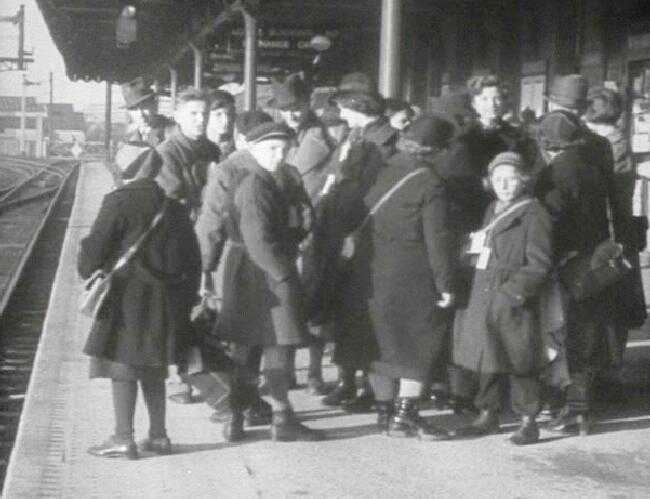
Some of the last Jews to get out of Germany were the children brought out through the Kindertransport. This was the transport of Jewish children out of Austria, Czecheslovakia, and Germany mostly during the summer of 1939. The British Government, horrified at the outburst of violence in Kristallnacht agreed to eased immigration restrictions for certain
of Jewish refugees. Two charitable groups help organize the program: the British Committee for the Jews of Germany and the Movement for the Care of Children from Germany. Together these groups persuaded the British government to permit children under the age of 17 to enter Britain from Germany and German-occupied territories (at the time what used to be Austria and the Czecheslovakia). About 10,000 children were saved--the largest group of children to be saved from the NAZIs. Most were aided by Jewish charitable organizations, but Quakers and other groups also helped. The experience was traumatic for the children, especially the younger ones, who did not understand why they were being separated from their parents. The children had to say a final goodbye to their parents and families for a long train journey to England and numerous checks by NAZI authorities. Most were never reunited with their families who were murdered in the NAZI death camps. The older children were put up on hostels, many of the younger children were adopted.
New regulations contiued to restrict Jewish life in Germany during the months leading up t World War II. Several new regulations followed Kristallnacht. The Government declared all driver's licenses issued to Jews were invalid, significantly restricting movement. Many Jews were forced to sell their businesses if they still had them, often at nominal prices. The few Jews still in universities were expelled (December 1938). The Government abloished all Jewish organisations (January 1939). The Government prohibited Jews from working in any aspect of the health sector (January 1939).
World War II changed everything. Jews in Germany lived under increasingly difficult conditions. The Nuremberg Laws deprioved them from citzenship and subsequent regulations made it virtually impossible for Jews to make a living in German. By the time of World war II. modt Jews had been reduced to poverty. Until the War approached, Jews were allowed to emigrate. They had to forfet their property, but they could leave if they obtained entry visas from foreign countries. As the War approsched, it becme inreasingly difficult for Jews to obtain exit visas from NAZI authorities. Very few German Jews were actually killed until Kristalnacht (November 1938). The Kindertransport was the last chance for many Jewish children. Even with the widespread brutality of Kristallnacht (November 1938), the numbers of Jews actually killed was limited in relation as to what was to come. We know from Mein Kampf that Hitler planned a new war from the very beginning. It also suggests that the extermination of Jews was also on Hitler's mind from the onset, but this is not entirely clear. The strteling success of German arms at the onset of the War, gave Hitler control over not only German Jews, but most of the Jews of Europe. The invasion and occupation of Poland massively increased the Jews under his control (September 1939)He now had the ability and the means to kill Jews in massive numbers. It was not until the victory in the West over France (June 1940), however, that plans for the the industrial killing of Jews were set in motion. And that killing began from the moment that Germn armies entered the Soviet Union (June 1941). The War also changed the lives of German Jews. As bad as it had been before the War, conmditions steadily deteriorated for Reich Jews. The final step was deportation to ghettos and death camps in the East. When the Allies finally entered the Reich, very few Jews had manahed to survive.
Too often accounts of the Holocaust deal with statistics and numbers. The numbers are so large to be overwealming. Behind every single one of those numbers are individuals. Looking at these individuals it seems almost unbelievable the fate awaiting them. We are interested in how the Holocaustvaffected individual families. We are collecting information about some families. With many we do not have a full account, but these accounts provide details on how the Holocaust affect individuals and families. We will also include here photographs we have found of individuals even though we may not be able to identify them.
The question of how much the average German knew about the Holocast and to what extent they were complicit in it is a much debated topic. It is one that few Germans have wanted to discuss. An American historian, Daniel Goldhagen has raised the issue and maintains that there was wide knowledge and that a kind of willing comoplicity. His books speaking engagements have attracted considerable interest, but many Germans are deeply resentful at him for raising the issue. There are some obvious facts. Most of the actual killing was done in Poland, the Soviet Union, and other Eastern Euroopean countries. In Poland where the death camps were located, most of the killing was done behind barbed wire where the SS carried out the murders without public scrutiny. Many of the Jews that arrived had no idea as to the fate that awaited them. Others while they did not know the details had few illusions about the NAZIs. NAZI controlled media in Germany never published accounts of the killings. Even the Allied propaganda did not provide details on the Holocaust and what claims were mentioned were dismissed by many Germans as war propaganda. (The Allies, especially the British, had during World War I fabricated many lurid accounts of German attrocities, specially in Belgium.) While all this is true. There are other clear facts suggesting that many Germans knew. Public statements by Hitler, Goebbels, and other NAZIs while not specific made it very clear as to the regimes plans for the Jews. The NAZI Stromtroopers (SA) and Hitler Youth had songs and chants with the words, "Death to the Jews". The NAZI pogrom of Kristallnacht was conducted in Germany in the full view of the German people. While the actual number of deaths were minimal compared to the later killings, there were killings and vicius beatings carried out in publiv view. After the War began, not only the SS but Wehrmacht units were involved in mass roundups and killings of Jews. Many must have talked about their experiences in the East. Jews were used as slave labor by large numbers of German companies and employees there would have been exposed to what was happening. The German railway system organized thetransport of large numbers of Jews east. Many would have know about where they were being transported and the fate that awaited them. The subject is difficult to reserach, because interviews with Germans living at the time cannot be taken at face value. Many Germans benefitted by the NAZI anti-Jewing campaign in the 1930s. Many got jobs that the Jews were dismissed from. Many got homes, shops, and other property that was stollen from the Jews. Many participated in small ways such as avoiding Jewish shops and ignoring or reporting on Jewish neighbors. School children ostraicized or even physically asaulted their Jewish school mates. These are painful memories that few Germans want to admit and most want to forget.
Berenbaum, Michael. The World Must Know (Ed. Arnold Kramer. Boston: Little, Brown, & Company, 1993).
Crane, Cynthia A. "The plight of German children from Jewish-Christian 'mixed marriages': Often forgotten victims of the holocaust," Children and the Holocaust: Symposium, United states Holocaust Memorial Museum, April 3, 2003.
Gilbert, Martin. A History of the Twentieth Century Vol. 2 1933-54 (William Morrow and Company, Inc.: New York, 1998), 1050p.
Goldhagen, Daniel
Held, Wendy. "A victim of survivor gelt," The Washington Post May 28, 2005, p. W11.
Hitler, Adolf. Mein Kampf.
Hobsbawm, Eric. Interesting Times: A Twentieth-Century Life (Pantheon: 2003), 448p. Hobsbawm was born in Egypt of an English father and Austrian mother. He was raised in Vienna and Berlin. As a teenagr he became a Marxist and was recruited to a communist youth group. He engaged in anti-NAZI activities, but he and his parents left Germany within weeks of the NAZI take over. He writes that he remained a Communist in later years out of loyalty to his young friend who fought the NAZIs--few of who survived the Third Reich.
Nuremberg Tribunal. "Individual Responsibility of Defendants: Artur Seyss-Inquart," Nazi Conspiracy and Aggresion Vol. II. USGPO, Washington, 1946, pp.956-1004.
Padfield, Peter. Himmler: Reichsf�hrer-SS (Henry Holt: New York, 1991), 656p.

Navigate the CIH Holocaust Section:
[Return to Main Holocaust country page]
[Return to Main Holocaust page]
[Return to Main World War II page]
[Allies]
[Biographies]
[Children]
[Concentration camps]
[Countries]
[Decision]
[Denyers/Apologists]
[Displaced persons]
[Economics]
[Eisatzgruppen]
[Eugenics]
[German Jews]
[Ghettoes]
[Impact]
[Justice]
[Literature]
[Movies]
[NAZIs]
[Occupied Poland]
[Process]
[Propagada]
[Resistance]
[Restitution]
[Questions]
[SS]
[Special situations]
[Targets]
[Wansee Conference]
[World War II]
[Return to the Main mass killing page]
[Return to CIH Home page]