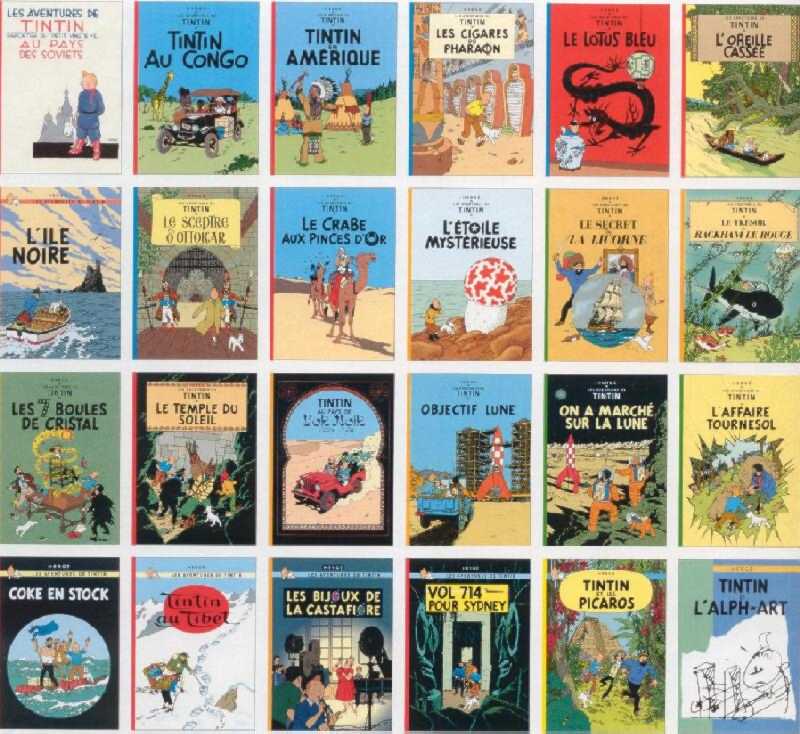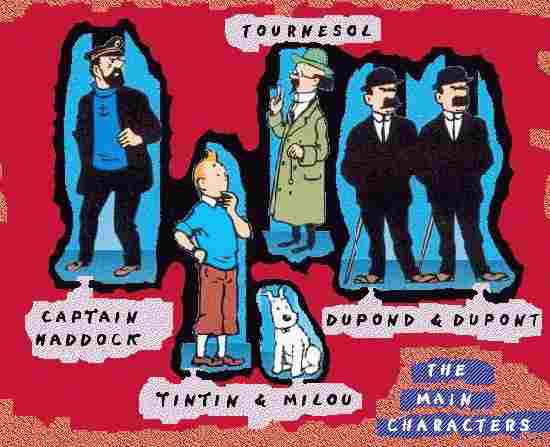
Figure 1.--Tintin is seen here in his trade-mark long knickers with some of the strip's main characters. |

|
The most famous Belgian boy literary character is Tintin, the comic character created by author Hergé. The Tintin books are the most well known comics for French-speaking children, as Hergé says from 7 to 77 years. The name of Hergé has been made out of author's reversed initials (R. G. pronounced in French "air-jay")--Georges Rémi (1907-1983). Hergé as a young boy was a devoted Boy Scout and actually started his career in comic strips by publishing comics in Scouts magazines. His first book, Tintin au pays des Soviets ( Tintin in the land of the Soviets) was published 1930 and his last book, Tintin et les Picaros in 1979. In total Hergé published 23 books, translated into 45 languages, sold 180 million copies.
Georges Prosper Remi (1907 – 83) is better known by his pen name -- Hergé. He is the most famous Belgian cartoonist celevrated for creating 'The Adventures of Tintin'. It was a series of comic books which were easily the most popular European comics. He also created two other well-known series: 'Quick & Flupke' (1930–40) and 'The Adventures of Jo, Zette and Jocko' (1936–57). It is Tintin, however, for which he is best known. He was born in
Etterbeek in central Brussels (1907). He was born into a middle-class family of limited means. Belgian is diviuded ethnically and linguistically as so was the Remi family. His Walloon father, Alexis Remi, worked in a candy factory. His Flemish mother, Elisabeth Dufour, took care of the home.
He had a younger brother, Paul. The family was Catholic, but not especially devout. He saw his boyhood as rather dull. He especially enjoyed the movies which by the 1920s was becoming a major industry. American films were his favoites. Drawing was a boyhood hobby. He drew scenes in the margins ofvhis school books. Here we see German soldiers as his four years of primary schooling at the Ixelles Municipal School No. 3 were during the first World War I German occupation (1914-18). He then attended the Place de Londres in Ixelles. He transferred to Saint-Boniface Schoo (1920). This was overseen by the archbishop and the instructors were Roman Catholic priests. He was a good student earming prizes for excellence. He funished school at the top of his class (1925). As an adult he wrote, "My childhood was extremely ordinary. It happened in a very average place, with average events and average thoughts. For me, the poet's 'green paradise' was rather gray... My childhood, my adolescence, Boy Scouting, military service—all of it was gray. Neither a sad boyhood nor a happy one—rather a lackluster one."
He joined the Boy Scout brigade at Saint-Boniface School, becoming troop leader of the Squirrel Patrol and earning the name 'Curious Fox' (Renard curieux). On Scoting trips he travelled to summer camps in Italy, Switzerland, Austria and Spain. His troop hiked 200 miles across the Pyrenees (1923).
His Scoutmaster, Rene Weverbergh, encouraged his artistic ability. He submitted illustrations to Scouting magazines. He developed his first comic series, 'The Adventures of Totor, for Le Boy-Scout Belge (1926). He began working for the conservative Catholic newspaper Le Vingtième Siècle. It was here he created 'The Adventures of Tintin' (1929). He colaborated closely with his editor, Norbert Wallez. The concept was the adventures of a boy reporter, Tintin, and his dog Snowy. The the series was presented as installments in the nbewspaper. They included 'Tintin in the Land of the Soviets', 'Tintin in the Congo', and 'Tintin in America' It was basically presenting a conservative Catholic message prpaganda for children.
The Germans after invading and occuoying Belgium (May 1940), closed Le Vingtième Siècle , but Hergé continued the Tintin series in Le Soir, a newspaper controlled by the NAZIs and allowed to continue publishing (1940-44). His cartoons were not pro-NAZI, but appearing in Le Soir gave the impression that he was pro-NAZI. After liberation (September 1944), the Belgian authorities shut down Le Soir and the staff, including Hergé, were accused of collaboration. It would take some time to shake that image.
Tintin is a teenager without a known family. He works as a reporter. In fact, it is adventurous as much as detective. Although ready for adventures, Tintin never seeks these: they always come to him as by chance. Courageous, he never hesitates to face the forces of evil, while defending the weak, minorities, and oppressed. Clever, reasonable and arguer??, he is, by his modesty and his sense of concrete, all the opposite of a superman. He is most probably the strangest character of all the history of the comic strip. In opposition to the majority of the heroes, he is indeed not characterized by any particularly remarkable feature. Admittedly, he is intelligent, astute, fast and almost invincible. It is by its almost total unreality that strikes us if one takes the trouble to examine it more closely. An unreality which makes of him, well more that an anti-hero, a kind of pure abstraction.
|
Observe his face: this round face where mouth and eyes are only points, this head that very few situations manage to animate and that touch of the famous bunch of hairs manages that gives him his unique particularity. If one considers his profession, except in the first album, one will never see him being an actual reporter. Tintin is a reporter, but what is a reporter if not a relay, a reflection, a pure mediator who carries from one
point to another information that he is only temporarily the holder? It
should be concluded: Tintin is nothing. He does not have a true age: sometimes it seems he is still a child, other times one believes to see in him a teenager, most of the time his behaviors evoke those of an adult. Not only the stories of the albums of Tintin are well built and captivating, reflecting a social reality that Hergé actually analyzed at the time of many voyages, but also the decoration is invariably of a meticulousness and an unusual exactitude in the comic strips. The name Tintin has been kept as is in most translations except in below languages where it became: Afrikaans: KUIFIE, Dutch: KUIFJE, German: TIM, Esperanto: TINCJO, Greek: TENTEN, Iranian: TAINETAINE, Islandic: TINNI, Japanese: TAN TAN, Latin: TINTINUS, Russian: TAHMAH, Turkish: TENTEN. Interestingly while most of the world use "Tintin" or a cognate, in Flanders (the Dutch-speaking area of Belgium) he is known by the Dutch "Kuifje". Incidently, a 'kuif' (of which kuifje is a dimunitive) means a forelock.
Tintin usually wore knickers. In fact over time they became his trade-mrked outfit. Normally they were long knickers bloused just a little above the ankles. This would be what an older boy night wear in Belgium during the late 1920s and 30s. Younger boys wore short pants. Tennagers by the time they were 15 or 16 would commonly wear knickers. We note images of European boys wearing knickers just like the ones worn by Tintin. While this changed as time progressed, Tintin's clothes were never updated. The storylines were updated, but not Tintin's fashions. Sometimes Tintin wore garments typical of the country where the story takes place.
Milou, the little dog, kind of shadow of Tintin, bringing many touches of humor. Captain Haddock, famous for his extraordinary swearwords Professor Tournesol, an imaginative scientist... Dupond (D) and Dupont (T) the two detectives appearing and acting like
twins although not at all brothers. In the attached illustration I gathered the main characters that can be found in every single adventure, although there are many others that reappear in several stories. These are the names in the French speaking areas of Belgium. All characters in Dutch speaking Flanders have different names (which is not always the case with strip figures, e.g. many characters in Disney strips have a different name in Holland and Flanders!) Dupond and Dupont = Janssen en Jansen Milou = Bobby professeur Tournesol = professor Zonnebloem (Tournesol = Zonnebloem = Sunflower).
Several films have been made about the famous Belgian reporter-detective from the cartoon series. HBC has noted several stills from the films. We do not know, however, what the actual titles are or what the plots were. They appear to be be very low-cost productions. As films they have little merit, but because they feature one of Belgium's pop-culture icons they are of some importance. They also often feature children. HBC has, however, no information on the costuming. Often in low-budget European films, the children wore their own clothes rather than being costumed. I do not know if this was the case in these films. Tintin has different names in different countries.
In neighboring Netherlands he is "Kuifje". As explained above, "Kuifje" is also used in Flanders. We know one film was made in the late 1960s.

Navigate the Boys' Historical Clothing Web Site:
[Return to the Main Belgian literary page]
[Introduction]
[Activities]
[Bibliographies]
[Biographies]
[Chronology]
[Clothing styles]
[Countries]
[Movies]
[Contributions]
[FAQs]
[Dutch glossary]
[French glossary]]
[Boys' Clothing Home]