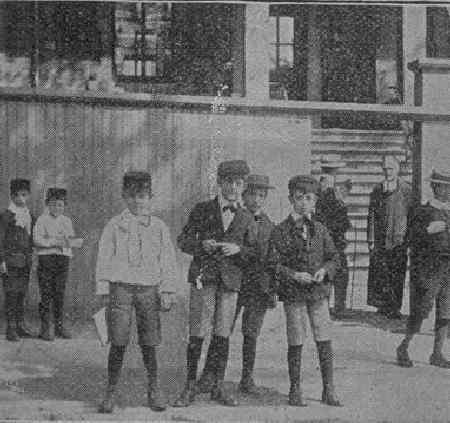
Figure 1.--This photographs shows boys in front of a Catholic school in Quebec in 1905. Al the boys wear kneepants and long stockings with a variety of caps, bows, shirts, and jackets. The caption read, "Après le dîner quelques élèves s'attardent à la porte de l'école." ("After lunch some pupils remain a little while at school door".) [L'album universel, Vol. 22, no. 1119, pp. 679 (30 septembre 1905)] Notice that many of the boys wear a kempi, a kind of military cap. This looks to be a kind of uniform requirement.
Canadian education is a very complicated and controversial topic tied of the Parti Québécois (PQ) and its quet for Quebec independence. Like the United State, there is no national education system in Canada. Canada is a Federal state and education is relegated to the provinces. Thus there are several different education sytems. Many are similar and the natiinal Minitry if Education helps to set some guidelines. There are, however, some factors that make Canadian education not only complicated to tudy, but highly controversial. First, there is no contitutional separation of church and state. This means that the Church played an important role in education, epecially Quebec which is strongly French Catholic. This is les true today as the role of the Church hs been replaced by the influence of the Parti Québécois (PQ) and its left-wing ideology. A similar development has occurred in the Rest of Canada (ROC), a similar development to America and Western Europe. Another complication is language. Frebch Canadian have since the development of public schools demanded language rights. This was especially the case in Quebec. chool authoritie in the ROC has handled this differently. Today in Quebec, officials have begun to deny English speakers the language rights available to French speakers in the ROC. HBC has very little information on Canadian schoolwear. We believe that like the United States, Canadian boys have not traditionally worn school uniforms. We suspect that it would be difficult to tell images of French and American school children apart just by looking at them. Available images show boys at the turn of the century wearing kneepants and long stockings with a wide range of caps, shirts, and jackets. We suspect that most boys by the 1950s would have worn knickers to school. Some private schools may have adopted English style school uniforms. The Catholic schools are especially important in Canada, especially in French-speaking Quebec. Boys there never seem to have worn smocks as in France itself. Nor did boys at parochial schools wear uniforms, at least in the early-20th century. They were later adopted, but discontinued in the 1960s.
Language is a serious and very controversial issue in Canada. An it is especually controversil in the schools. Education is relegated to each privince. Thus Quebec has been avle to primote the French language more in the schools than any other area. Especially conriversial in Quebec is the Law 101 language law. We note an internet posting about the law inder the heading, 'The Right of Choice'. "As Canadians, we each have the basic human right to choose as to how we conduct our daily lives. Yet when it comes to language, we have no say in how we can express ourselves. Language laws, specifically Bill 101, have taken away this right. No longer can parents decide in which language or languages their child can receive an education. The Quebec government does not allow its people the right of choice when it pertains to language. There is blatant racism when it comes to the treatment of both English speaking communities and French speaking ones. Children of English speaking parents are encouraged to receive their education in French schools, but French speaking parents may not send their children to English schools. This practice is not only unfair to French speakers, but downright racist as each community's rights are based on a different standard.
All newcomers to Quebec must learn in French schools; and, as a result, receive the same poor English education as French speaking students, all of whom learn English only 4 periods in each nine-day cycle. Yet immigrants who choose to live in the rest of Canada, may opt for English or French schools for the most part.
The Parti Quebecois wishes to further the divide by introducing yet another language law that will force English speaking high school graduates to pass a difficult French exam in order to graduate, Canadian Armed Forces personnel will no longer be able to send their children to English schools, and English CEGEPs would have to prioritize English student applicants before considering French ones. The Office de la Langue Francais will be able to conduct "search and seizure" operations on private businesses without giving prior notice and take their evidence to a criminal prosecutor without notification to the alleged offender. Businesses with 26 or more employees would have to make French their working language. Finally, municipalities would lose their bilingual status if the English population dropped below 50%. We are serving notice to Prime Minister Harper that if or when Bill 14 passes, we demand that your government veto it!"
We suspect that it would be difficult to tell images of French and American school children apart just by looking at them.
We have very limited chronological informtion on Canadian school clothes at this time. School images are not only important as a redord of school wear, but because many of them are dated, they are a wonderful record of changing fashion trendsover time. Available images show boys at the turn of the century wearing kneepants and dark long stockings with a wide range of caps, shirts, and jackets. There is some indication that boys in Nova Scotia may have worn kilts. I'm not sure how common this may have been. We suspect that most boys during the 1920s and 30s would have worn knickers to school, much like American boys. Long stockings and knickers were very common. Knickers were more common than in America during the 1940s. Some boys in the 1940s wore short pants with both long stockings and kneesock. As in American, Canadian primary boys began wearing jeans to school, although they were not allowed in secondary schools until the 1960s. We notice that in the 1980s boys commpnly wore sweaters and jeans. Dresses were still common for girls.
Canada like the United States has no national school system. Rather education is a function left to the individual provinces. Thus each privince has its own school system and there are differences between them which have varied over time. This is especially the case in Quebec where Catholics and French speakers are a majority. Generally speaking, public schools in Canada have not required school uniforms. Some private schools may have adopted English style school uniforms. The English-language public schools as in America never had uniforms. Many private schools, however, do have uniforms. The Catholic schools are especially important in Canada, particularly in French-speaking Québec. Americans will be somewhat confused by the fact that in Canada there were Catholic public (state) schools as well as Catholic private schools. Boys there never seem to have worn smocks as in France itself. We have received a variety of different commnents about uniform policies at parochial schools. One reader tells us that boys at parochial schools did not wear uniforms, at least in the early 20th century. We note boys wearing simpl uniforms in the early 1940s. A Canadian reader tells us that school uniforms were adopted at Catholic schools, although they were discontinued in the 1960s. Another French Canadian reader writes, "Uniforms have been required in Catholic schools for years. You know, Brothers andSisters were themselves
in uniform and the first community of woman in New France went here at the first years of the colony around 1608. When an adult is wearing a uniform, he will require the same from children. A a matter of fact, uniforms disappeared in Catholic schools when Brothers and sisters were replaced by young teachers in miniskirt . When religious communities
were at their peak from 1890 to 1960, there was a different uniform for different schools held by different communities."
Terminology
English speaking Canada
English-speaking Canada had primary and secondary schools roughly structured like American schools: primary schools (5-6 years), middle school/junior high (2-3 years), and high schools (3-4 years).
Québec
Before 1965 Québec schools consisted of: primary schools (6 years) and classical college (8 years from éléments latins to philosophie). The university was a 4 year program for a baccalauréat degree) and a 1 year prgram for a licence/masters degree). The license led to professional work like psychlogist, lawyer, ect. A Ph.D. Doctorate program involved 1 year for course work and 3 years for writing a disertation. This led to research positions or teaching ay the university level. After 1965 Québec schools consisted of: primary (6 years) and different types of secondary schools. Secondary school not preparing for university involves 5 years of study. For university bound students there is Secondaire I to Secondare V studies in the same school. Then there is college d'enseignement général et professionnel (CEGEP) which is a 2 year program leading to university and professional careers. The undergraduate university program is 3 years to get the Bacalauréat degree. The master degree program is another year of course work and another year to write thesis called a Mémoire. The doctorate is another 1 year of course work and 3-5 years for the the Ph.D. disertation.
Canada is divided into five major regions: the Maritimes (Labrador, New Bruswick, , Newfoundland, Nova Scotia, Prince Edward Island), Quebec, Ontario, the prarie provinces (Manitoba, Saskatchewan, and Manitoba), and British Colombia. There is also the Yukon and the Northwest Territories, but the populations are very small. Canbada does not have a centrakized educatiin system. Like thge United States, each province have the exclusive responsability for education. The Québec system is really distinct from other provinces. Clothing styles could differ significantly on a regional basis, especially during the 19th century. Outside of Quebec, the rest of Canada has had a strong British influence, and this was very evident in the private schools where uniforms were often required. Public schools generally did not require uniforms and boys tended to primarily wear American-styled clothing.
Ideology
There is no contitutional separation of church and state in Canada. This means that the Church played an important role in education, epecially Quebec which is strongly French Catholic. And the Cathlic clerfy was very conservative on moral and modesty issues. This is less true today as the role of the Church in education has been replaced by the influence of the Parti Québécois (PQ) and its left-wing ideology. A similar development has occurred in the Rest of Canada (ROC), a similar development to America and Western Europe. tudent today are taught that free market capitlism has been a drstructive force and that socialist policies offer prosperity and economic security. There is little dicusion of these issues, but basically the student are provided only one side of the issue. An Englih reader in Quebec writes, "The Catholic Church no longer has any say in the education issues. This is all politics now including what history is taught in Quebec. The History courses in both French and English HS are controlled by a bunch of separatist bureaucrats within that ministry even if there is a pro-Canada party in power in Quebec. The propaganda that they spew out is revolting by both what is taught and what is omitted."
Schoolwear
HBC has very little information on Canadian schoolwear. We believe that like the United states, Canadian boys in state schools have not traditionally worn school uniforms. Private schools often did have uniforms. A readr writes, "I have seen some older photographs of my prep school in Toronto, Canada from the 1930s and the boys then had completely British style uniforms, including peaked caps. They were phased out in the 1960s. Prep schools in British Commonwealth countries wore uniforms and caps the same as British prep schools." I am less sure about schoolwear at Catholic schools.
We note Canadian boys involved in a range of school activities. These activity photographs are very valuable in understanding educational trends. We see the children comingv and going to school. Of course in Canada during the winter, the children are bundled up. We note a range of classrom activities as well as other school activities like gym. nd there are a range of extra-curricular activities like sports, band, science fairs, and farm fairs. These views tells us a lot more about the educational program than the static school portaits which are primarly useful about assessing fashion trends over time. The academic program and the extra-curricular activities was affected by the size of the school.
A Canadian reader reports, "Some English private girls schools have uniform with jumpers or gym frocks like the ones worn in Britain. They are coomonly worn with tights. Before the 1960s long stockings were worn. After the Dior revolution, skirts became longer as it was in French Catholic schools. since a century or more. The uniform skirt ended below the knee. and because there was no gym, girls in Québec felt a nonsense to wear "bloomers" then, they wore long stockings. Around 1965 came the mini from England with Mary Quant. Girls wanted to wear shorter skirts and felt long skirts were dowdy. The first to create really functional colored tights was DIM in France."
Opinions
Opinions on school uniform in Canada as in other countries have varied. One parent writes, "Here in Canada children at both private and public Catholic schools wore uniforms. The reason was theoretically to equalize social status and limit expebditures on school clothing. I don't think it really had any positive impact. In public schools, there are some rules. It is possible for a child to wear extravagant dresses but let me tell you that the group will be aggressive against any showoff. Jeans are not very attractive, but they are practical for doing arts, gym and everything else. School is a place to enjoy, not an army corps."
We have little information on individual Canadian schools at this time. A reader mentions the Reverend Woods's Church School in Montreal during 1885, although we do not know much about it at this time. We also note St. John's Anglican School in Montreal during 1899. While it is in Montreal, we assume it is an English-language school. A reader has sent us a photograoh of an Anglo-Canadian schoolboy from the Crescent School in Toronto, Ontario during the 1930s. It is a boys' private school. Notice that his uniform is British in style with the short pants, kneesocks, blazer with piping and traditional school cap. Being a Dominion of the British Empire, the British influence in English Canada was very strong. British uniforms were worn by private school children in all of the British overseas Dominions. As our archive of Canadian schools grows, we will eventually archive them by name and year. We also note the Loyola School in Montreal, it appears to be a Catholic boarding school.