|
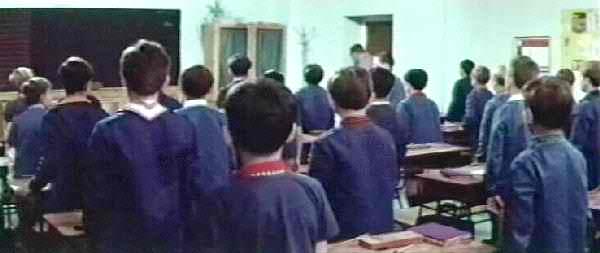
We have not yet acquird much information on Hungarian schools. Our Hungariam archive is very limited. We have some limited information. We see some Hungarian boys in the 19th century wearing military-styled uniforms. Modern Hungarian boys did not wear school uniforms. Some uniform-type garments do seem to have been widely worn, both school caps and smocks. Some schools appeared to have required smocks in the 1960s. As a Communist Government was in power, this may have been a nationally mandated style, but HBC has only limited information at this time on school smocks and uniforms. .
HBC has very limited information on historican Hungarian school trends and schoolwear. We have some limited information on schools during the Austro-Hungarian Dual Monarchy (1867-1918). We notice some boys wearing military-styled school uniforms. We do not know how common they were. Hungary achieved its independence in the aftermath of World War I and the breakup of the Austro-Hungarian Empire (1918). Our information is limited on schoolwear in independent Hungary. We do not think children wore uniforms to school. Major changes were made in Hungarian schools after the Communist takeover in 1945. We note that merit was not always what determined if secondary school graduates went to university under the communist regime. Children whose fathers were aristocrats or businessmen before the communist take over were labeled as a "class alien" and thus excluded from university. [Grove] Short pants were commom through the 1950s. They declined in popularity during the 1960s, but some boys still wore them. Some boys in the 1960s were wearing smocks, byt HBC is not sure how common this was. The Communists introduced a military-styled uniform fir the boys and and a dress and pinafore for the girls. Both were based on Soviet styles. After the Hungarian Revolution (1956), the Soviets more closely controlled Hungarian affairs. And sure way of demonstrating your political reliability swas to copy Soviet approaches. The uniforms were done away with with the collapse of the Soviet empire. The same occurred in other former Eastern European satellite countries.
Hungary for four centurues was controlled by a German (austrian) momarch yy and isstill infkudnced by he lkarger Germnic world and economy. This includes education. German education trends influenced educationa systems throughout Eastern nd Central Europe. In the case of Hungary, but was close to Germny abd part of the Hpsburg Austrian Empire. which became pty of the Austro-Hungrian Empire (1868). Austria was of course part of the Germanic world. As concerns the education of gurls there were common threads throughout Europe and to a lesser extent the United States. The eduction of girls was seen of much less imprtant than the education of boys. Thus we see girls in primary school, but far fewer in secondary and university level education. In addition, Hungary was not as developed as Germnany with lrgely agricultural economy. Another factor is minorities. There was a substantial Slovakian populstion which was prmarily a turl pesant popultion, which was less well educasted than the majority Hungarian popultion. These limits on femle education duid not chnge substantially until the Communists seized power. The reson for the differencds in the edivation of boys abd girls was of course long established cultural patterns which also mean that most women did not wok out side the hime. Some two thirds of Hungrian women ar tyhe time if World War II did mjot have jobs, but married and maintained the home. Apparently female literacy was high. An author suggests 10 percent, but that does sound high to us. Only four to six yeats of education wee common. The uthor sescribes secondasr eduction for girls was "very rare, abd, in fct, obraind only by girls in the rulking weakthy circkes". [Ézéchy] This strikes us as Comminisdt propagbds. We suspect that mny middle-cvlass gurls attended secondaruy schools. The autors then describes how much imprivement has been made in educatiuon or girls in Communist Hungay. As well as the increrased emplyment opportunities. Here this sounds more reasonable. If course unmentioned is the even greater improvements in Western Europe during the same time period, esoecily in the wage levels and living standards. .
Hungarian boys did not wear school uniforms, but some information is available on schoolwear. At least some elementary level boys appear to have work smocks. Hungarian boys in the early 20th century appear to have worn a kind of military-styled peaked cap. This appears to have been a style for secondary schools. I'm not sure what elementay-level boys wore. Boys in the 1960s were wearing a wide variety of collared and casual shirts, such as "T" shirts under their school smocks. The principal schoolwear item appears to have been a blue jacket-like smock that both boys and girls wore. We note quiye a few images of Hungaraian school children wearing what look like blue smocks. They are styled rather like front buttoning jackets. HBC is unsure how common this was, but it looks to have been very common. Hungary at the time had a Communist Government with a very centralized school system. Hungarian boys through the first half of the 20th century appear to have worn kneepants and short pants to school. Most boys appear to have worn lace-up shoes, but a few boys in the 1960s also wore closed-toe sandals that looked rather like English school sandals. HBC is unsure if sandals were more common in earlier years. Boys at school wearing shortpants in the early 20th century commonly wore dark colored three-quarter length socks or kneesocks. Knee socks became more common in the inter-war period. The declining number of boys wearing shorts by the 1960s commonly wore them with kneesocks, both white and colored kneespcks. Boys in the 1960s often had portfolio-style bookbags. Nany boys seem to have had similar book bags. I do not think that the styles were required by the schools, but may have reflected the limited availability of comsumer products in Eastern European Communist countries.
|
Some of the few Hungarian movies known to HBC include many school scenes providing some information on schoolwear. HBC believes that Hungarian films with contemporary settings often had the children sear their regular clothes rather than costume them.
Hungary was part of the Austro-Hungarian Empire until 1918. We know that some Hungarian boys attended military school. We do not, however, know if there were military schools actually located in Hungary and conducted in the Hungarian language or if Hungarian cadets attended Austrian schools and studied in German. At this time HBC has little information on the military and educational system of Austro-Hungary. As a result of the revolution of 1848, the Empire was made a dual monary with the Emperor holding both the Hungarian and Austrian crowns.
We are unsure, however, to what extent the reforms were really window dresing as opposed to fundamental reforms.
Intel Chairman Andrew S. Grove was born in Hungary. As a Jew he narrowly missed the NAZI roundups and shipment to the death camps in 1944. He was a young teenager at the time at looked on evading the NAZIs as a great adventure, not fully comprending what was at stake. His father had prepared the family for what was to come. After surviving the NAZIs, Grove experiences with the Communists that replaced them. He was a good student and earned excellent gades in secondary school during the 1940s. He was, however, denied access to university because the Communist authorities labeled him a "class alien". This was because his father jhad been a businessman. He writes, "It's hard to describe the feelings of an 18-year old as he grasps the nature of a social stigma directed at him." [Grove] Such actions like this, limiting the prospects of its talented youth is one of the many reasons that communist regimes reported such poor economic results. Contrast this to what Grove managed to achieve with Intel in his adopted country, America.
Grove, Andrew S. "Stigmatizing Business," The Washington Post, July 17, 2002, p.23.
Careful, clicking on these will exit you from the Boys' Historical Clothing web site, but several are highly recommended

Navigate HBC Chronological pages
[The 1880s]
[The 1930s]
[The 1940s]
[The 1930s]
[The 1940s]
[The 1950s]
[The 1960s]
[The 1970s]
[The 1980s]
Navigate the HBC Shool Section
[Return to Main Europoean school page]
[Return to Main national school page]
[Return to Main Hungarian page]
[Activities]
[Chronology]
[Clothing styles]
[Countries]
[Debate]
[Economics]
[Garment]
[Gender]
[Hair]
[History]
[Home trends]
[Literary characters]
[School types]
[Significance]
[Transport and travel
[Uniform regulations]
[Year level]
[Other topics]
[Images]
[Links]
[Registration]
[Tools]
[Return to the Historic Boys' School Home]