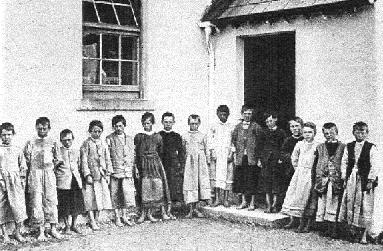
Figure 1.--These boys at a rural Irish school were still wearing 'dresses in this photograph taken in 1915. |
|
We do not yet have extensive historical information on Irish schools, but we know a little bout the medieval period and it is a particularly fascinating story. There appear to have been two types of schools in medieval Ireland, the secular bardic schools and the Christian monastic schools. Ireland was a rare corner of learning and seduction in the Dark Ages. The monastic schools were particularly impressive, some quite large. These schools were known on the Continent and their art and scholarship admired. The Book of Kells created by Irish monks (800 AD). It is one the most beautiful and ornate manuscripts ever created and a jewel of early medieval medieval Christianity. Many monasteries and their schools were destroyed by the Vikings (9th century), but even more by Oliver Cromwell and his English New Model Army (17th century). This bright the era of impressive learning to a halt. Catholics meaning the great bulk of the population were not allowed to have schools. Schools outside the Protestant Church of Ireland were outlawed (1695). This was modified (1782), but for most of the 19th century few Irish children were able to attend school. And of course in the middle of this was the devastating Irish Potato Famine. Only in the late-19th century did large number of Irish children begin to attend school, but even this was limited because of the island's endemic poverty resulting from English rule. Some information is available on the 20th century. The education system is somewhat similar to England . This is of course because England controlled Ireland for several centuries. Britain lagged behind America and many European countries in creating a free public school system. This included Ireland. Ireland began moving toward independence (1920s). As a result, as an Irish reader tells us, " Ireland now has its own variations and vagaries. Our school system now differs quite a bit from the U.K. school system." Another issue in Ireland has been finances. Ireland was the poorest part of the United Kingdom and this of course affects the ability to finance the education system. The country's economy improved very little after independence, largely because of the socialist policies adopted by the Government. Market reforms have since result in substantial economic growth (1990s). HBC currently has very little information on Irish school wear and school uniforms. Boys in rural areas that went to school were often outfitted in dresses. Boys in urban areas were more likely to dress like English boys. Affluent Irish boys appear to have worn basically the same styles as British boys. English-style styles appear to have become increasingly common in the 20th century, especially after World War I. This is an interestingly development because this was just the time when the Irish Free State was form and Ireland broke from the British. HBC still has limited information on Irish school wear, but Irish readers have supplied some information which has helped to sketch out some basic patterns.
There appear to have been two types of schools in medieval Ireland, the secular bardic schools and the Christian monastic schools. The bards or appeared during the pre-Christian Druidic era of antiquity, although no one knows just when. Bard refers to the wandering medieval minstrel-poets who composed and recited poems that celebrated the feats of Celtic chieftains and warriors. They also played an role in spreading learning, although it is unclear just how many children learned to read and do sums in these schools. The operation of these schools were largely unknown outside of Europe.
The Christian era began later than in Europe (5th century AD), th monastic era in the other hand began earlier than on the Continent. The monasteries became a very important part of the Irish medieval economy. And monasteries of any size would found schools. Some of the monastic schools were major undertakings with a few thousand students. These monastic schools and the work of their scholars became known and admired throughout Christian Europe. The existence of monastic texts is far greater than the written record left by the Druidic bardic schools.
These two types of very different schools are both part of the literary history of Ireland. They do not seem to have interfered with each other and worked contemporaneously (5th- 17th century). We have no information as to how the students at these schools may have dressed other than the standard garments of the day.
Ireland was not invaded during the Roman or Anglo-Saxon period, but like England suffered Viking invasions (9th century). The English began invading during the Norman period (12th century). More significant intervention occurred during Elizabeth's reign (16th century). It was, however, during the English Civil War (1642-51) that English control of Ireland began. The Catholic Irish sided with the Royalists which meant that as Parliament gained the upper hand, there would be a price to pay. Lord Protector Oliver Cromwell led the Parliamentary forces in the Wars of the Three Kingdoms. He invaded Ireland with his New Model Army on the authority England's Rump Parliament (August 1649). Cromwell's campaign was extraordinarily brutal. Cromwell's victory had huge consequences for the Irish people. Defeat in the field led to guerrilla warfare, famine, and plague.
Cromwell's victory led to an end to the Bardic schools. The Catholic people of Ireland were made landless with the English gaining ownership of the land through various legal impositions, beginning with the Act of Settlement (1652). An Irish nobelman who fought Cromwell, "The period of the hedge schools follows the disappearance of the ancient professional schools of Ireland known as the Bardic Schools. These lasted until the ‘Beginnings of the Trouble’ in 1641 and were closed down when the people were made landless, homeless and exiles." [Carney]
The famous Hedge Schools appeared in Ireland as a result of English occupation resulting from Parliamentary victory in the English Civil War and Cromwell's campaigns in Ireland. The Hedge Schools were conducted in secret because they were illegal. The Hedge Schools called 'scoileanna scairte' in Irish were set up almost entirely for Catholic children. Parliament outlawed
all schools for Catholic and 'non-conforming' children (1695). (Non-conformist referred to Protestant sects which were not significant in Ireland.) They were also not allowed to send their children abroad to school. This of course only involved the rich. But at the time only a minority of Irish children were attending any kind of school. There were no free public schools in Ireland or anywhere else at the time. The Hedge Schools despite the name were not all conducted outdoors--remember this is Ireland and it rained a lot. They might have used small buildings. The most common practice was for the teachers to teach in homes that offered them room and board. This could, however, not be a permanent matter as word would eventually get about to the authorities. And such a sitiation was not consusive to the pernanence needed for effective education. If poverty was especially severe, the teachers might have to move about to get other employment. The teachers were mostly men, though there were a few women teachers. The Hedge Schools varied from school to school, or probably more correctly teacher to teacher. The children were taught taught reading, writing and arithmetic. Greek and Latin may also have been taught, but not as commonly. You have to question how effective the teaching could be without established schools and long-term instruction. Children of all ages attended these schools. They could not have been very large groups or the authorities would have noted. Thus the teacher had to deal with a group of mixed ages, making teaching very difficult. Younger children just learning to read need a lot of attention. And because there were no permanent facilities, there were few if any books. And then there were the issues of paying teachers. You could hardly earn an income by teaching a small group of poor students on an intermittent basis--and facing arrest and prosecution. In addition, hedge school teachers faced the problem that the Irish peasantry was very poor. Few had much money, so often they paid what they could, food or turf. The hedge schools existed, but the number of children virtually by definition would have been small and the quality of education limited. The penal laws came to an end in 1782. This meant that hedge schools did not have to be in secret places anymore. Some moved in to larger buildings. They remained as private schools even up to the 1880's. These schools were often called after their teacher if, for example, the school lasted in one place for a period of time.
A good example is Closhessy's hedge school recorded in 1824 in Maudlin Street, Kilkenny.
I have virtually no information on clothes worn at Irish schools in the 19th Century. England was one of the last major western European countries to establish free public education. Many of the wealthy elite was concerned that education would cause the poor to become dissatisfied with the existing social order. Of course such concerns were even stronger in Ireland where English landlords had been killed by disgruntled tenants. Thus even less attention was given to public education in Ireland. School clothes were probably quite different at state and private schools.
State schools: I do not believe that Irish boys wore uniforms at state schools. Some photographs showing the boys wearing their normal everyday clothes. Boys in rural areas still often one-piece dresses to school. These dresses, often referred to as petticoats, were often worn under boyish looking jackets. This practice did not finally disappear until after World War I (1914-18) in the 20th Century.
Private schools: Private preparatory and secondary schools were established in Ireland. Most closely followed English patterns and adopted English school uniforms.
HBC has very little information on Irish school wear in the early 20th century. We believe that some boys at schools in rural areas wore simple dresses, but we do not know how wide-spread this was. Boys in urban areas were more likely to dress like English school boys. Private schools generally followed English school fashions. The Irish Free State came into being in 1922, following the signing of a Treaty with England in December 1921. In 1926 the School Attendance Act made school attendance compulsory on all school days for children between the ages of six and fourteen. The primary school program consisted of attendance for five or six hours, five days a week for a minimum of 190 days a year. The subjects studied included, Irish, English, Arithmetic, History, Geography and Music. Girls also received instruction in needlework. In the late 1920s, the Department of Education had introduced the Primary School Certificate examination. This examination was voluntary until 1943 when, despite strong opposition, it became compulsory for all children who had reached sixth class.
|
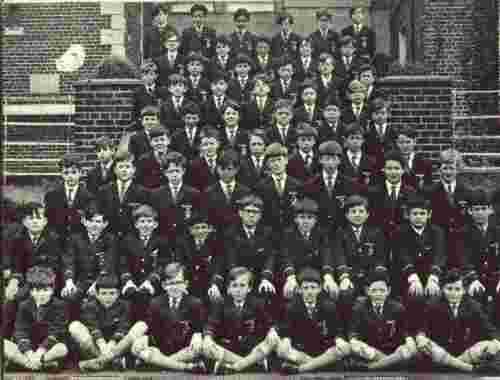
Irish school uniforms began to change about the same time that they did in England. One source indicated that most Irish boys wore caps, short pants, and knee socks to school in the 1950s until they were about 13 years old. Another source confirms this, indicating, "When I was a boy back in Ireland of the 1950's we wore grey worsted shorts to school until we were about 12 years old." Even older boys sometimes wore short pants to school. This was usually not because the school required it, but rather the opinion of the parents as to when their son was ready for long trousers. Thus at many schools there were some younger boys in longs and some older boys in short pants. An Irish contributor was was in school in the 1960's reports that most boys wore short trousers to school up to the age of 13 or so. Privileged boys in prep schools wore short pants as part of a school uniform incorporating a blazer and knee socks with coloured garters. State school boys wore pullovers or "jumpers" with their shorts. Families were often large so a boy could expect to wear the same shorts for many years and to then hand them down to his younger brothers. This meant that the pants were often overtight and tended to ride up. He remembers the chilly Irish mornings with "lots of us huddled together, our bare knees joined to keep warm and everyone sprouting goose-pimples."
By the early 70s many 14 year old boys still wore short pants to senior school. This had died out completely by the mid 70s. The school photograph albums record the changes to the year. By the 1970s it was becoming less common for older boys to wear short pants school uniforms or wear caps. Few other changes, however, occurred in school uniforms. HBC observed only a few Irish boys wearing school shorts in the 1980s, during an admittedly brief visit. This appeared to be the general pattern in state schools. Many private schools, however, continued to have traditional uniforms. One Irish observer in the 1990s, however, reports that it is still normal practise for junior school boys at private schools to wear short pants and colored blazers up to the age of 11 or 12. In some schools, especially city schools, only younger boys wear shorts--up to about 9 in the cities.
Carney, Noel. "Milltown’s Bardic School: Kilclooney Castle," Milltown Heritage Group (2019).
O’Sullivan, Thomas. Preface. Marquis of Clanricarde's memoirs (London, 1722).

Related Chronolgy Pages in the Boys' Historical Web Site
[Main Chronology Page]
[The 1900s]
[The 1910s]
[The 1920s]
[The 1930s]
[The 1940s]
[The 1950s]
[The 1960s]
[The 1970s]
Navigate the HBC Country School Pages
[Return to the Main National School Page]
[Return to the Main Irish School Page]
[Australia]
[England]
[France]
[Germany]
[Italy]
[Japan]
[New Zealand]
[Scotland]
[United States]
Navigate the HBC School Section
[About Us]
[Activities]
[Chronology]
[Clothing styles]
[Countries]
[Debate]
[Economics]
[Garment]
[Gender]
[Hair]
[History]
[Home trends]
[Literary characters]
[School types]
[Significance]
[Transport and travel
[Uniform regulations]
[Year level]
[Other topics]
[Images]
[Links]
[Registration]
[Tools]
[Return to the Historic Boys' School Home]