|
Educational trends in Italy varied wuthb the nirth-south solit that impavted the ciuntry untilafter Workld War II. Niorthern Italy develooped an impressibe system of public education. While this development was far more limited in the south. A major factor here was the Austrin influence in the north and the Spanish influence in the south. Chronological trends concerning schoolwear in Italy seems similar to that of France. This is in part because children in both countries have not traditionally worn school uniforms and school clothes are thus in large measure a reflection of regular clothing trends. Our historical information is still very limited, but we have begun to collect a few images from different periods. Of course a photograph at a specific school can not be taaken to be represenastative of Italy as a whole. We can develop some idea of basic trends as we add more schools to our aarchive. We know boys were commonly wearing school smocks in the 1930s, but we believe that smocks were introduced much earlier. One major exception is school smocks. French boys tended to wear smocks less after World War II (1939-45) and even more so after the 1950s. School smocks in Italy, however, continued to be commonly worn even into the 1970s. While declining in the 1980s and 90s, some Italian children still wear them in the 2000s, although generally younger children in primary school.
Italy did not exist in the 18th century. The Italian principalities that had led the European Renaissance and the revival of learning disappeared. There were major changes with Spain in the south and Austria in the north suffering defeats, but by the end if the century before the French Revolution, Austria controlled much of the north and Spain much of the South, and the Papal States controlling Rome and central Italy. Savoy which would become the kernel for the Kingdom of Italy, was a small principality in the western Alps. These political developments had a huge impact on Italian education. The Austrian Empire was a part of the German world and it was here (and in the fledgling American republic) that the idea of public education was born. Austria and the German states and Spain were very different. In the German state snot only was public education developing different. As a result, you have the beginning of public education and a very high level of literacy. Spain was very different. There was no substantial public education and a very low level of literacy. These differences developed in Austrian-controlled northern Italy. and Spanish controlled southern Italy. Emperor Joseph II (r 1765-90) promoted important reforms after 1770 and more forcefully after Maria Theresa's death (1780). He abolished the long-standing old system of public administration and magistratures (1786). In the short period before the French Revolution (1789), it was having some impact , but gradual the entrenched aristocracy prevailed after the defeat of Bonaparte (1814-15). Two developments that did have lasting impact was reducing the Catholic Church's power. Joseph's educational reform established popular elementary schools as well as new disciplines at the Palatine School of Milan and the University of Pavia. The declining power of the Church had educational consequences. The Church was not a major supporter of public education. In the South where Spain's influence prevailed and the governing and social system was largely feudal There were no educational reforms and no real effort to build a public education system.
There was no unified Italian state at the dawn of the 19th century, meaning there was no Italian education system. Piedmont dominated the northwest. The Austrians held the northeast. The Papal states controlled central Italy. And the now French Bourbon monarchy controlled the Kingdom of Two Scilies in the south. Each of these states has different education policies which for the most part gave little attention to education. Into this mix, the French Revolution and Napoleon and the French burst and made major changes in boundaries and rularship. New ideas were introduced into very conservative societies. The first public schools were introcuded in Piedmont. Schooling was limited elsewhere in Italy, especially in the poverty-stricken south. This did not change until the Risorgimento and the unification of Italy. The Piedmont school law became the school law of unified Italy. Public education, however, continued to be very limitd, especially in the south. The major problm was financing. Municipalities in the south had limited resources to support public schools and the endemic poverty meant that many families could not support their children educational aspirations.
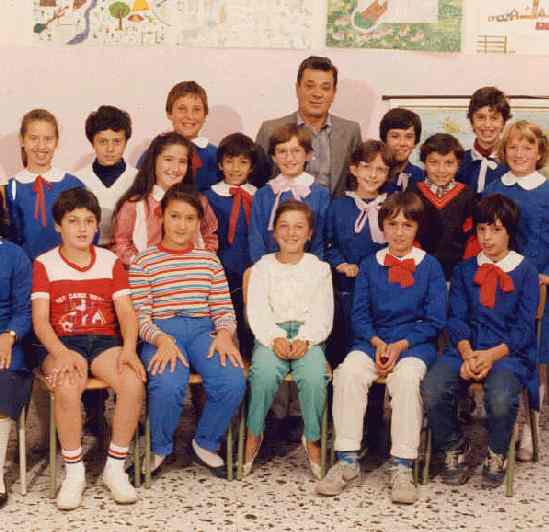
We note Italian school trends similar to other European countries in the arly 20th century. The major difference from the rest of Western Europe was that Italy was a relatively poor country, especially southern Europe. Schools seem very basic, especially in the south of the country. This of course affected the ability of children to pursue their educations and how they dressed for school. A major change occured a few years after Missoloini and his Fascists seized control of Italy. We see Italian children wearing svhool smocks (1930s). The reason for this was the same reason smocks were adopted in France, to reduce differences between children in the public schools. This applied to primary schools, although some secoibaryt schoools required grls to wear smocks. Children from poor families would not feel embarassed by better dressed children from more affluent families. We see most children wearing smocks in the 1930s and for several decades. These were variously colored smocks and wide white collars, sometimes with bows. Dark blue smocks seem the most common. Most boys wore short pants with smocks. Education as other aspects of Italian life were disrupted by Worls War II. The post-War recovery fueld by American assistance and European integrration transformed the Italian education system, especially in the south. Not only do we see increasingly well-equipped scgools, but school attendance reached levels common in northrn Europe. Smocks continued to be widely worn into the 1970s, but were no longer required by the Government. It was left up to individual schools, some of which continued to incourage their students to wear smocks.
We note that smocks continue to be worn by Italian school children, mostly younger children. The colors appear o be primarily blue (various shades), pink, and white. The boys mostly wear the blue smocks. The girls primarily wear the pink and white smocks, but some wear blue as well. One store offered a rather large assortment of different styles, mostly in sized from 3-7 years. Other stores offered others colors like red and green. Common sizes fir the younger children were 55-75 while styles for older children ranged from 55-95 cm, the girls' smocks in larger sizes than the boy's smocks.

Related Chronolgy Pages in the Boys' Historical Web Site
[Main Chronology Page]
[The 1900s]
[The 1910s]
[The 1920s]
[The 1930s]
[The 1940s]
[The 1950s]
[The 1960s]
[The 1970s]
Navigate the Relate Boys Historical Clothing Style Pages
[Main country page]
[Long pants suits]
[Short pants suits]
[Lederhosen]
[Kneesocks]
[Eton suits]
[Jacket and trousers]
[Blazer
[School sandals]
Navigate the Boys' Historical Clothing School Uniform Pages
[Return to the Main Italian School Page]
[Return to the Main School national page]
[Australia]
[England]
[France]
[Germany]
[Ireland]
[Japan]
[New Zealand]
[Scotland]
[United States]
Navigate the Boys' Historical Clothing Web Site:
[About Us]
[Activities]
[Chronology]
[Clothing styles]
[Countries]
[Debate]
[Economics]
[Garment]
[Gender]
[Hair]
[History]
[Home trends]
[Literary characters]
[School types]
[Significance]
[Transport and travel
[Uniform regulations]
[Year level]
[Other topics]
[Images]
[Links]
[Registration]
[Tools]
[Return to the Historic Boys' School Home]