
HBC-SU has not yet done much work on African schools and education. Generally speaking, African education has lagged behind that of other regions. The primary factor here has been the low-level of education at the time of independence and the limited resources of the new indepoendent countries after Wofrld war II. A major factor here i that most of the new leadees were heaviky inbflkuencecby soicialist thought and invested available resources in expabding giovernment and state development projects. Little attention was goiven to priomoting the private sector. The result has been an econoimic disaster and the faiure to develop modern economies despite massive foreign assistance. Corrupotion and civil strife has further impaired development. Economic failure has left these new countries unable to adequtely finance modern education systems. The situation has varied from country to country, but this is tge general pattern. As to school uniforms, generally speaking they have followed European styles. HBC does not know of any country where there are school uniforms based on indigenous tribal fashions. Some North African countries have adopted French or Italian smocks. In Sub-Saharan Africa, French and British school uniform styles have been important. The poverty of many African countries has meant many families can not afford school uniform. Uniforms are most prevalent in the more prosperous urban areas. Some secondary-age boys in recent years have objected to wearing short pants uniforms. Hopefully some African readers will help us build the HBC African school pages, but we note that there are very few HBC viewers from African countries.
HBC does not yet have detailed information on Algerian school uniforms. Most of our informaion on Algeria comes from the colonial era. France was the colonial powe and Algerians fought a long and brutal war during the 1950s and early 60s, at times looking more like a civil war, to achieve independemce. We have acquited some images from European schools that existed in the country before independence. The school uniform styles reflect the clothing worn by conmtemporary European boys. We believe at one time smocks were widely worn in Algerian schools, but have few details on modern Algerian schools.
The Portuguese reached Angola in the 15th century. They established trading posts, but did not begin to colonize the interio until the 19th century. It was thus the Portuguese that established the fiurst schools. Thisdid nit begin to any extent until the 19th century. The language of instruction was Portuguese. There were separate schools for the Portuguese and the African population. African access to educational w very limited for most of the Portuguese colonial period. Schools fun by the government were limited and mostly confined to the cities. The Government did finance schools for the Portuguese, but schools for the Africans population were mostly bleft to Roman Catholic and Protestant missionaries.
Each of the missions established its own school system, although all were subject to Portuguese regulations. Thgere was limited supersion by Portuhuese authorities except for how political issues were addressed. Portuguese authorities began giving more sttention to african education (1960s). This was about the same time that the independence movement began to develop. At the time African illiteracy was very high, probably about 85 percent. Few Africans achieved a secondary education. The development of a modern education was limited, g\first by the indeoendenmce war and than the civil war between rival groups thst fought for independence. Considerable progress has been made in education in recent years. The iliteravy rste has been cut in half to about 40 percent. Oil revenue has helped the country finance its school system. Children enter primary school at about age 7 years. School is compulsory for children age 7-25 years. Public education is free. Portuguese continued to be the language of instruction in schools after independence. There has been a gradual shift to vernacular (tribal) lnguages. One source reported 1.0 million primary students (1991), 0.2 million secondary students (992), and 31,000 teachers (1992). This is the last year for which stztistics are available, suggesting the weakness of the Governmental administration system. The Government allocated 2.6 percent of GDP to education (1999).
The principal univeristy is the University Agostinho Neto in Luanda, founded in 1963. There were 6,331 students in tertisry institution and 787 teaching staff (1999).
Benin is the former French colony of Dahomey. The first schools were missionary schools. Franch made only limited efforts to establish a school system during the colonial period. France granted independence (1960). A democratically elected government set about building a public school system, although resources were limited. The educational model was the French system. The effort was impaired by the ethnic strife which bedelved the new country. A military coup established a Communist dictarorship.
The Marxist-Leninist state was the People's Republic of Benin (1972-90). The military as well as many educated beklieved that Capitalism was a filed system and that Socialism would lead to the rapid modernization of the country as xwell as the enrichment of the ruling elite. As in the several other countries that followed this approach was both political repression and economic failure. This inevitably affected the education system. The Marxist military rejected French culture ans as part of that effort sought to replace the French education system. Reforms introduced a strong dose of Marxist-Lenist ideology into the curiculum, but the Frebch model persisted in part because all the country's teachers had been trained in schools using the French model.
The Government made primary education compulsory. The primary schools are for children 6-11 years of age. Secondary schools offer another 6 years of education. Another six years of secondary education follows the primary education.
The enrollment of boys during the 80s in the primary schools were double than the girls. The country's economic failure as a result of mismanagemnt and socialist policies severly affected the standards and availability of education.
The Marxist dictatorship was replaced by the multi-party Republic of Benin (1990). The new government gave education a high priority. One of the efforts was to promote girls' education and in just a few years enrollment approached that of boys.
The National University of Benin at Cotonou was founded (1970).
Burundi is a small land-locked nation in East Africa. We have no information Burundi education before the arrival of the Europeans. There were native kingdoms so some kind of informal schooling was possible. We suspect, however, that there were no formal schools. The Germans colonized Burundi in the late-19th century, although considerable force was required causing widespread damage. Burundi became part of German East afeica. Even so, the Germans do not seem to have interfered greatly in local life. Belgium occuped the colony in World War I (1916). After the War it became a League of Nations Mandated and subsequently a United Nations Trusteeship. The Germans/Belgans found some schools. The general pattern was to set up schools for German/Belgan nationals, but to give little attentiion to the native children. We do not yet have details on native education. Missionaries also often played an important role. We do not yet have specufic details. Bekgium granted indeoebdence (1962). Burundi is a very poor country. The Belgiums did very little to create a modern educatiin system and the indepebdent new country had few resources to devote to education. Education is an important concern in modern Burunsi and the Ministry of Education like other African countries is attempting to create a universal public school system. Resources are, however, very limited.
We know nothing about education in Chad until the modern era. Presumably therewassomesort of training for the ruling class in the various kingdoms or chieftanates. Mosques also likely hadsome kind of basic education. It was not until the arrival of the Europeans that education in the modern sence reached Chad, actually sometime after the Europeans first arrived. The first schools we note were established by Protestant missionaries (1920s). They set up mission schools in the mon-Ialamic south. French colonial authorities required that all schools be conducted in French. An exception was religion classes. This apparently included instruction at mosques. French authorities fiollowing theFrench education system created a standard curriculum imposed on all educational institutions desiring official recognition and government financial support. The schools established were primary schools. There were no secondary schools. Young people who wished to pursue secular education beyond the primary level. Some children went to Brazzaville (now in the Republic of the Congo), but this meant only small number of children were involved. The first secondary school in Chad opened (1942). It was, however, not for a decade that the certificate academic levels were recognized by French authiorities (mid-1950s). Chad achieved indepencence (1960) and like other newly independent African countries placed apriority on expabding the education system. The immediate goal was universal primary education. The Government made school attendance compulsory until 12 years of age. Mandating this an achieving it were two different matters. The Government faced numerous in aschieving its educational goals. The development of a national standard currucula was a problem. The Government phased a range of problems. There were an inadequate number of schools. And the ones that existed were mostly 2-3 year schools. There were a verry small number of 5- and 7-year coll�ges and lyc�es. Another issue was the Muslim preference for Quranic education. Many parents were hesitant to send their children to school, especially Muslim parents. Here there was special concern with the girls. The Government reported that some 17 percent of students between the ages of 6 and 8 years were in school (mid-1960s). Quranic schools throughout the northern Saharan and Sahelian zones teach students to read Arabic and recite Quranic verse. Modern Islamic secondary schools have a wider curriculum, such as the Ecole Mohamed Illech, founded in 1918. The country has continued to expand education, but the system is still limited. Problems include the size ofthe country and the dispersed population, especially in the north, and limited resources. Parental resistance continues to be a problem. Muslim parents in particular are concerned about secular education, especially for girls. Mission and Quranic schools continue to function. Considerable progress was made (1970s-80s). Available estimates vary. One source suggests that 70 percent of boys today continue education beyond the primary level, but this may be optimistic. The proportion of girls is substasntially lower. Literacy is increasing, but over half of the population is still illiterate. There is now the University of N'Djamena (1971). It offers higher education.
The Democratic Republic of Congo was a Belgian colony until 1960. The Belgian Congo covered an emense area of central Africa. Ling Leopold administered the colony as his own private fiefdom
and terrible attrocities were committed by the Belgians during his reign. Belgium granted the country independence (1960), but had not prepared it for independence. While mineral rich, the country has drifted back and forth between turbulance, cuvil war and dicttatorial rule. The country changed its name to Zaire (1971-1997). Belgiam left a basic educational system, but much of it has deteriorated.
Djibouti was a French colony. The French and other European colonists were interested in the Horn of Africa as a result of sea lanes to and from Suez. France also wanted a east-west collection of colonies connecting the Indian Ocean to the Atlantic. At the same time the Briutish were building a north-south connectin between Capetwn and Cairo. French Somaliland (French Territory of the Afars and Issas) was created in the first half of the 19th century . The British and Italians also estanlished Somali colonies. The Republic of Djibouti became independent (1977). As a French colony, the system of education in Djibouti is influenced by the French education system. The degrees or diplomas are still awarded by French universities. The countryis very poor and a a result has a very limited education system. There is no formal university in the country which of course limits the training of professionals, including educational professioinals. There is some limited technical training. Some Djibouti students are enrolled in foreign universities under a state-finasnced scholarship scheme. There are teacher training facilities staffed by French faculty. The limited education system inherited from the French was academic in nature and focused on educating the elites. The country's education is growing. Enrollment in education has increased in the country every year since independence. The iliteracy rate is very high, especially among women (an estimated 85 percent). The government began a series of reforms under a new Education Law. The state system consists of 9 years of compulsory study (5 years of primary education followed by 4 years of middle education). There is a non-compulory 3-year secndary program. Stidents whowant to begin secndary scjhool need a Certificate of Fundamental Education. The New Education Law has also introduced vocational education in secondary level and has established sonme university-level facilities in Djibouti. One source reports that there are 81 public primary schools, 24 registered private primary schools, 12 secondary schools and two vocational schools in Djibouti (2007). In addirion to he state schools, there also exist a number of Koranic madrasas.
There were some schools in ancient Egypt, but only a few and very small number of children attended them. All the pupils were boys. Most children learned from their parents at home. In Egypt's strictly statified society, most boys pursued the occupation of their fathers and women stayed at home to maintain the houshold. The wealthy elite might have private tutors, normally a slave. Access to schooling was wider during the Roman era, but still very limited. Egypt was conquered by the Arabs (7th century). We have little information about Arab schools. Egypt after the construction of the Suze Canal became a British protectorate (1882). As Egypt was not a colony, Egyptians retained responsibility for local government, including education. This mean there was still very limited public education through the first half of the 20th century. Egypt has made considerable progress in recent years to expand educational opportunity. One estimate suggests that as many as 95 percent of the school age children attend primary schools. Most of the children who do not, especially those who drop out are girls. Even so, the education of girls is much higer than ever before. Youth literacy rate have increased from from 61 percent in 1990 to about 85 percent in 2007. Resources are limited and the Government is unable to fund schools. The quality of state education is seen as relastively poor. Other problems include the wide-spread use of corporal punishment. The current Egyptian educational system is divided unto primary, intermediate and secondary schools. Elementary education is free and compulsory for children between the ages of 6 and 12 years of age. Graduates of the primary schools may attend either a general intermediate school, which prepares for a secondary education, or a technical intermediate school specializing in industrial and agricultural subjects. The secondary school system is similarly divided into general schools, with curricula designed to prepare students for a teriary education, either universities or technical schools. Only about 45 percent of the adult population is literate. Many women in particular are illiterate.
We know nothing about historic education in Eritrea at this time. Italy colonized much of what what is now Eritrea and Somalia in the late-19th century. They founded some schools, but we have few details. The British seized the Italian colonies during World War II and Eritra was annexed by Ethiopia. We have little information on schools during the Ethiopian period. After a long independence struggle, Eritrea gained its independence at the time of the fall of Ethiopia's Marxist Government. A Eritrean source reports on schools in modern Eritrea, "Education is well organized in Eritrea. Tuition is subsidized by the government and studies relevant to the development of Eritrea are their main focus. In the first 10 years of independence, Eritrea has invested heavily in education. School enrollment increased by 270 percent at the Elementary and middle levels and by 185 percent at high School level. Education starts at the age of five with two years for social interaction and adjustment of behavioral reaction. Thereafter follow five years of Elementary School at the age of seven until grade five, where the children learn to read and write, operations, mathematics, biography, geography, Eritrean history, singing, arts and sports. Primary education is followed by 2 years of middle School (grade 6 and 7) where the subjects mentioned above are deepened. Finally there is four years of Secondary School (grade 8 to 11) with the subjects physics, chemistry, biologics, history, geography, mathematics, English and civics."
Formal education began in Ethiopia before anywhere else in Sub-Saharan Africa. Christianity wa the state religion and the Christian Chutch controlled education (4th century AD). As in Europe, during the medieval era, only a small fraction of the population received any education. Afyter the fall of Rome (5th century AD), Ethiopia was still in contact with Christian Europe. This change with the Aran outburst. Arab armies conquered Egypt and North Africa (7th century AD). Ehiopia thus spent centuries without any contact with Wesern Christendom and thus not exposed to major movements like the Renaissance, Reformation, and Englightenment that transformed education in Europe. Ehiopia became wrapped in a medieval time warp, much as the Muslim world.
Education remained in the hands of the Church and schooling was seen as the preserve of Ethiopia's ruling urban Amharic minority.
This did not begin to change until the Italian invasion (1935). The Italins began setting up European styles public schools, but only in the cities After World War II, the restored Ethiopian Government expanded the initial small Italian effort (1950s). This ended the hold on education of the Amharic minority and education became available to all children. The structure the Ethiopian educational system despite a revolutionary Communist regime has remained largely unchanged from that established when the modern Ethiopian school system was founds in the 1950s. Formal education in Ethiopia consists of six years of primary school, two years of junior elementary, and four years of senior secondary. Most children begin school at age 5 years. Ethiopia continues to be a poor country, and the school system is not adequately financed. This is a problem throughout Africa, The average class size is an incredible 65 students. Virtually no school supplies are available to the children. Most children lack pencils, books, and paper. Schools outside the cities and larger towns often lack water or useable toilets. Corporal punishment is common and widely accepted in Ethiopian schools. As in the rest of Africa, Etiopian schildren generally wear European-style clothing or uniforms. One exception is the Omo Valley where tribal children commobly wear traditional garments.
Gambia is a small West African country surrounded by Senegal. It is a former British colony centered around the Gambia River. It is a graphaic example of how important rivers were in the history of Aftrica. As a forner British colony, the education system has been influenced by the British. The country has significantly expanded the education system since independence in 1965. Schools are administered by the Ministy of Basic and Secondary Education. Primary education in now free and available to most Gambian children. Education is a faurly low nationalmpriority, condstituting less than 10 percent of the national budget. This is low by African standards. It is not, however compulsory. The country reported 0ver 150,000 children attending primary school (1000). This was about 85 percent of primary age children. Only a little over half of the children complete primary school. There were over 55,000 children attending secondary schools, nearly 35 percent of secondary age children. Interestingly, girls outnumber boys. Adult educational achievement is still very low, about 2.5 years. This of course is rising as the fairly large number of children now in school reach adulthood. The country most important institution of higher education is The Gambia College, in Br�kama. There are also several technical and training schools.
The medium of instruction in Ghanian schools is English, There are various Ghanaian dialects that are also taught.
Guinea Bissau is asmall West African country wedged between Senegal and Guinea. It was an ijmoortanter enrerport in the slave trade. The country's name comes from the name of the capital--Bissau. The city which is located on the Geba River estuary, off the Atlantic Ocean. The estuary provided needed anchoeages for the slavers and the Geba River access to the interiors where africans were being captured. Portugal made no real effort to develop the colony. Few schools were ooened until the indeoendence struggle began and the Portuguese began opening schools to imoprive their iamge. The country became indeoedent after a left-wing miliraty coup (1974). Upon liberation from Portuguese rule in 1974, the Partido Africano da Independencio da Guine e Cabo Verde or PAIGC (African Independence Party) established broad educational goals for the country that included the elimination of illiteracy, free compulsory education. The Government made very little progress toward that goal,. The country was very poor and the Proruguese had done very little to create an education system. Economic progress after independence was very limited, in part because of the autoritarian and socialist orientation of the new government. Cuba was a major influence which hardly argued for economic success. This affected the country's ability to fund an educational system. Education is legally compulsory from age 7 to 14 years, but many children still do not attend school. Only a little more than half of all children enter primary school. And only about a uarter complete the basic first 2 years. As a result of this adult illiteracy remains very high, especially among the women. Schools now exist in many rural areas, but facilities are very basic. Rural teachers tend to be poorly trained. The country in recent ygears with ecinonomic reforms has reprted important progress (2010s). More children are now attending school and for longer periods.
The Ivory Coast / Côte d'Ivoire was within the borders of various African states like the Ghanian and Mali Empires . One would think there might have been some kind of scgools for the elites and merchant families. We have, however, not information on early schools and the societies were preliterate. We believe that the first formal schools in the Ivory Coast came with Islam, in part because early Ivorian civilization was pre-literate. We believe the first schools wereIslamic madrasas attached to mosques. We kbnow little about these schools, but believe they primarily taught the boys (no girls allowed) to reach an write Arabic and recite Koranic passages. Perhaps readers will know more about these schools. The Islamic influence was especially strong in the north. As aesult if colonizatiion, most Ivorians are now Christians. It was French missionaries who introduced the first schools with a secular curriculum. The French Government eventually began foonding schools, espcially after World War II. After independence, Ivorian officials continue an education based on the French system and taught in French. Primary education in today free, although families usully have to provide school supplies and equipment to their children. Primary school (6 years program) is compulsory. The 2002 civil war and recent unrest has disrupted school attendance and adversely affected the education of many. Uniforms are not compulsory. We are not sure if this saves money or winds up costing more. Only a fraction of the children continue their education to secondary school. There is pressure for children to drop out of school and help support the family, either with farming and household activities. There is a substantial education gap for girls, a situation found inmany African countries. Secondary school enrolment rates are especially low for girls. Among younger Ivorians (the 15-24 year-old cohort), over 70 percent of young males are literate. Only about 60 percent of females are litrate.
|
We have only limited information at this time on school uniforms in Kenya. A HBC reader writes, "While watching BBC-TV yesterday, I saw a program on the Starehe Boys School in Kenya. Since there's nothing about Kenya on HBC, I thought I'd sent this along. The Starehe Boys School in Nairobi is Kenya's most prestigious private boys secondary school, with an enrollment of 1,100 boys up to age 19. Over 15,000 applications for admission are received each year. Many boys from poorer families are able to attend on scholarships. All boys wear the school uniform of salmon color shirt, school tie and navy blue blazer, medium blue short pants, and grey kneesocks with striped tops. On warmer days, the boys doff their blazers and attend class in hortsleeves. The only exception made to the school uniform is for the 'prefects', a few upperclassmen selected as student leaders, who are permitted to wear adult-style suits with long trousers."
The first schools in Liberian were missionary schools, although we still have little infomation about early schools in the country. The history of Liberia is closely tied to the American abolitionist movement wehich began settling former slaves in Liberia (1822). The first schools were proably adopted at the tiome. The capital is name Monriovia after U.S. President James Monroe who was president when the settling of former slaves began. The Afro-Americans declared a republic (1847). A social divide developed between the Afro-Americans and the native residents in the interior.
Samuel Doe carried out a military coup which led to authoritarian rule (1980). Charles Taylor led a rebellion (1989). This was the beginnung of the Civil Wars. The country's education system was severely impacted by the First and Second Liberian Civil Wars (1989-2003). The literacy rate was estimated at slightly over 60 percen (2010). The male rate was somewhat highr thn thee female rate. Primary and secondary education is free and theotetically compulsory for children 6-16 years of age. Ebforcement is, however, very limited. Liberian children average abput 10 tears of education, actully fairlt immressive after more than 10 years of civil war. As in most African countries, education in Liberia is handicapped by inadequate buildings and supplies as well as a lack of well-trained teachers.
Madagascar like most Aftrican socities before the arrival of the French had no formal school system. There ws an informal education system. Traditional Malagasy society as was often the case throuhout Africa, Asia, and the Americas emphasized stability and maintaining one inherited place in society. Social mobility was limited in the hierarchical societies the Europeans encountered. The French in Madagascar found a society that emphasized the poroper observance of ritual and compliance with a wide range of taboos (called 'fady') food and other prohibitions. Malagasy soiciety was both pacifist and tolerant. Inter-troibal warfare was less common than in other areas of Africa, but common with much of Africa was respect for the elderly and ancestors. Formal education in the Western sene came with the Europeans, but not for several centuries. Despite French Catholic influence, it was the Protestants who founded the first school. David Jones of the London Missionary Society (LMS) established a school in Antananarivo (1820). The lMS was active throughout Africa and a major force in the abolitionist movement that had helped launch Britain and the Royal Navy on a decades-long effort to end the slave trade. Jones convinced King Radama I to support a small school. The first students were children of the royal family. The Imerina missionaries launc=hed a lkarger effort, building many schools. This began to increase the number of literate Malkagasy.
After the French established a colonial admninistration, they also set up a public school system modeled on France's own seducation stystem. There were elite schools resembling schools in France. They were reserved for the children of French citizens. Thesewere mostly French families living in in Madagascar. Few Malagasy people were granted French citizendhip.
Schools for the Malasay people emphasized practical and vocational education. They did not attempt to train students for positions of leadership as such positions were to be filled by the French. There was a need for lower level civil servants. These individuals were trained at the Écoles régionales (regional schools), the most important of which was the École le Myre de Villers in the capital. French educational policy began to change after World War II. The French began to provide more educational opportunities for Malagasy children. As a result, Madagascar when France granted independence (1960) had an educatiinal system similar to France.
Malwaian school uniforms show a strong British influence, at least in urban areas. Primary boys in state schools now mostly wear cotton drill bush shirt and shorts, in either grey or khaki. Colors are more varied at private schools Secondary boys also used to wear shorts, but long pants are now increasingly common.
HBC does not yet have detailed information on Moroccan school uniforms. We have acquited some images from European schools that existed in the country before independence. The school uniform styles reflect the clothing worn by conmtemporary European boys.
Mozambique is a former-Portuguese colony in southwest Africa. During the Portuguese colonial era, there was little effort to build a school system for the mjority African population. Portugal fought a protracted colonial war (1950s-70s).
A leftist military coup in Portugal finally brought an end to the War and independence for Mozambique (1975). The FREELIMO Government which seized power adopted Marxist policies. This and support for guerillas fighting white-minoritiy governmebnts in South Africa and Rhodesia left the Government without the resopurces to build a quality education system. And this was further complicated when the Rohodesia and South Africa supported opposition grouos in Mozambique, resulting in a protracted civil war. The civil war did enormous damage to the country's infrastructure, including the limited education infrastructure. A peace agreeent was finally achieved (1992), allowing the Mozambique Government to focus on domestic development. The education system has since rapidly expanded to accommodate the large number of children who were without schools. Attendance gradually incresed, reaching nearkly 70 percent (2003). The limited reqorces of the country, however, requied the Government to require families to pay school fees. School fees for primary children were finally abolished (2005). Reports now indicate that vurtually all primary-age children attend school (2010). Major problems, however, remain. One of the most serious is that many teachers are not well trained. Many schools operate on adouble-shift system and some even have tripe-shifts. For the critical begonning years, teachers confront classes of about 75 children on average. And while almost all children now begin school, about half leave school before finishing 5th grade. Many schools lack adequate water and sanitation facilities and many classrooms do not have desks and basic school materials. And endejmic poverty and AIDS has forced the schools to confront issues beyond that of basic education. The Governement attempts to provide health services as well as other basic services to orphaned and other vulnerable children.
We do not know about education in the pre-colonial era. Namibia was orginally a German colony, Southwest Africa. Walvis Bay, the largest city and port, was a separate British colony. We have little informarion about schools in the German colony. The German colony after World War I was turned over to South Africa as amandate unfer the League of Nations. South Africa thus administered the colony as a result of World War I and after the War administered it as a League of Nations mandate territory. After World War II South African without international sanction occupied the country. The same Apartheid systen developed in South Africa was imposed on Namibis wih was not two different than the German system. Namibia achieved independence (1990). We have only limited information on the school system at this time. We do have information on a private school, the Windhoek Gymnasium.
The Niger educational system like other French colonies is largely based on the French system. As far as we know there were no secular schools in Niger until the arrival of the French in the late-19th century. Education was largely limited to the Islamuic madrasas attached to mosques. The first schools in French African countries were generally founded by Christian missionaries. We do not yet have details on Niger. Misionary activity was generally more limited in largely Muslim areas which includes most of Niger. With the French came schools, at leat in the cities. We know very little about the Fremnch colonial school system. We note school operating in the cities during the 1950s with a few French children mixed in with the Niger African children. France granted independence (1960). Niger is a very poor country and very limited resources were available for education. State spending on education is below 3 percent. The litracy rate was extrordinarily high and still is, about 85 percent (2000). The illiteracy rate among women is especially high. School is compulsory for children aged 7�15 years. This law is widely ignored. This is partly a function of poverty, but many parents refuse to send girls to school. A now dated report indicated that the country had 3,175 primary schools with 11,545 teachers and 482,065 pupils (1997-98). This meant that there were many small schools. The pupil-teacher ratio at the primary level was a very high 41 to 1 (1999). Only about 20 percent of primary-school-age children were enrolled in school, most of whom were boys. A mere 6 percent of the older children attended attended secondary school. There were nearly 97,000 pupils in secondary schools, taught by some 3,600 teachers (1997). Almost all were in general secondary with a small number in teacher training and vocational programs. The program is 6 years of primary school and 7 years of secindary school. Niger has asmall university system. The National School of Administration was founded in Niamey (1963). The University of Niamey was founded (1973). It has schools of the sciences, letters, education, mathematics, agriculture, health, economics, and social sciences. The Organization of the Islamic Conference helped found the Islamic University of West Africa at Say (1987).
Nigeria is the African country with the largest population. It is a former British colony. The country is divided between an Islamic north and Christian south. We have no information, however, on Nigerian schools at this time. We believe that the British influence from the colonial era is more pronounced in the Christian south than the Islamic north as is educational achievement. Girls' education is also more advanced in the south.
Réunion is a French island in the Indian Ocean, east of Madagascar. The education system is based on the modeled on the French system. We have only little information on the history of education on the island or schools before World War II. We do not know when public schools were founded. At the time of World War II more than half the population was illiterate. Through the 1970s, only a small fraction of the primary school children went on to secondary scjhools. Réunion children today have access to a first-class education, comparable to schools in mainland France. As a result, the illitracy rate has been substabntially reduced, now less than 10 percent. They begin school at age 6 years. There are 6 years of primary school. Seconary school (lycée) consists of 6-7 years depending on the program. There are also lower secondary schools, called collåges, offering a 4-year general curriculum. Most children attend public schools, but about 10 percent go to private schools.
Attitudes toward education vary in the Island's multi-ethnic society. Woekers from Africa were brought to the Island as slaves and later Chinese and Indians came as indentured workets. Families of French, Tamil, Gujarati, and Chinese ancestry reportedlyare particularly suppportive, African families less so. One report suggests that pupils with African and mixed etnic origin who grow up in a family with a single mother, often do not do well in school.
Rwanda is a central African country. It was part of the Belgian colony of Ruwanda-Urundi which was situated east of the vast Belgian Congo. Much of the country is situated on a high plateau. It has a largely agricultural economy. There is also cattle raising and some mining. Belgium granted limited independence in 1961 and full independence was achieved in 1962. We have very limited information on the school system.
The Seychelles were unihabited when discovered by the Portuguese (1502). And there was no formal settlement until the 19th century. Catholic and Anglican churches opened mission schools (1851). France claimed the islands (1756). Britain seized them during the Napoleonic Wars. Missions throughout offered the only schools. The British colonial government first assumed responsibility for education (1944). The Catholic mission operated boys' and girls' secondary schools using foreign Brothers and nuns. The Government opened a teacher training college (1959). This substantially inceased the number of locall teachers and enabled the Government to open new schools. The Government after independence established a system of free education (1981). Most children (some 90 percent) attend an optional nursery school at age 4 years. All children are required to begin school at age 5 years. So years and complete a 9 year program. The expansion of the school system greatly increased literacy rates, whch among the school-age population reached 90 percent (late-1980s). Many older Seychellois did not attend school and thus literacy rates were very low. Adult literacy classes have risen adult literacy levels. A recent inventory reports 23 crèches, 25 primary schools, and 13 secondary schools. Schools are located on Mahé, Praslin, La Digue and Silhouette. Seychelles also has three private schools: École Française, International School, and the Independent school, all located on Mahé. The International School also has a branch on Praslin. There are seven post secondary scgools, but not yet a university.
|
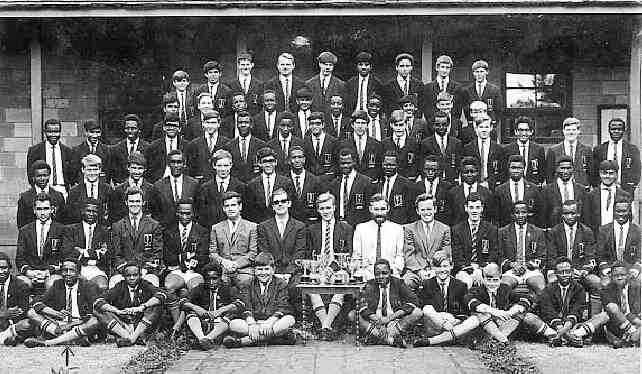
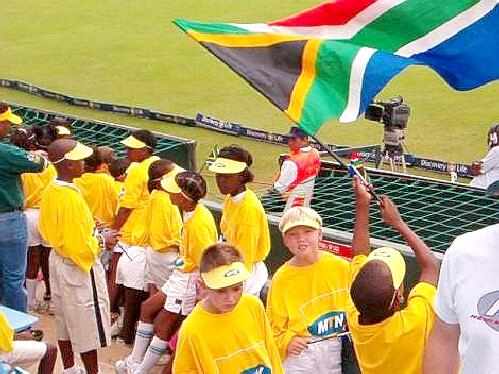
South Africa like many former British colonies (Australia and New Zealand) has had uniforms based on traditional English styles. A school uniform consisting of a blazer, school tie, and dress pants which has been worn by boys in many countries, especially
English-speaking countries. This uniform evolved in England during the late 19th century and spread to the English colonies which at the time spanned the globe. South Africa of course was one of those countries. South African schools, despite the widely different
climate tended to follow the British syles very closely until the 1960s when they begun to develop their own distinctive styles and standards. Schoolwear was of course affected by overall South African boys' clothing trends. South Africa has British style uniforms for the winter term. The elementary winter uniform often includes short pants and knee socks. Many schools have and a simple summer uniform of grey shirt and shorts for the summer.
A Swaziland teacher in 2009 tells us that he believes that required school uniforms are making school fees too costly for students. [Tfwala]
Tanzania is the union of Zanzibar and Tanganika. Zanzibar was an Arab emirate which for centuries was a key port in the Arab Indian Ocean slave trade. The emirs were pressured by the British during the 19th century end the Indian Ocean slave trade. Zanzibar became a British protectorate (1890), but Britain while suppressing the slave trade did not intervene substantially in domestic matters like education. Tanganika was a German colony sized by the British during World War I (1914-18). After riots on Zanzibar following independence (1963), the island was united with Tanzania (1964). The Arab emirs and the German colonial authorities gave little attention to education. The foundation for the modern Tanzanian education system is the schools set up during the British colonia era. The education system today. Two ministries share responsibility: 1) Ministry of Education and Culture and Higher Education and the the Ministry of Regional Administration and Local Government. The Tanzanian school system includes the basic primary, secondary, and tertiary leves. The schools offer 2 years of pre-primary education, 7 years of primary education, 4 years of Junior Secondary (ordinary Level), 2 years of Senior Secondary (Advanced Level) and up to 3 or more years of Tertiary Education. There is also an adult education program. The main feature of Tanzania�s education system is the bilingual policy, which requires children to learn both Kiswahili and English. The Government initiated an important educational reform program (1995) which is still in progress.
We have only limited information on Tunisia at this time. As is common for the Middle East and North Africa, we have been able to find some information about European colonial schools, but little information about Tunisian post-independence schools. We do not fully understand this dichotomy at this time. Tunisia was a French colony. One reader has mentioned the Menzel-Bourguiba school at Ferryville. We do not know much about the school, but the younger boys had a romper uniform.
Uganda is a former British colony in East Africa. At independence the country was relatively prosperous. That prosperity was shattered by Idi Amin's dictatorship and friving out the South Asians who plyed an important role in the Ugandan economy. The Ugandan economy has never recovered. The country today is racked by rural violence, especially that of the Lord's Resistance Army. These problems have impaired the country's ability to fund a public school system. The education system is set up on an English model, although we have little information at this time. Many schools have basic uniforms, odten including brightly colored shirts.
Zambia is a land locked country in Est Africa, a former British colony. As with other Africn countries, as far as we know the first schools in the country were established by the Europens as part of the 19th century Scramble for Africa. The colonial policies of both countries were not to educate the population. This would have been an expensive undrtaking. Rather the British set up scgools for the Euriopean settlers. Missionary groups also established schools. It was not until independence that efforts were made to create a public school system for the entire population. Zambia despite having immense minerl wealth has not been an economic success since independence. A combination of inadequate ledership and a commitment to socialist economic policies hss ment that the country has actually declined economically since independence. This has meant that the country has been unable to fund a quality educational system. As in other countries, the modern school system is divided into a primary (grades 1-7) and secondary system. The secondary system includes both a junior (grades 8 and 9) and secondary (grades 10-12) level.
Most Zambian children begin primary school and many finish. Primary schools are referred to as "basic schools" and finishing primary school is widely regarded as the normal level of education. Budget difficulties, however, mean that primary school is free only through grade 7. As a result many children drop out at that point. Attendance at secondary schools is much more limited and relatively few actually complete secondary level. There are both public and private schools in Zambia. The private schools are for the most part schools orginally founded by missionaries.
One of the most prstigious is the Roman Catholic St Mary's Seminary located in Eastern Province. The private schools use either British or American curriuculum and methods. Few Zambians have the monet or cademic prepaeation for univerirt studies. The University of Zambia is the primary tertiaty education institution. There are several teacher training schools which offer 2-year programs for students completing secondary school..
Zimbanwe is one of the former British colonies in southern Africa. It was formerly known as Southern Rhodesia. Like many of these countries, school uniform and dress trends show yhis British heritage. Elementary school children in Zimbabwe commonly wear uniforms. At one representative school in the 1990s the girls wore blue dresses with large Peter Pan collars and the boys wore khaki open collar shirts and short pants. We believe that this is also the case in secondary schools. We still have very limited information on the country. Zimbabwe's spiral into disorder and poverty in recent years has undoubtedly affected the ability of parents to afford school uniforms.
Tfwala, Zwelithini. E-mail message, March 19, 2009.

Related Chronolgy Pages in the Boys' Historical Web Site
[The 1880s]
[The 1930s]
[The 1940s]
[The 1930s]
[The 1940s]
[The 1950s]
[The 1960s]
[The 1970s]
[The 1980s]
Related Style Pages in the Boys' Historical Web Site
[Long pants suits]
[Short pants suits]
[Socks]
[Eton suits]
[Jacket and trousers]
[Blazer]
[School sandals]
Navigate the Boys' Historical Clothing Web Page
[Return to Main national school page]
[Return to Main school page]
[About Us]
[Activities]
[Chronology]
[Clothing styles]
[Countries]
[Debate]
[Economics]
[Garment]
[Gender]
[Hair]
[History]
[Home trends]
[Literary characters]
[School types]
[Significance]
[Transport and travel
[Uniform regulations]
[Year level]
[Other topics]
[Images]
[Links]
[Registration]
[Tools]
[Return to the Historic Boys' School Home]