|
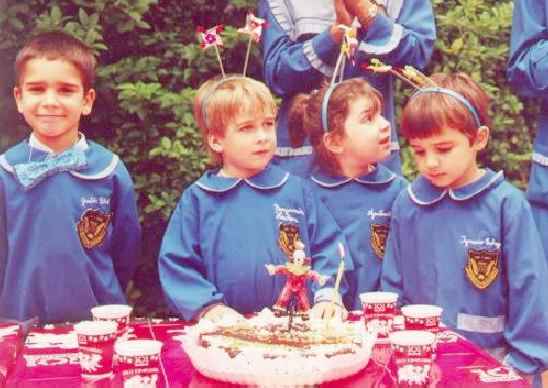
HBC at this time has very limited information on Spanish school uniforms or schoolwear in general. School uniforms do not appear to have been common in Spain, with one exception. School smocks, which are a kind of uniform, do appear to have been common. Spanish school children were commonly wearing smocks by the 1930s, although we are not sure when this practice first began. Short pants were common until the 1970s. Young kindergarten age children still commonly wear smocks in Spain. It is no longer common, however, for older boys to wear them--but some still do. Spanish contributor report that school smocks are still worn at many Spanish schools, especially private schools. Hopefully our Spanish readers will probide us more detailed information.
HBC at this time has very limited information on Spanish school uniforms or schoolwear in general. School uniforms do not appear to have been common in Spain, with one exception. School smocks, which are a kind of uniform, do appear to have been common. School uniforms may have been worn at sme private schools, but HBC has few details at this time.
We have limited informationn on Spanish schoolwear at this time and a relatively small archives of Spanish school photographs. As far as we call tell uniforms were not common at Spanish schools. We do not notice school uniforms in Spain even in the 1950s after World War II, even at private schools. We are less sure about the situation in modern Spanish schools. Available information suggests that school smocks were very common in Spain. We do not know when Spanish school children began wearing smocks, but they seem to have been very common in the inter-war period of the 20th century. School smocks have declined in popularity after the 1960s, but are still worn at many schools--especially private schools. Here they take the form of school uniforms with required colors and styles.
HBC believes that schoolwear has varied at Spanish schools depending on the type of school. Some private schools may have had uniforms, although our inforation is very limited. Children commonly wore smocks to state schools in the inter-war period, but now they are mre commonly worn at private schools. Many of the private schools are Catholic schools.
HBC at this time has little information on specific schoolwear garments. HBC has acquired some information on school smocks. Spanish school children were commonly wearing smocks by the 1930s, although we are not sure when this practice first began. Short pants were common until the 1970s. Young kindergarten age children still commonly wear smocks in Spain. It is no longer common, however, for older boys to wear them--but some still do. Spanish contributor report that school smocks are still worn at many Spanish schools, especially private schools. Hopefully our Spanish readers will provide us more detailed information on other schoolwear garments.
We do not yet have much information on Spanish school sctivities. Our Spanish archive is still quite limited. One activity was gym. We do note a gym class in 1913, we think at a primary school. It seems to be a drill or exercise. We believe that was fairly common at the time. We are not sure what the Spanish would have called it at the time.
We have only limited information on Spanish school regulations. We believe that Spain under Franco had a centalized school system. After Franco died the responsibility for education was over time shifted to regional government. This shift was fomented by a national referendum which defined the authority of the regions (1983). Some regions like Andulucia, Catalonia and the Basque Lands were give substantially more autonomy than the other regions.
We have very little information on individual Spanish schools at this time. We do notice a Catholic monastary school for boys near La Alberca, The school is run by monks. There were also friars. It is called The Batuecas after the valley region of the Sierra de Francia in Salamanca, Castilla y León. The monastery elongs to a cloistered secluded monks called the Discalced (Barefoot) Carmelites. We have ben able to find very little infirmation about the monastary school. We do not know if it it was a kind of boarding school where parents sent their boys forva religious education or if the boys were indigent children taken in by the monks. Nor do w know the nature of the eduction the boys received. We are not sure when she monastary was founded, but the order dates to the 16th century. We know the school was still operting in the 1920s, but do not know if it survived the Civil War (1936-39).
Education since the medieval era and the Reconquista has been the province of the Catholic Church. We do not yet have any detiled information on the role of the Church in Spanish education. Education ebven in the early 20th century until the short-lived Republic was still dominated by the Catholic Church. Even in state schools the Church played a central role. This role was sharply reduced by the Republic. After Franco's victory in the Spanish Civil War, the unfluence of the Church was restored in education. After Franco died in 1975 a new democratic constitution was adopted (1978). Under this constitution sweeping reforms have been adopted in Spain. As part of these reforms Spain has created a secular school system. Many school photographs prominently feature Cathlolic clerics, often as teachers.
The minimum school-leaving age in Spain in the 2000s is 16 years of age.
Related Links: Careful this will exit you from the Boys' Historical Clothing web site, but both sites are highly recommended
Boys' Preparatory
Schools: Lovely photographic book on British Preparatory Schools during the 1980s with over 200 color and black and white images.
Apertures Press New Zealand eBooks: Six eBooks are available on British schools available
Apertures Press New Zealand book: Three e-Books are available on New Zealand schools

Related Chronolgy Pages in the Boys' Historical Web Site
[Main Chronology Page]
[The 1900s]
[The 1910s]
[The 1920s]
[The 1930s]
[The 1940s]
[The 1950s]
[The 1960s]
[The 1970s]
Navigate the Relate Boys Historical Clothing Style Pages
[Main Spanish country page]
[Long pants suits]
[Short pants suits]
[Lederhosen]
[Knee socks]
[Eton suits]
[Jacket and trousers]
[Blazer
[School sandals]
Navigate the Boys' Historical Clothing School Uniform Pages
[Return to the Main school country page]
[Return to the Main school Page]
[Australia]
[England]
[France]
[Germany]
[Ireland]
[Italy]
[Japan]
[New Zealand]
[Scotland]
[]
[United States]
Navigate the HBC School Section:
[About Us]
[Activities]
[Chronology]
[Clothing styles]
[Countries]
[Debate]
[Economics]
[Garment]
[Gender]
[Hair]
[History]
[Home trends]
[Literary characters]
[School types]
[Significance]
[Transport and travel
[Uniform regulations]
[Year level]
[Other topics]
[Images]
[Links]
[Registration]
[Search]
[Tools]
[Return to the Historic Boys' School Home]
Created: January 28, 2002
Last updated: 1:17 AM 11/3/2015