|
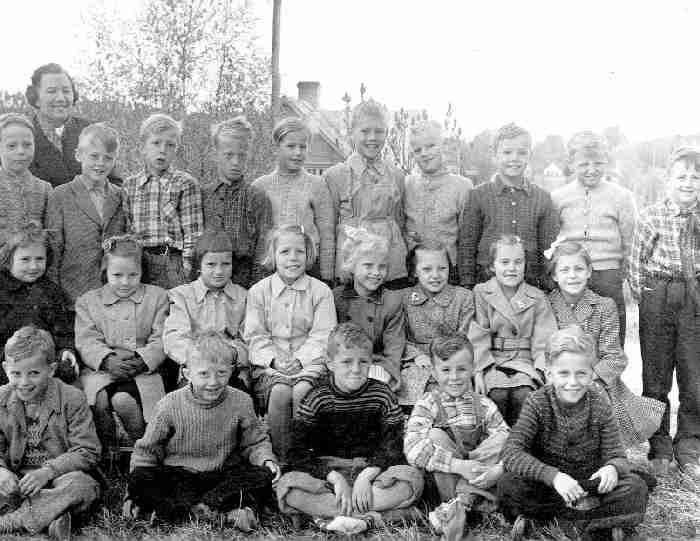
We have very limited information about Swedish schools. We have not yet researched the Swedish school system. And our arcgive of Swedush school poertaits is very small. Swedish children have not worn school uniforms. Sweden is located in northern Europe, thus the climate is a very important factor affecting schoolwear and clothing in general. Sweden is influenced by European styles, but we see some substantial differences which look to be strongly influenced by the climate. We note considerable seasonal differences. We see children wearing a lot of cold weather garments like jackets, coats, and sweaters. School porraits are very valuable as they provide informtion on schoolwear in various eras. We only have, however, a few images of Swedish schools As uniforms were not worn, these school portraits provide a very useful look at children's clothing in Sweden over time. The image here shows a typical Swedish school class in 1952 (figure 1). Hopefully our Swedish readers will provide us some information on Swedish schools and schoolwear.
As in all Ptotestant countties, education was very importnt. We have very limited information about Swedish schools. We have not yet researched the Swedish school system. A reader tells us that school begins a little later in Sweden than in many other countries where children often begin school art age 6 years. Swedish children begin school at age 7.
School uniforms are not common in Sweden. Swedish children in state schools have not worn school uniforms. Children just wore their regular clothes to school. Thus school portraits are a good representation of popular clothing styles over time. Of course children in city schools dressed
the most stylishly. Fashions in rural areas and villages tended to lag those in the city. Some private schools have had uniforms, some looking just like British school uniforms. Uniforms at private schools were still worn in the 1960s, but some of the more liberal schools were making them voluntary. Sweden has been influenced by European styles. We also notice casual American styles beginning to become important in the 1950s. The influence here seems to be television and movies. We also see some styles which look to be strongly influenced by the climate. We note considerable seasonal differences. We see children wearing a lot of cold weather garments like jackets, coats, and sweaters.
Sweden is located in northern Europe, thus the climate is a very important factor affecting schoolwear and clothing in general. We note Swedish children often dressed very warmly with cold-wreather gear. Sweaters seem especially popular. Most of the images in fact we have noted show the children bundled up to protect them from the elements. When the weather warms up in Sweden the children seem to dress more like the children in the rest of Europe.
We do have a few images from Swedish schools which provide some informtion on schoolwear in various eras. As uniforms were not worn, these school portraits provide a very useful look at children's clothing in Sweden over time. The available images are currently fairly modern. We hope to add earlier images to have a more complete view of Swedish schoolwear. The image here shows a typical Swedish school class in 1952 (figure 1). Hopefully our Swedish readers will provide us some information on Swedish schools and schoolwear.
Swedish school children for the most part have not worn school uniforms. We have, however, noted some children wearing school uniform garments. Apparently some schools had uniforms but did not require the children to wear them. The uniform garments we have noted are British-style garments, including peaked caps and blazers. We are not sure how common it was gor schools to adopt uniforms.
Swedish school children engage of course in all the nirmal school activities. We have very little specific information about school activities in Sweden at this time. We do have an interesting impage showing Swedish children participating in school yard games, presumably at recess.
We notice a lot of photographs of what look like school groups, but in non-school settings like the country side. We at first assumed that these were classes on a school outing. We note similar images of German children. We are wondering if some of these images are not school groups, but eather camp or other group vacation experiences organized for children. Many of the images look to have been taken during the summer when the children are on vacation from school. They may have been organized around school groups. Hopefully our Swedish readers will be able to tell us more about this.
We have very limited information on individual Swedish schools at this time. We hope to gradually expand this section as we obtain images of Swedish schools and as HBC grows have collected a few images. . Many important insights on both fashion and education can be achieved by collecting school images over time. And we are steadily expanding our coverage of Swedish schools. Hopefully some of our Swedish readers will submit some information about their schools so we can better undesstand Swedish school trends. These school photographs not only provide a lot of useful information about the schools, but are a good example of children's clothing fashions over time.
Careful, clicking on these will exit you from the Boys' Historical Clothing web site, but several are highly recommended

Related Chronolgy Pages in the Boys' Historical Web Site
[The 1880s]
[The 1930s]
[The 1940s]
[The 1930s]
[The 1940s]
[The 1950s]
[The 1960s]
[The 1970s]
[The 1980s]
Related Style Pages in the Boys' Historical Web Site
[Long pants suits]
[Short pants suits]
[Socks]
[Eton suits]
[Jacket and trousers]
[Blazer]
[School sandals]
Navigate the Boys' Historical Clothing Web Page
[Return to Main school uniform country page]
[Return to Main Swedish page]
[Introduction]
[Activities]
[Biographies]
[Chronology]
[Cloth and textiles]
[Clothing styles]
[Countries]
[Topics]
[Bibliographies]
[Contributions]
[FAQs]
[Glossaries]
[Images]
[Links]
[Registration]
[Tools]
[Boys' Clothing Home]