|
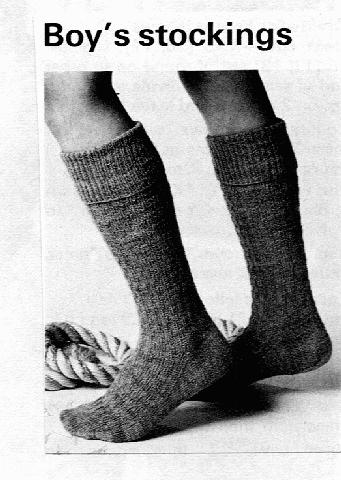
Children's hosiery and footwear is a relatively modern topic. Most children until the 19th century went barefoot except perhaps living in extreme northern areas like Laplanders. Siberian tribes, and Eslimoes. The children of affluent parents might also have footwear, but most other children went barefoot, both boys and girls. This did not begin until the industrial Revolution which affected children's footwear in two ways. First the Industrial Revolution generated wealth on an unprecedented scale. For the first time in history, average people and their families, at least in Western Europe and North America, could lead prosperous, comfortable lives. This mean that they could afford footwear for their childrn for the first time. The second development was that because of constantly improving industrial practicies and ever increasing efficencies, the price of footwear declined so that moderate income consumers could afford both hosiery and shoes of various types. Of course footwear is a very utilitarian item. Wearing shoes prorected the feet and allowed children to do things and go places that were not before possible. And it help keep the child warm in cold weather. And like other clothing a fashion component soon followed. We have developed information on all kinds of related garments, including hosiery, leggings, spats, and footwear. There are of course a grat many types of these items, especially hosiery and footwear.
Footwear predates history, appearing during the Stone Age. No one knows just when because the materials used are biodegradeable and do not last well unless preserved in unknown circumstances. The oldest footwear was sandals that have been discovered today were made by Native Amercans. They were found in Fort Rock Cave in the United States (Oregon). They were woven from sagebrush bark. This suggests there were earlier examples, almost certainly far older. Radiocarbon tests fond that these sandals were 10,000 years old or older (8000 BC). [Robbins] Hosiery, meaning footwear without duravle soles, came later. It was almost certainly animal fur and were probably a kind of combinstion hosery-footwear. Children's hosiery and footwear is a relatively modern topic. Most children until the 19th century went barefoot except perhaps living in extreme northern areas like Laplanders, Siberian tribes, and Eslimoes. We see children going barefoot in msny ancient socities. The best images are from ancient Egyot, but we alsi see this in Greece and Rome. The children of affluent parents might also have footwear, but most other children went barefoot, both boys and girls. This did not begin until the industrial Revolution which affected children's footwear in two ways. First the Industrial Revolution generated wealth on an unprecedented scale. For the first time in history, average people and their families, at least in Western Europe and North America, could lead prosperous, comfortable lives. This mean that they could afford footwear for their childrn for the first time. The second development was that because of constantly improving industrial practicies and ever increasing efficencies, the price of footwear declined so that moderate income consumers could afford both hosiery and shoes of various types. Of course footwear is a very utilitarian item. Wearing shoes prorected the feet and allowed children to do things and go places that were not before possible. And it help keep the child warm in cold weather. And like other clothing a fashion component soon followed.
Prehistoric man went barefoot until some long lost soul conceived of footwear--probably consisted primarily of tree bark, plant leaves, or animal hides tied around the bottom of the foot simply to provide protection against rocks and rough terrain. During the 19th century and into the first half of the 20th century it was very common for boys and even girls to go barefoot even to school. This was especially common in the summer and in areas like the south of the United States and southern Europe. This is largely forgotton, by Hollywood. One sees very few children barefoot in films and television that is set during this period of time. Most American boys, at least during the summer went barefoot. There were several reasons for this: cost, manliness, comfort, and others.
Hosiery or hose are tailored coverings for the feet or legs worn with shoes or sandals. The extent to which legs were covered and not just feet depended on the fashion trnds of the era, especially the hem length of pants, skirts, and related garments. Modern hose are made of knitted or woven fabric, but this has not always been the case throughout history. Hoisery in American usage is synomous with hose, but in Briatain may refer to any machine-knitted garment. The discussion here refers to the American usage.
The boys and girls wearing long stockings in the second half of the 19th Century held them up with various styles of stocking supporters. I believe that boys did not wear these supporters commonly in the first half of the 19th Century because kneepants were not nearly as common. Boys wearing long trousers did not commonly wear stocking supporters. It was not until the 1870s when kneepants became more commonly worn that stocking supporters became widely worn. Both boys and girls wore them. They were several different styles, including over the shoulder and waist styles. They were not very comfortable especially for boys involved in strenous outdoor activities. Notably Lord Baden Powell when he designed the first Boy Scout uniform chose kneesocks so cumbersome stocking supporters would not be necessary.
We have relatively little information about leggings or gaiters. The first images I have noticed are during the 1870s, but they may have been worn earlier. Presumably leggings came into style as boys began to commonly wear kneepants. Mothers apparently concluded that boys in kneepants needed the leggings for warmth. They were worn with a variety of garments through thr 1940s, but were little worn by the 1950s. I know that they were commonly worn in America. I'm less sure about how common they were in other countries. They were made in a number of materials, including leather and woolen fabrics. They also were made in many styles, including some with large numbers of buttons.
Spats are short gaiters or leggings worn over the instepans usually fastened undr the instep with a strap. The purpose was to protect the shoe. Spats are more associated with adults than children, but we have noted children wearing them as well. The term appeared around the turn of the 19th century in England and was an abreviation for " spatterdash ".
Men have worn footwear since prehistpric times, boys were, however, more likely to go barefoot. Early footwear probably consisted primarily of tree bark, plant leaves, or animal hides tied around the bottom of the foot simply to provide protection against rocks and rough terrain. However, it wasn't long before footwear became a touch more sophisticated while at the same time growing somewhat more attractive, to the extent that, as with a hat, a man's status could be judged merely on the basis of what he wore on his feet. American boys well into the 20th century would commonly go barefoot in the summer. This was especially common in rural areas. This was in part because if the cost of shoes, but also because boys finding going barefoot in the days before sneakers more comfortable. Some boys considered in more manly to go barefoot.
Now boys mostly like to wear sneakers or sport sandals. Boys in New Zealand and Australia, however, still often go barefoot. Boys have wore sandals since ancient times. In more recent times, boys have worn both closed-toe and open-toe sandals. The closed toe-type is now considered by most to be for only very small boys or girls. Oxford shoes appeared as modified boots for, as the name indicates, Ocford university students in the 17th century. Boys have worn a wide variety of shoes since the 17th century. Until the 19th century, however, they mostly wore small editions of women's shoes while still in dresses and small editions of their fathers' shoes after breeching. Distinctive shoes for children appeared in the late 18th and early 19th century. Boys in the early 19th century wore slipper-type pumps with white stockings. Strap shoes were worn at mid century by boys still in dresses. After the middle of the century, button boots were comonly worn especially in America. By the turn of the century footware had become more varried. After World War I sneakers, saddle shoes, and closed-toe sandals appeared. The principal shoe for boys, however, was to be the oxford. After World War II other styles like loafers appeared, but by the 1970s boys wanted to wear sneakers. Sandals have become increasingly popular during the 1990s.

Navigate the Historic Boys' Clothing Web Site:
[Introduction]
[Activities]
[Biographies]
[Chronology]
[Cloth and textiles]
[Clothing styles]
[Countries]
[Topics]
[Bibliographies]
[Contributions]
[FAQs]
[Glossaries]
[Images]
[Links]
[Registration]
[Tools]
[Boys' Clothing Home]
Navigate the Historic Boys' Clothing Web chronological pages:
[Early 18th century]
[The 1800s]
[The 1830s]
[The 1850s]
[The 1860s]
[The 1870s]
[The 1880s]
[The 1890s]
[The 1900s]
[The 1910s]
[The 1920s]
[The 1930s]
[The 1940s]
Navigate the Historic Boys' Clothing Web style pages:
[Knee pants]
[Knickers]
[Short pants suits]
[Kilts]
[Sailor suits]
[Shoes]
[Ring bearer/page costumes]
[Shortalls]