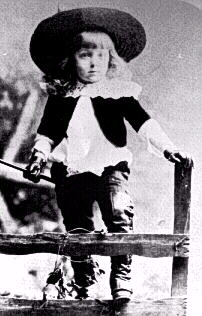
Figure 1.--This boys with long hair wears a very small velvet jacket to show off his elaborate lace collar and blouse. Note the large roll over lace cuffs. To emphasize his boyishness he is pictured here with a riding crop and boots. |

|
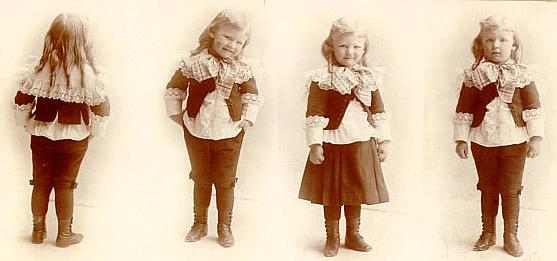
The Fauntleroy rage began in America during the mid-1880s with the publicatiion of Mrs. Burnett's famous book. It created a fashin sensation. The classic Fauntleroy suit with a small velvet jacket, knee pants and fancy lace or ruffled collar was popular for about 10-15 years and then began to change. Even during the height of the Fauntleroy craze, there were variations other than the classic suit avialable. Boys might wear regular suits with a range of Fauntleroy items such as lace or riffld callar to give a Fauntleroy look. The style continued into the new century and influenced boys' clothes through the 1920s. The Fauntleroy suits that appeared in the 1880s went through several major stylistic periods:
HBC has organzined the different types of Fauntleroy suits into four basic periods. This varied somewhat from country to country, but the basic pattern was fairly standard. The primary period for the classic Fauntleroy suit was from 1885 when Mrs. Burnett published her book to about 1905-1900. While this was the period in which Fautlroy suits were mopst popular, we see Fauntleroy suits or Fauntleroy-like styling over a much monher propd. There were variations within these basic periods, but some basic patterns emerge.
Velvet has been used used for boys clothing since specialized boys clothing appeared after the mid-18th Century. Many better skeleton suits in the late 18th and early 19th century were made from velvet. This was especially true for boys from Ruropean aristocratic or wealthy families. Boys were dressed in velvet suits and lace collars well before the style was popularized in America by Mrs. Frances Hogdson Burnett in the 1880s. Many of these early suits did not have the fancy lace and ruffled styling of the Fauntleroy suit. Some did. Mrs. Burnett is saud to have neen inspired by the fancy suits she sawFrench boys wearing when they kived in Paris.
Fancy velvet suits for little boys began to appear in the early 1880s. The classic period, however, began with the publication of Mrs. Burnett's book in 1885-86. Her book popularized the style with romantically inclined mothers during the late Victorian period. The velvet suits and accompanying elaborate lace collars were soon bought not only for little boys, but older boys as well. The lace blouses dominated many of the origninal
suits and the jackets were made small and worn open to show the blouses for maximum effect. Many mothers added large collar bows and long sausage curls to complete the effect.
The stylistic changes of the Edwardian period began in the mid-1890s, well before the death of Queen Victoria in 1901. Fauntleroy suits remained popular among mothers throughout the Edwardian era. Classic styles persisted umtil about 1905, although numbers began to decline.. Several stlistic changes were notable. The velvet jackets became larger, in many cases covering the lace trimmed blouses which once dominated the suits. Bows remained popular, but in the 1900s the sausage-length curls popular in America and some other countries became increasingly less common. White socks appeared, at first primarily in Europe.
|
The classic Fauntleroy suit, like many other 19th Century styles disappeared in the aftermath of World War I. Some mothers continued dressing boys in Velvet suits. Perhaps a casualty of the Great War which destroyed the romantic inclination of the Edwardians. The elaborate lace collars disappeared, replaced by more modest, but still sometimes quite large, ruffled collars. Short pants gradually replaced knee pants. White socks or long white stockings became increasingly common. The white stockings seem more popular in America than Europe. Earlier we mostly see black or dark long stockingd, especially in America. lthough not so common, younger boys as late as the 1930s might be dressed in velvet suits and blouses with some Fauntleroy features. They were generally short pants suits and the fancy lace and velvet collars were replaced with simplier Peter Pan collars.
While not precisely Fautleroy suits, younger boys in recent years have worn velvet suits, but without the lace and ruffles. They were not perhaps actually Fauntleroy suit, but the influence os obvious. They were often worn with short pants and knee socks. These seems particularly popular for festive holiday wear at
Christmas, but declined in popularity after the 1970s as families increasingly took a casual approach to the holidays.
|
A HBC contributor provided this comment: "I wonder if all young boys' velvet and lace suits should be lumped together under the portmanteau term "Little Lord Fauntleroy suit". Perhaps there should be a generic term 'Boys' velvet and lace suits' with a sub-division 'Van Dyck suits' and a further sub-division under the latter sub-division of "Little Lord Fauntleroy suits"--i.e. those directly inspired by the book illustrations."
This is an important question. As HBC has begun to build this web site, in many cases there were no existing text books to provide basic information. So the idea of what a Fauntleroy suit is can be complicated. Advertising at the time frequently labeled a variety of suits as Fauntleroy suits. Vevet suits with lace collars are not the only garments pictured in the book. In addition, give the popularity of the term, calling a suit a Fauntleroy suit helped to sell it. Subsequently in the 20th century, a variety of suits were called Fauntleroy suits. It may well be that the Fauuntleroy suit section should be reorganied. The suggestion above is an interesting approach. HBC will have to give more thought to this. There is, however, already a separate section for old velvet suits that were precursors to Fauntleroy suits as well as newer styles of velvet suits that are clearly not Fauntleroy suits. This is the last historical era category liked above.

Fauntleroy Related Pages:
[Fauntleroy dresses]
[Fauntleroy blouses]
[Fauntleroy movies
[Lace collars]
[Collar bows]
[Vivian Benett]
[Fauntleroy patterns]
[Literary characters: Cedric Erol]
Other Related Pages:
[Dresses]
[Kilts]
[Smocks]
[Pinafores]
[Velvet]
[Sailor Hats]
[Blouses]
[Ring Bearers]
[Long hair]
[Ringlet curls]
[Bangs]
[Main bow page]
[Sashes]
[Hair bows]
[Lace collars]
[Ruffled collars]
Navigate the Boys' Historical Clothing Web Site:
[Introduction]
[Activities]
[Biographies]
[Chronology]
[Clothing styles]
[Countries]
[Theatricals]
[Topics]
[Bibliographies]
[Contributions]
[FAQs]
[Glossaries]
[Images]
[Links]
[Registration]
[Tools]
[Boys' Clothing Home]